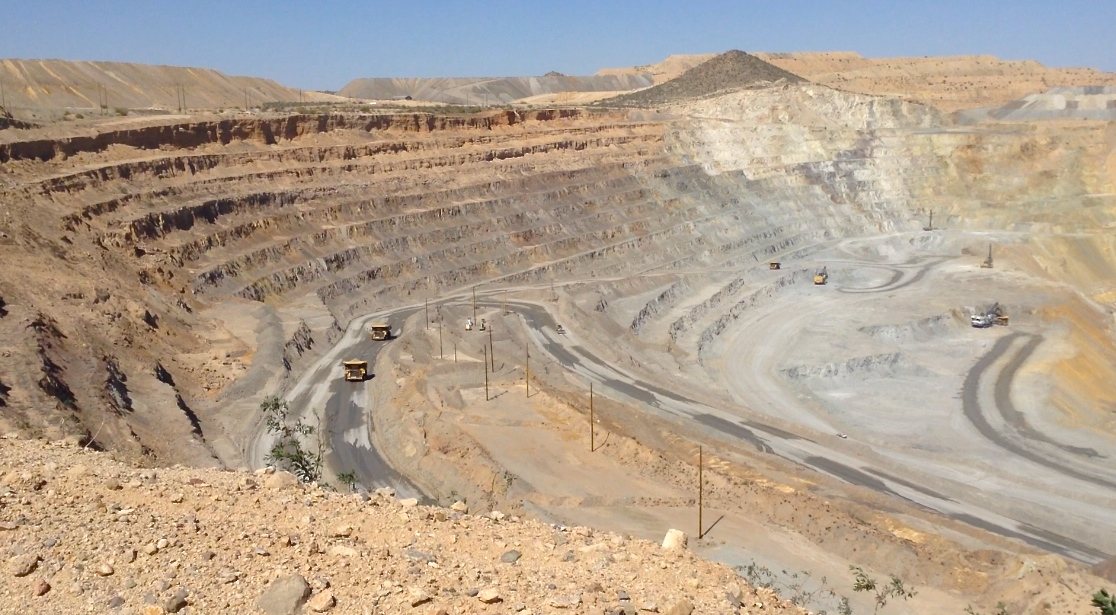
A hole that keeps getting wider
Stand at the rim of a large open pit copper mine and the first thing that strikes you is not the depth but the width. The terraced walls step outward at a shallow angle — perhaps one horizontal metre for every vertical metre descended — so that by the time the working floor is several hundred metres below your feet, the pit mouth is kilometres across. That geometry is not accidental. It is the physical expression of a calculation that mining engineers call the strip ratio, and it governs whether a deposit is mined from the surface at all, or whether it is approached from below through shafts and tunnels.
What the strip ratio actually measures
To reach ore that is buried, you first have to remove the rock above and around it. That overlying material — rock, soil, and everything else that is not worth processing — is called waste or overburden. The strip ratio expresses how much waste must be shifted for every unit of ore recovered. A strip ratio of three means three tonnes of waste for every tonne of ore. A ratio of ten means ten tonnes of waste per tonne of ore.
The economics follow directly. Waste rock has to be drilled, blasted, loaded, hauled and dumped somewhere, and all of that costs money. The ore, once reached, must itself be drilled, blasted, hauled, crushed and processed. If the revenue from the metal in the ore does not comfortably cover both sets of costs — plus capital, plus a margin — the mine cannot sustain itself. A low strip ratio is therefore a blessing: relatively little waste stands between the miner and the ore. A high strip ratio puts pressure on every assumption in the financial model.
The strip ratio is not fixed for a deposit as a whole. It changes with depth. As an open pit grows deeper, the walls must be kept at a safe angle, which means each additional bench of depth requires removing a ring of extra waste around the entire pit perimeter. The deeper you go, the more waste you move per additional tonne of ore. At some point the cost of that incremental waste exceeds the value of the incremental ore, and you have reached what engineers call the economic pit limit.
A worked example (illustrative)
Suppose, for illustration, that a hypothetical mine contains a gold-bearing ore body that starts near the surface and continues to depth. The operator estimates that the cost of mining and processing each tonne of ore is eighty dollars, and that at current metal prices the ore produces revenue of one hundred dollars per tonne of ore processed — a margin of twenty dollars per tonne of ore. Each tonne of waste costs four dollars to remove. The breakeven strip ratio is therefore twenty divided by four, which equals five. As long as each tonne of ore requires fewer than five tonnes of waste, open pit mining generates a surplus. When the geometry of the pit wall pushes the strip ratio above five, mining that next slice of ore from the surface would cost more than it returns. That is the economic pit limit for this set of assumed costs and prices — change either number and the limit shifts.
Real calculations involve many more variables — haul distances that lengthen as pits deepen, ore grade that may vary with depth, the cost of building and maintaining access roads and drainage systems — but the underlying logic is the same arithmetic performed at much greater detail.
When the pit reaches its limit
Reaching the economic pit limit does not necessarily mean the deposit is exhausted. The ore body may continue downward in perfectly good condition; it is simply that the overburden above it has become too expensive to remove by open-cut methods. At this point the operator faces a choice with no single right answer.
One option is to stop. If the remaining ore is marginal and underground mining would require substantial new capital, the rational decision may be to rehabilitate the pit, recover what value remains in stockpiles, and close. Many pits end this way.
A second option is transition to underground mining. Instead of removing all the rock above the ore, underground methods send miners and machinery down through shafts or declines — ramp-like tunnels wide enough for trucks — to extract ore from within the rock mass itself. Underground methods move far less total rock, but they are slower, more complex, and generally more expensive per tonne of ore mined than a well-run open pit. The transition makes economic sense when the ore grade at depth is sufficiently high, or the metal price sufficiently favourable, to justify that higher cost structure.
The transition is not simple. An existing pit may actually help: a decline can be driven down through the pit floor, giving underground equipment a head start on depth. But the pit walls, previously stabilised for open-cut geometry, may behave differently once underground excavations begin removing support from below. Geotechnical work to understand those interactions is a significant part of any transition study.
A third option is a combination. Some large deposits are mined open-cut to the economic limit, then continue as underground operations below that horizon, with both methods running concurrently for a period. The surface infrastructure — processing plant, tailings facilities, power supply — can often be shared, which is one reason such transitions are sometimes more viable than starting an underground mine from scratch.
Why this matters beyond mining
The strip ratio decision shapes more than the mine plan. It determines how much land is disturbed, how much diesel is burned moving waste, how much water is pumped, and how long the operation lasts. A deposit with a gently rising strip ratio will sustain open-cut operations for decades; one where the ratio climbs sharply may transition underground, or never be developed at all. Both outcomes affect the eventual supply of the metal, which in turn affects everyone who uses it.
For the reader who wants to go further
The worked example above treats the strip ratio as a single number, but in practice engineers calculate it block by block using three-dimensional geological models and optimisation algorithms — notably the Lerchs-Grossmann method and its successors — that identify the theoretically optimal pit shell for a given set of economic inputs. Understanding how those shells are constructed, and how sensitivity analysis on metal price or mining cost shifts the shell boundary, is where open-pit planning becomes a discipline in its own right.