Module 5 · Scrap, price and failure
Scrap: the chain as a loop
Level 2 · Working knowledge 10 min read 4 questions
Copper does not degrade in use, so essentially all of it ever produced still exists. What decides how much comes back is collection, sorting and what it was alloyed with.
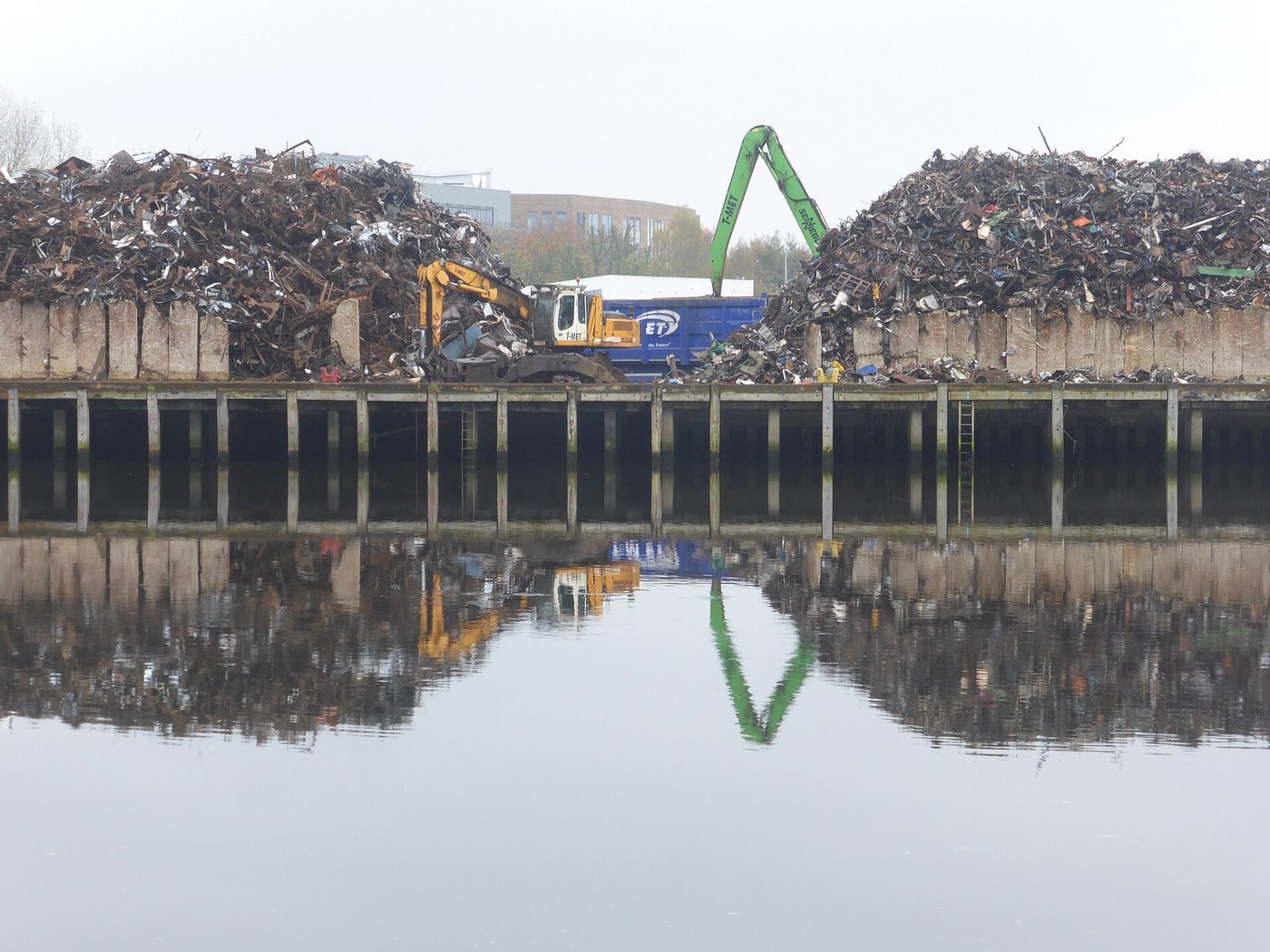
Copper is a genuinely recyclable metal in a way that many materials are not. It does not degrade chemically in use; a copper atom in a wire installed a century ago is exactly as good as a newly refined one. The constraint is never the metal. It is getting it back, keeping it clean and knowing what it is.
Two kinds of scrap
- New scrap, or prompt scrap
- Offcuts and process losses from fabrication: rod ends, trimmings, swarf. It never reached a customer, its composition is known exactly, and it returns to the chain quickly. It is not really new supply - it is the same metal going round again inside the manufacturing system.
- Old scrap, or post-consumer scrap
- Copper recovered from products at end of life: demolished buildings, scrapped vehicles, retired cable, electronics. This is the genuine addition to supply, and it is the hard one, because it arrives dirty, mixed and decades after it was sold.
Grades: why the trade has its own vocabulary
Scrap is bought and sold against named specifications - in North America the ISRI grade names, now maintained by ReMA, which the rest of the trade recognises too. The names sound arbitrary and are not: each describes a physical condition that determines what can be done with the material and therefore what it is worth relative to the exchange price.
| Trade name | What it is | Route back into the chain |
|---|---|---|
| Bare bright | Clean, uncoated copper wire, 16 gauge and thicker, free of alloy and insulation | Straight to a rod mill or melt shop; the highest price |
| No. 1 copper ("Berry", "Candy") | Clean unalloyed copper solids and clippings, uncoated | Direct melt |
| No. 2 copper ("Birch", "Cliff") | Unalloyed copper with solder, paint, coating or light oxidation | Secondary smelter or refinery |
| Insulated wire | Copper with plastic or rubber insulation, sold on recovered metal content | Granulation and separation, then melt |
| Yellow brass, red brass | Copper-zinc and copper-tin alloys | Back into the same alloy, not into pure copper |
| Refinery brass / low grade | Mixed, heavily contaminated material | Secondary smelter, then full electrorefining |
Trade grade names in current use · ISRI / ReMA scrap specifications
Names and exact definitions are set by the specifications circular and are commercial conventions rather than legal standards. The principle is universal even where the names differ: cleaner and better-identified material re-enters the chain at a later, cheaper stage.
Read that last column again, because it is the whole logic. The cleaner the scrap, the further down the chain it can re-enter, and the more of the chain's cost it skips. Bare bright wire goes straight into a melt furnace and skips mining, concentrating, smelting and refining entirely. Mixed low-grade material has to go through a secondary smelter and a full electrorefining cycle, which is most of the chain over again.
Why more does not come back
- Dissipative uses. Copper in small quantities in electronics, coatings and chemicals is not economically recoverable. It is not lost to physics; it is lost to economics.
- Collection systems. Recovery rates depend on whether there is an organised route from a demolished building or a scrapped vehicle to a processor, and those routes vary enormously by country.
- Alloying. Zinc, tin and nickel cannot be economically removed, so an alloy generally returns as that alloy. Mixing alloys destroys value.
- Timing. The stock in use is vast and the release rate is governed by the life of buildings and infrastructure, which is measured in decades.
- New scrap recirculates inside manufacturing; old scrap is the genuine addition, and it arrives decades late.
- Grade names encode how far down the chain the material can re-enter, which is what sets its price.
- Alloyed copper generally returns as the same alloy, because zinc and tin cannot be economically removed.
- New / prompt scrap
- Fabrication offcuts, of known composition, returning quickly.
- Old / post-consumer scrap
- Copper recovered from products at end of life.
- Dissipative use
- An application in which the metal is too dispersed to be worth recovering.
- Why recycling is not enoughon this site
- Steel scrap, for comparisonon this site
- ISRI / ReMA specificationsprimary source
Check yourself
1. Bare bright wire commands the highest scrap price because it:
Cleanliness buys re-entry point. The further down the chain scrap can re-enter, the more cost it avoids and the more it is worth.
2. Why can recycling not buffer a rapid rise in copper demand?
The release of post-consumer scrap follows the life of buildings and equipment. It cannot respond on the timescale of a demand surge.
3. A demolition yard mixes clean copper wire with brass fittings. The consequence is:
Mixing destroys the grade. The combined material has to follow the route the worst component requires.
4. 'New scrap' is best described as:
It is prompt industrial scrap - the same metal circulating inside the manufacturing system rather than a genuine addition to supply.