Module 4 · Downstream: taking the barrel apart
Inside a refinery
Level 2 · Working knowledge 12 min read 4 questions
Separate, convert, treat, blend. Four ideas explain every unit in a refinery, and the amount of conversion a plant has is what decides which crudes it can make money on.
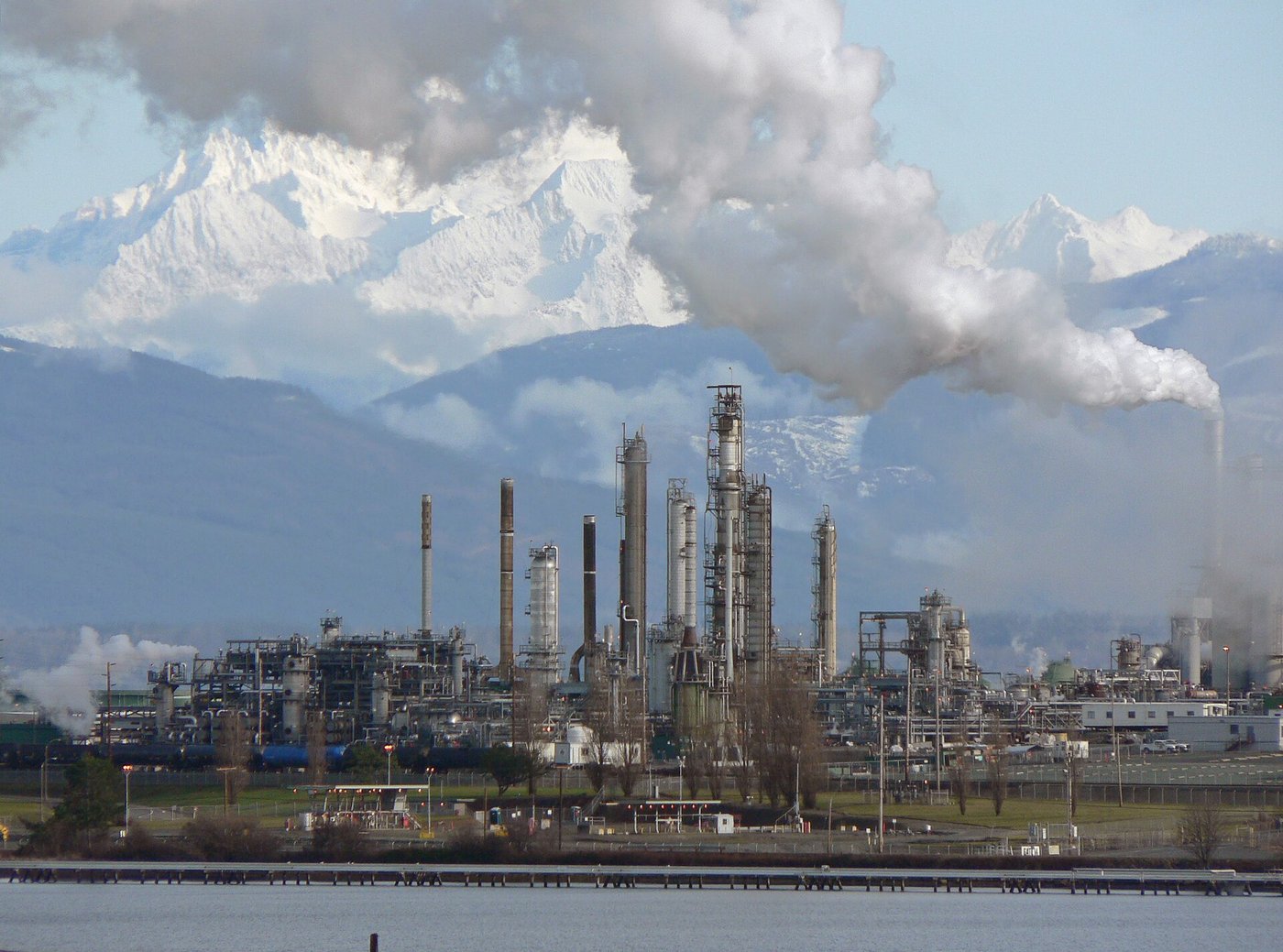
A refinery is the middle of oil's chain in the way a smelter is the middle of copper's, and it plays the same role: it is where the geography concentrates, where the capital is, and where the chain is most likely to break. Everything inside one is an instance of four ideas.
- Separate the mixture by boiling range.
- Convert the fractions there is too much of into the fractions there is not enough of.
- Treat each stream to remove sulfur, nitrogen and metals.
- Blend the treated streams into finished products that meet a written specification.
Separate
Crude is heated and fed into the atmospheric distillation unit, a tall column in which vapour rises and condenses at different heights according to boiling point. Light gases leave the top; naphtha, kerosene and gas oil are drawn off at descending levels; what will not boil at atmospheric pressure leaves the bottom as atmospheric residue. That residue goes to a vacuum distillation unit, where lowering the pressure lowers boiling points and allows more to be recovered without cracking the molecules thermally.
Convert
A barrel naturally contains more heavy material than the market wants and less light material. Conversion units close that gap by breaking long chains into short ones, and by rearranging molecules to improve their properties.
- Fluid catalytic cracker (FCC)
- Cracks heavy gas oil into petrol-range material over a circulating catalyst. The workhorse petrol-maker, especially in refineries serving petrol-heavy markets.
- Hydrocracker
- Cracks under high hydrogen pressure. More expensive, but it makes excellent middle distillate - diesel and jet - and handles heavier, dirtier feed.
- Coker
- Thermally cracks the vacuum residue - the bottom of the barrel - into lighter streams, leaving solid petroleum coke. A coker is what allows a refinery to run heavy, sour crude profitably.
- Catalytic reformer
- Rearranges low-octane naphtha into high-octane aromatics for petrol blending, producing hydrogen as a by-product - which the hydrotreaters then consume.
- Alkylation unit
- Combines light gases into high-octane liquid petrol components.
The amount of conversion capacity a refinery has is its complexity. The industry's usual shorthand is the Nelson complexity index, which scores a plant's units relative to distillation capacity. A simple hydroskimming refinery does little more than distil and treat; a deep-conversion refinery with a coker and a hydrocracker can take the worst crude on the market and still make road fuel.
Treat
Hydrotreating passes a stream over a catalyst with hydrogen, converting sulfur to hydrogen sulfide and nitrogen to ammonia, which are removed. The hydrogen sulfide goes to a sulfur recovery unit and comes out as elemental sulfur. Hydrogen is central to a modern refinery's economics: the reformer makes some, and the rest is made from natural gas, which links refining margins to gas prices.
Blend
Nothing leaves a refinery as a single stream. Finished petrol is a recipe of reformate, alkylate, cracked naphtha and other components, blended to hit octane, vapour pressure, sulfur and other limits at the lowest cost. Specifications vary by country and by season - vapour pressure limits are tightened in summer for air quality, which is one reason products are not freely interchangeable between markets.
What a refinery earns
A refinery's gross margin is the value of the products it makes minus the cost of the crude it runs, before operating costs. The market shorthand is a crack spread, quoted as a simplified ratio - the 3-2-1 crack, for instance, values three barrels of crude against two of petrol and one of distillate. It is a proxy, not any real refinery's economics, because no plant has that yield and because it ignores the cost of energy, hydrogen and the discount at which the actual crude was bought.
- Every unit in a refinery is separating, converting, treating or blending.
- Conversion capacity - complexity - is what lets a refinery profit from cheap, heavy, sour crude.
- Crack spreads are a convenient proxy and not any real plant's margin.
- Atmospheric / vacuum distillation
- Separation by boiling range, the second at reduced pressure to recover more without thermal cracking.
- Complexity
- How much conversion capacity a refinery has relative to its distillation capacity.
- Crack spread
- A standardised proxy for refining margin.
- Hydroskimming
- A simple refinery that distils and treats but converts little.
- Petroleum cokeon this site
- Sulfuron this site
- Smelting and refining, the metals analogueon this site
- EIA refinery capacity and utilisationprimary source
Check yourself
1. A refinery with a coker and a hydrocracker has an advantage over a simple hydroskimming refinery principally because it can:
Conversion capacity monetises the discount on poor-quality crude. Without it the plant must buy the premium grades.
2. Which unit makes hydrogen as a by-product that other units then consume?
Reforming naphtha into aromatics releases hydrogen, which the hydrotreaters use. The balance is usually made from natural gas.
3. Why is the sulfur removed at a refinery commercially significant beyond compliance?
Refineries and gas plants are a major source of the world's elemental sulfur, which links oil refining to copper hydrometallurgy and to fertiliser.
4. The 3-2-1 crack spread is best described as:
It is a convention used to talk about refining margin. No real refinery has that yield, and it ignores energy, hydrogen and the actual crude discount.