Module 2 · Upstream: finding it and lifting it
The unconventional barrels: shale and oil sands
Level 2 · Working knowledge 11 min read 4 questions
Two ways of producing oil that nature failed to concentrate - one by creating permeability, one by mining the rock - and how differently each behaves as a business.
Lesson 2 ended with the two cases where the petroleum system is incomplete: oil that never migrated out of its source rock, and oil that migrated all the way to surface and was degraded there. Each has produced an industry with its own physics and its own economics, and neither resembles a conventional oil field.
Tight oil: manufacturing permeability
Source-rock shale holds oil, but with permeability so low that a conventional vertical well would produce a trickle. Two techniques combined changed that. A well is drilled vertically to depth and then turned to run horizontally for a long distance within the target layer, maximising contact with the rock. Then fluid is pumped in at pressure high enough to crack the rock, with sand carried in the fluid to hold the cracks open once the pressure is released. The cracks are the permeability that nature did not provide.
| Conventional field | Tight oil | |
|---|---|---|
| Unit of investment | A field, developed once | A well, repeated thousands of times |
| Lead time to first oil | Years, sometimes more than a decade | Months |
| Production profile per well | Long plateau, then slow decline | Very steep decline from an initial peak |
| To hold output flat | Maintain pressure and drill infill wells | Keep drilling new wells continuously |
| Response to a price change | Slow; the decision was taken years ago | Fast; next quarter's rig count moves |
| Main constraints | Geology, capital, permitting | Rigs, crews, sand, water, takeaway pipeline capacity |
Structural comparison, not time-specific · Characteristics as described by EIA, Oil and petroleum products explained, and drilling productivity reporting
Two constraints on the list deserve naming because they are not obvious. Water is needed in volume for fracturing and comes back as produced water that must be disposed of, usually by injection - and injection has its own limits. Takeaway capacity is the pipeline out of the basin: drilling can outrun the pipelines, and when it does, local crude prices fall relative to the benchmark until trucks, rail or a new pipeline arrive. That is a pure logistics discount and is covered in lesson 7.
Oil sands: mined like ore, refined like oil
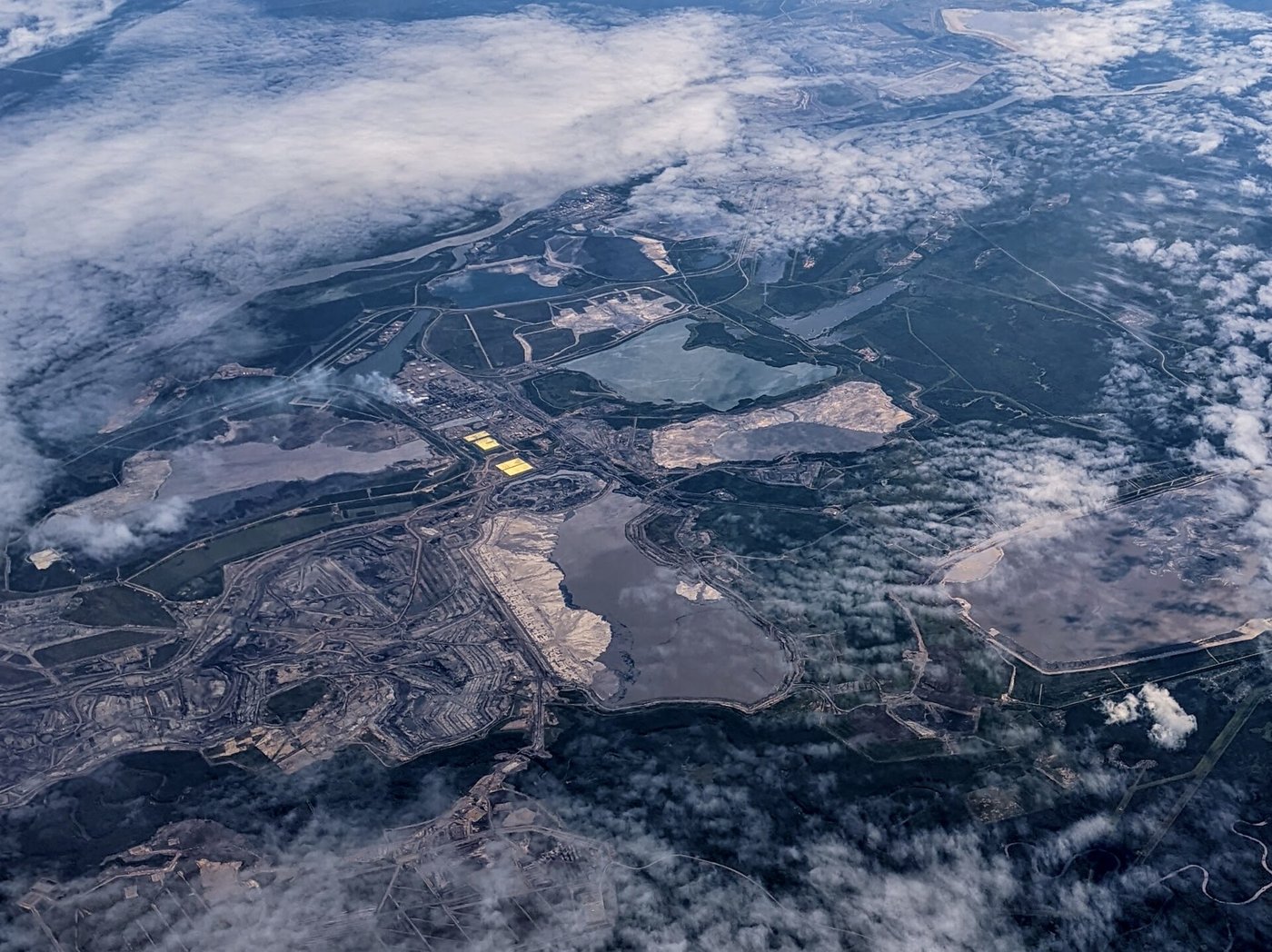
In the Athabasca deposit the bitumen is so viscous that it will not flow at surface temperature. Where the deposit is shallow enough, the answer is not drilling but mining: shovels and trucks remove oil-saturated sand in open pits, and the bitumen is separated from the sand with hot water. This site's Athabasca entry sits in the mines database rather than anywhere else for exactly that reason, and it is among the largest surface mining operations in the world by material moved.
Where the bitumen is too deep to mine, steam is injected instead. In steam-assisted gravity drainage, a pair of horizontal wells is drilled one above the other; steam injected through the upper well heats the bitumen until it flows under gravity into the lower one. The energy to make that steam - usually from natural gas - is a permanent part of the cost and of the carbon intensity of the barrel.
What the two have in common
Both produce a barrel that nature did not concentrate, and both therefore pay an energy and capital penalty for doing the concentrating themselves. Both also sit at the steep end of the supply cost curve, which makes them the swing producers of their respective regions: they are the barrels most likely to be added when prices rise and shut in when they fall. And both illustrate the general rule that runs through this whole site - where nature has not done the concentration step, somebody has to pay for it in energy.
- Tight oil creates permeability artificially; the steep per-well decline makes it short-cycle supply.
- Oil sands are mined or steamed, then upgraded or diluted, before any refinery can take them.
- Both pay an energy penalty for the concentration step nature skipped, which puts them at the steep end of the cost curve.
- Tight oil
- Oil produced from the low-permeability source rock it formed in, using horizontal drilling and hydraulic fracturing.
- SAGD
- Steam-assisted gravity drainage: paired horizontal wells, steam above, heated bitumen drained below.
- Dilbit
- Bitumen blended with light diluent so that it will flow in a pipeline.
- Takeaway capacity
- The pipeline capacity available to move production out of a producing basin.
- Oil sands and bitumenon this site
- Athabasca Oil Sandson this site
- Alberta oil sands, tracedon this site
- Suncor Energyon this site
- EIA drilling productivity dataprimary source
Check yourself
1. Why does a tight oil producer that stops drilling lose output much faster than a conventional producer that stops drilling?
The steep per-well decline curve means the fleet of wells has to be constantly replenished simply to hold production level.
2. Steam-assisted gravity drainage is used when:
SAGD is the deep-deposit answer: a steam injection well above a production well, with heated bitumen draining down under gravity.
3. A reported API gravity of about 21 degrees for a dilbit blend tells you:
Dilbit is a blend, and the quoted gravity describes the blend. Athabasca bitumen on its own is roughly 8 degrees.
4. Which constraint is specific to tight oil rather than to conventional production?
Short-cycle drilling can outrun the pipelines out of a basin in a way a long-planned conventional development, which is built with its export route, generally does not.