Module 1 · What wood is, and how it is measured
How many board feet are in a tree
Level 2 · Working knowledge 11 min read 4 questions
Two measurements - diameter at breast height and merchantable height - put a standing tree on a table. This lesson is that table, and what to do with it.
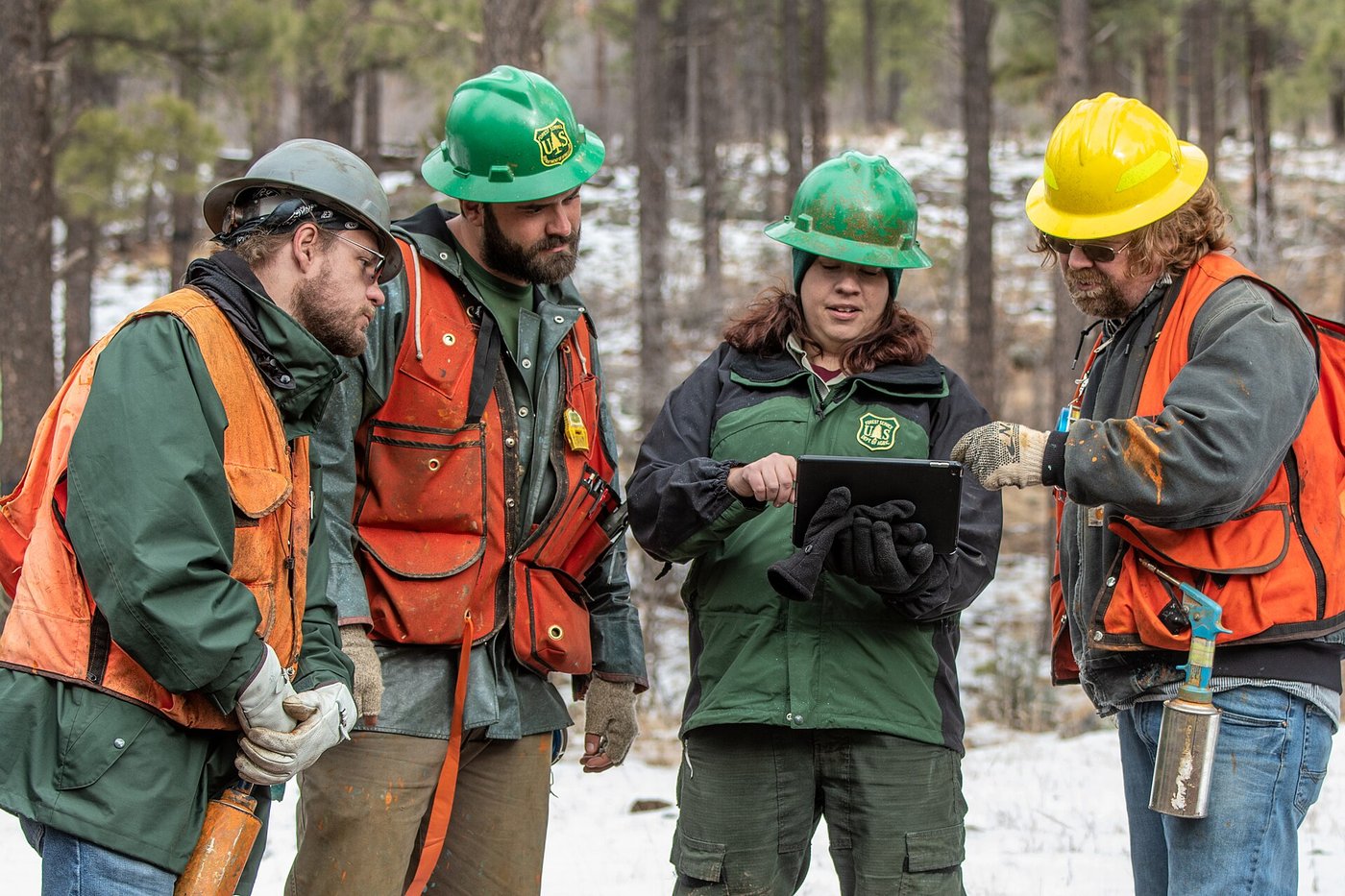
This is the question every landowner asks first, and it has a workable answer. Estimating the volume of a standing tree requires two measurements and one lookup.
- Diameter at breast height (DBH)
- Diameter outside bark measured 4½ feet above the ground on the uphill side. It is the standard reference because it is reachable, repeatable and above most root flare.
- Merchantable height
- How far up the trunk is usable sawtimber, counted in 16-foot logs and halves. It stops where the trunk forks, becomes too crooked, or narrows below a usable top diameter.
The table
This is the direct answer. Rows are DBH; columns are the number of 16-foot logs of merchantable height; the figures are gross board feet under the International 1/4-inch rule, which is the rule that best estimates what can actually be sawn.
| DBH, in | 1/2 log | 1 log | 1-1/2 | 2 | 2-1/2 | 3 | 3-1/2 | 4 |
|---|---|---|---|---|---|---|---|---|
| 12 | 30 | 60 | 80 | 100 | 120 | - | - | - |
| 14 | 40 | 80 | 110 | 140 | 160 | 180 | - | - |
| 16 | 60 | 100 | 150 | 180 | 210 | 250 | 280 | 310 |
| 18 | 70 | 140 | 190 | 240 | 280 | 320 | 360 | 400 |
| 20 | 90 | 170 | 240 | 300 | 350 | 400 | 450 | 500 |
| 22 | 110 | 210 | 290 | 360 | 430 | 490 | 560 | 610 |
| 24 | 130 | 250 | 350 | 430 | 510 | 590 | 660 | 740 |
| 26 | 160 | 300 | 410 | 510 | 600 | 700 | 790 | 880 |
| 28 | 190 | 350 | 480 | 600 | 700 | 810 | 920 | 1,020 |
| 30 | 220 | 410 | 550 | 690 | 810 | 930 | 1,060 | 1,180 |
| 32 | 260 | 470 | 640 | 790 | 940 | 1,080 | 1,220 | 1,360 |
| 34 | 290 | 530 | 730 | 900 | 1,060 | 1,220 | 1,380 | 1,540 |
| 36 | 330 | 600 | 820 | 1,010 | 1,200 | 1,380 | 1,560 | 1,740 |
| 38 | 370 | 670 | 910 | 1,130 | 1,340 | 1,540 | 1,740 | 1,940 |
| 40 | 420 | 740 | 1,010 | 1,250 | 1,480 | 1,700 | 1,920 | 2,160 |
| 42 | 460 | 820 | 1,100 | 1,360 | 1,610 | 1,870 | 2,120 | 2,360 |
Standard published volume table · Ohio State University Extension, Measuring Standing Trees
Gross volume in board feet, International 1/4-inch rule. Columns are merchantable height in 16-foot logs. Dashes are combinations the table does not carry. These are gross figures: deduct for rot, sweep, crook and other defect before using them commercially.
The Doyle equivalents, for regions that trade on that rule, are the second table in the same source, and lesson 3 compared the two directly. For a 20-inch tree with two and a half logs, the tables give 350 board feet International and 260 board feet Doyle.
Worked example: a single yard tree
- A white oak measures 88 inches around at breast height. Divided by 3.14, that is a DBH of 28 inches.
- The trunk runs clean to a first major fork at about 40 feet. Allowing for stump and trim, that is two and a half 16-foot logs.
- The table gives 700 board feet gross at 28 inches and 2½ logs.
- The butt log has an old wound with visible decay. The scaler deducts the butt log's bottom half: call it 550 board feet net.
- Grade is then assessed separately, and for a clear white oak butt log grade will matter more to the cheque than the volume did.
What a whole stand looks like
Scaling up from one tree to a stand is done by cruising: measuring sample plots, or using a prism to select trees by angle gauge, and expanding the sample to the acre. The result is expressed in board feet per acre by species and product class. Lesson 8 covers what happens to that number commercially.
| Quantity | Roughly equivalent to |
|---|---|
| 1 MBF of framing lumber | About 125 studs at 2 x 6 x 8 ft |
| A typical single-family house frame | Several tens of MBF of softwood lumber plus panels |
| One 20-inch DBH tree, 2-1/2 logs, International scale | 350 board feet gross |
| One log truck load | Commonly in the range of 3 to 6 MBF depending on log size, rule and region |
Orientation figures only · Computed from the volume tables in Ohio State University Extension, Measuring Standing Trees; load and house figures are indicative trade ranges
The last two rows are ranges the trade uses conversationally and vary widely with region, house size, log size and which scale is in use. They are here to give a sense of magnitude, not to be quoted.
- DBH and merchantable height in 16-foot logs put a standing tree on a published table.
- A 20-inch tree with 2-1/2 logs is about 350 board feet International, 260 Doyle.
- Table volume is gross; defect, grade, metal and access decide what it is actually worth.
- DBH
- Diameter at breast height, 4-1/2 feet above ground.
- Merchantable height
- Usable sawtimber height, counted in 16-foot logs.
- Cruising
- Sampling a stand to estimate volume per acre by species and product.
- Gross / net scale
- Volume before / after deductions for defect.
- Ohio State University Extension volume tablesprimary source
- USDA Forest Inventory and Analysisprimary source
Check yourself
1. Diameter at breast height is measured:
4-1/2 feet, on the uphill side - high enough to clear most root flare and low enough to reach.
2. A 24-inch DBH tree with 3 logs of merchantable height contains approximately how many board feet under the International 1/4-inch rule?
590 board feet gross, from the table. 430 is 2 logs and 740 is 4 logs.
3. Why is a large open-grown yard tree usually worth far less than its table volume suggests?
Knots, metal and felling cost between them usually consume the entire value, which is why many mills will not take yard trees at all.
4. Merchantable height is counted in:
The tables are built on 16-foot log counts, stopping at the fork, at excessive crook, or at a minimum top diameter.