Module 3 · Stump to mill
Engineered wood: using the trees a sawmill cannot
Level 2 · Working knowledge 10 min read 4 questions
Plywood, OSB, glulam, LVL and CLT exist because small, crooked, low-grade wood can be broken down and reassembled into something more predictable than the tree it came from.
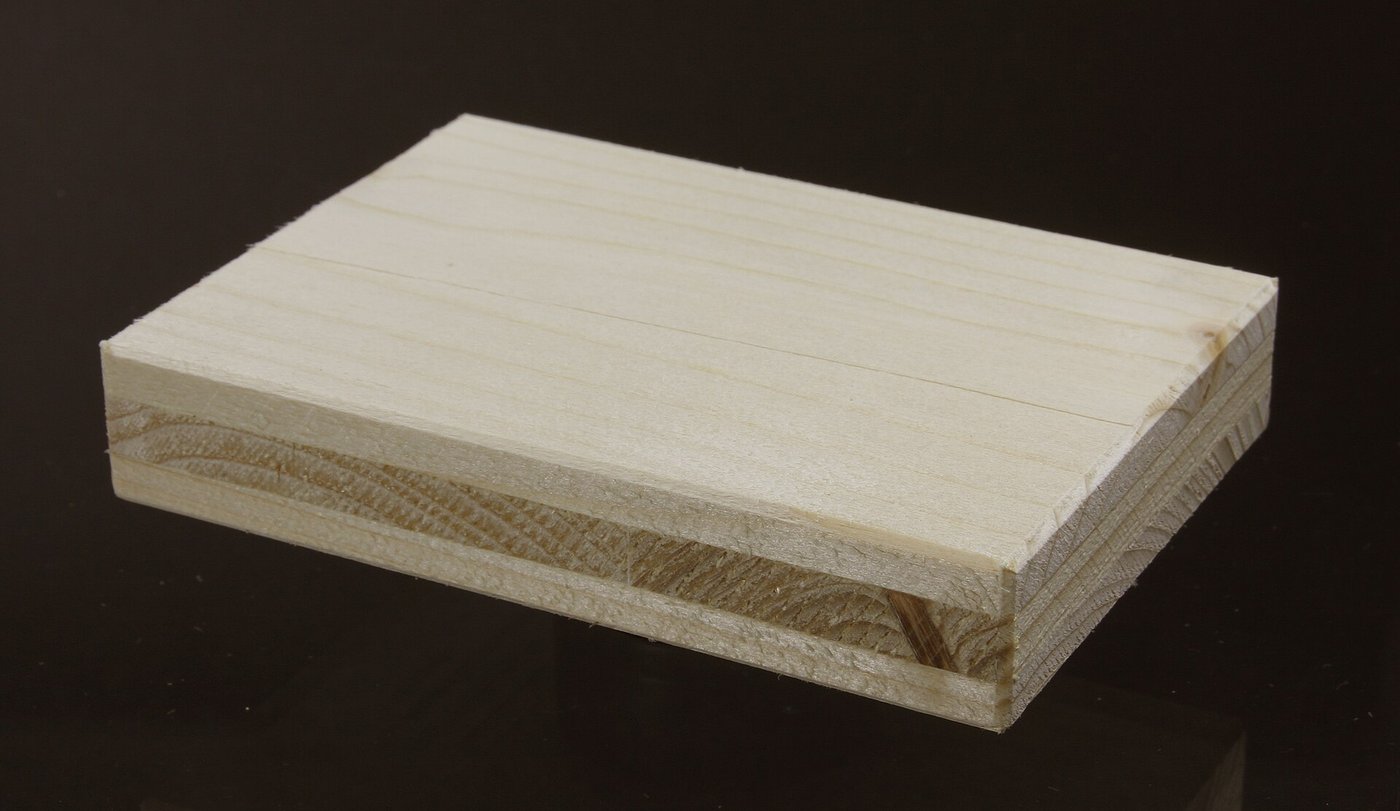
Every engineered wood product is the same idea applied differently: break wood down into smaller units, dry them, and glue them back together in a controlled arrangement. Doing so buys two things a sawn board cannot offer - predictability, because defects are dispersed rather than concentrated, and size, because the product is no longer limited by the diameter of a tree.
| Product | Made from | What it is for |
|---|---|---|
| Plywood | Thin veneers peeled from a log, glued with grain alternating at right angles | Sheathing, flooring, formwork, furniture, marine and structural uses |
| OSB (oriented strand board) | Strands of small, low-grade wood, oriented in layers and pressed | Wall and roof sheathing, subfloor, I-joist webs - the volume structural panel |
| Particleboard | Chips and sawdust with resin | Furniture and cabinet carcasses, shelving, usually faced |
| MDF (medium density fibreboard) | Wood fibres with resin, pressed to a uniform board | Mouldings, doors, cabinet doors, painted joinery |
| Hardboard | Fibres pressed at high temperature | Backing panels, door skins, perforated board |
| Glulam | Graded lumber laminations glued into large beams | Long-span beams, arches, exposed structural work |
| LVL (laminated veneer lumber) | Veneers glued with grain parallel | Headers, beams, rim board, I-joist flanges |
| I-joists | LVL or lumber flanges with an OSB or plywood web | Floor and roof joists - light, straight, long |
| CLT (cross-laminated timber) | Boards glued in alternating layers into large panels | Structural walls and floors in mid-rise buildings |
Current commercial practice · Product definitions per USDA Forest Service Wood Handbook (FPL-GTR-190) and standard industry usage
What this does to the forest
Engineered products change what a tree is worth, and therefore what gets grown. A stand of small, fast-grown, knotty softwood that could never produce a Select Structural board makes perfectly good OSB strands. That creates a market for thinnings and for short-rotation plantation wood, which in turn makes thinning economic - and thinning is what concentrates growth on the better stems that eventually become sawtimber.
CLT and tall timber buildings
Cross-laminated timber is the most consequential recent addition. Boards are glued in alternating layers into panels that can be several metres wide and many metres long, strong in both directions, and prefabricated with openings cut before they leave the plant. That makes structural walls and floors out of softwood in buildings that would otherwise be concrete or steel.
For this site's purposes the interesting part is the substitution. A mid-rise building framed in CLT displaces cement and structural steel - both covered in the steel and construction end market here - and does so with a material that grew back. How far that substitution goes is limited by fire regulation, by code adoption, by cost and by the supply of suitable graded lamstock, not by the idea.
Where the material comes from
Follow the chain backwards and the picture from lesson 10 completes itself. Particleboard and MDF consume sawmill chips, sawdust and shavings. OSB consumes small roundwood and thinnings. Plywood and LVL consume peeler logs, which are a grade of their own - straight, large, clean - and compete with sawlogs for the same trees. Glulam and CLT consume graded sawn lumber, so they compete directly with construction framing for the same boards.
So the engineered sector spans the entire quality range, from sawdust to premium logs, which is why it is the part of the industry most able to use whatever the forest actually produces rather than what a sawmill would prefer.
- Engineered products disperse defects and escape the size limit of a tree.
- OSB and panels create a market for small and low-grade wood, which makes thinning economic.
- CLT substitutes for concrete and steel in mid-rise construction, and competes with framing for graded lumber.
- OSB
- Oriented strand board: strands of small wood pressed in oriented layers.
- Glulam / LVL / CLT
- Glued laminated beams / parallel veneer lumber / cross-laminated panels.
- Peeler log
- A log good enough to be rotary peeled for veneer.
- Lamstock
- Graded lumber used as the laminations in glulam or CLT.
- Steel and constructionon this site
- USDA Wood Handbookprimary source
- FAO panel productionprimary source
Check yourself
1. OSB and particleboard matter to forest management because they:
A market for small wood makes thinning pay, and thinning is what concentrates growth on the stems that become sawtimber.
2. Cross-laminated timber competes structurally with:
CLT makes structural walls and floors, which puts it against concrete and steel rather than against other wood panels.
3. Peeler logs used for plywood and LVL compete with:
Peelers are a premium log grade, so the veneer industry bids against sawmills for the best material.
4. Why is adhesive type part of an engineered panel's specification rather than a manufacturing detail?
The glue governs both durability in service and indoor air quality compliance, and failure is not gradual.