Module 3 · Stump to mill
Inside a sawmill
Level 2 · Working knowledge 12 min read 4 questions
A log arrives round and wet and leaves as several different products of very different value. How the mill decides what to cut is the whole of its profitability.
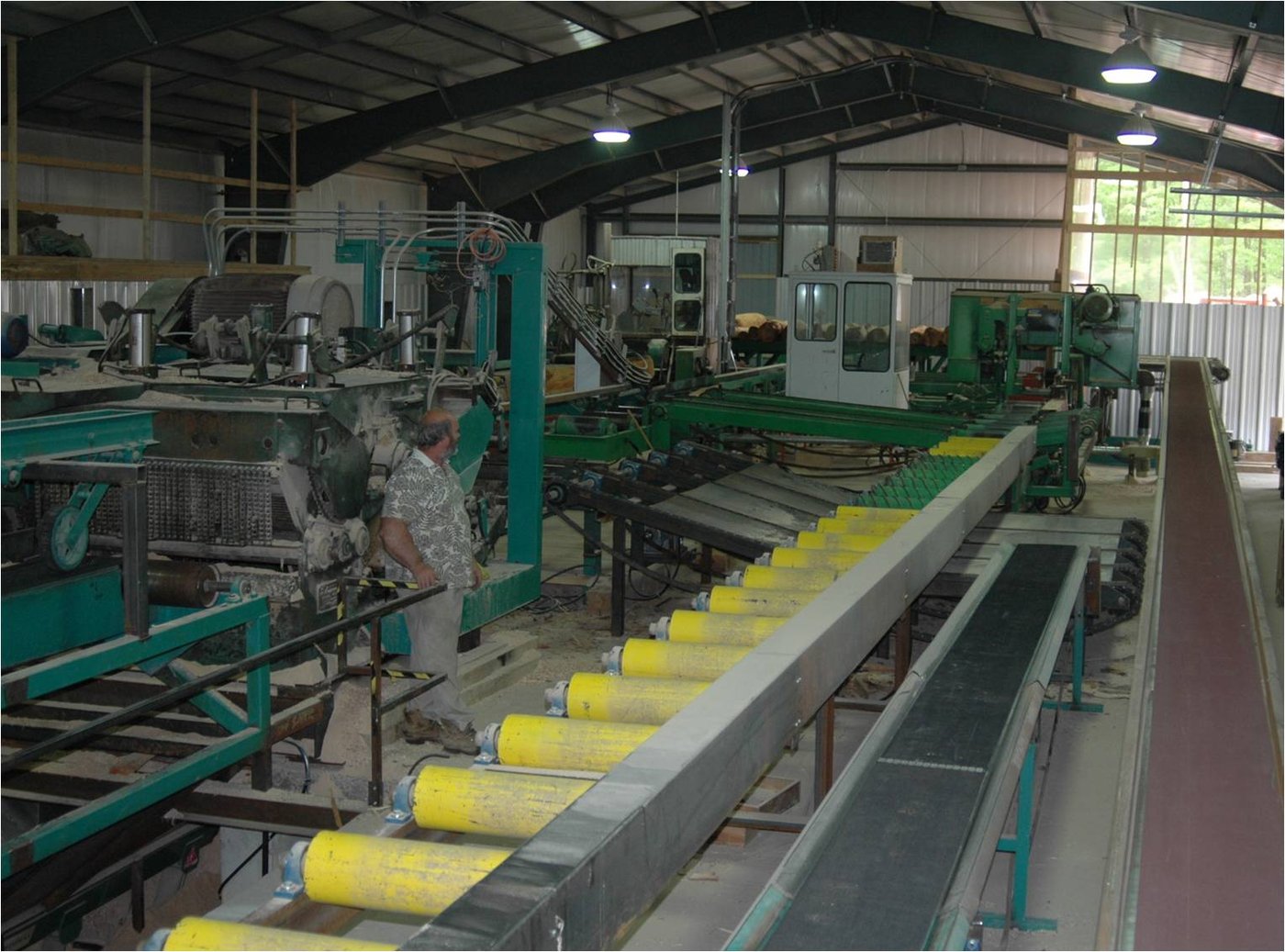
A sawmill converts a round, wet, tapered, defective object into rectangular dry products of graded quality. Roughly half of the log's volume becomes lumber and the rest becomes something else - and what happens to that rest is lesson 10.
Sawing patterns, and what they are for
- Live sawing (through and through)
- Cut straight through the log in parallel slices. Fastest and highest volume recovery; produces a mix of grain orientations.
- Cant sawing
- Square up the log into a cant, then slice it. The standard for structural softwood, where speed and dimension matter more than figure.
- Grade sawing
- Cut a few boards from one face, turn the log, cut from the next best face, and keep turning. Slower, lower volume recovery, but it chases the clear faces - which is how hardwood is sawn, because grade is worth more than volume.
- Quartersawing and riftsawing
- Cut so the growth rings meet the face steeply. Much lower yield and slower, but the boards are far more dimensionally stable and, in oak, show the ray fleck the trade pays for.
Lumber recovery, and where the log goes
The share of a log's volume that emerges as lumber is the lumber recovery factor, conventionally board feet of lumber per cubic foot of log. It depends on log diameter (large logs recover better, because the slab and edging losses are proportionally smaller), on taper, on saw kerf, on sawing pattern and on how well the mill is run.
| Stream | Rough share of log volume | What it becomes |
|---|---|---|
| Lumber | Roughly 45-55% | The product; graded and sold per MBF |
| Chips from slabs and edgings | Roughly 25-35% | Pulp, panel furnish, or fuel |
| Sawdust and shavings | Roughly 10-15% | Pellets, panels, bedding, fuel |
| Bark | Roughly 10% | Mulch, fuel, growing media |
Indicative ranges only · Typical softwood sawmill mass balance as described in USDA Forest Service and industry technical literature
Wide ranges and they must be. Recovery varies with log size, species, kerf, sawing pattern, product mix and whether shares are computed on solid volume or on green weight. These figures are for orientation - any real mill knows its own numbers to the percentage point and they are commercially sensitive.
Kiln drying: where value is won and lost
Drying is the longest and riskiest step. Dried too fast, wood checks, splits, honeycombs internally and case-hardens; dried too slowly, it stains, moulds and ties up capital and kiln capacity. Softwood framing is dried in a day or two at high temperature. Thick hardwood is air dried for months and then kilned for weeks on a carefully controlled schedule, and a badly run kiln can take a pack of FAS hardwood worth a great deal and turn it into something worth a fraction.
Kiln drying also serves a second purpose: it kills insects and fungi, which is what ISPM 15 heat treatment of pallets from lesson 7 is about, and what makes dried lumber acceptable in international trade.
- Grade sawing trades volume recovery for grade; cant sawing does the opposite. Both are correct for their products.
- Roughly half of a log becomes lumber - the rest is chips, sawdust, shavings and bark.
- Drying is the slowest, most capital-intensive step and the easiest place to destroy the value of a good log.
- Headrig
- The primary breakdown saw that makes the first cuts in a log.
- Cant
- A log squared up on two or more faces, ready to be sliced.
- Wane
- Bark or missing wood on the edge of a board, where the log's curve intruded.
- Lumber recovery factor
- Board feet of lumber per cubic foot of log.
- USDA Forest Products Laboratoryprimary source
Check yourself
1. Grade sawing a hardwood log rather than cant sawing it results in:
Turning the log to chase clear faces sacrifices volume for grade, which is the right trade when grade spreads are multiples.
2. Why do large-diameter logs have a better lumber recovery factor than small ones?
It is geometry. The unusable outer curved material is a smaller fraction of a bigger log.
3. Quartersawn oak is specified mainly because it is:
The ring orientation reduces the worst direction of shrinkage, and in oak the large rays produce the characteristic figure.
4. Kiln drying serves a regulatory as well as a technical purpose because heat treatment:
Phytosanitary treatment is why pallets crossing borders carry a stamp, and heat treatment in a kiln satisfies it.