Module 1 · What wood is, and how it is measured
Softwood and hardwood: the distinction that is not about hardness
Level 1 · Foundation 9 min read 4 questions
The two great divisions of commercial timber are botanical, not mechanical. Some hardwoods are soft and one important softwood is hard, and the naming has confused buyers for a century.
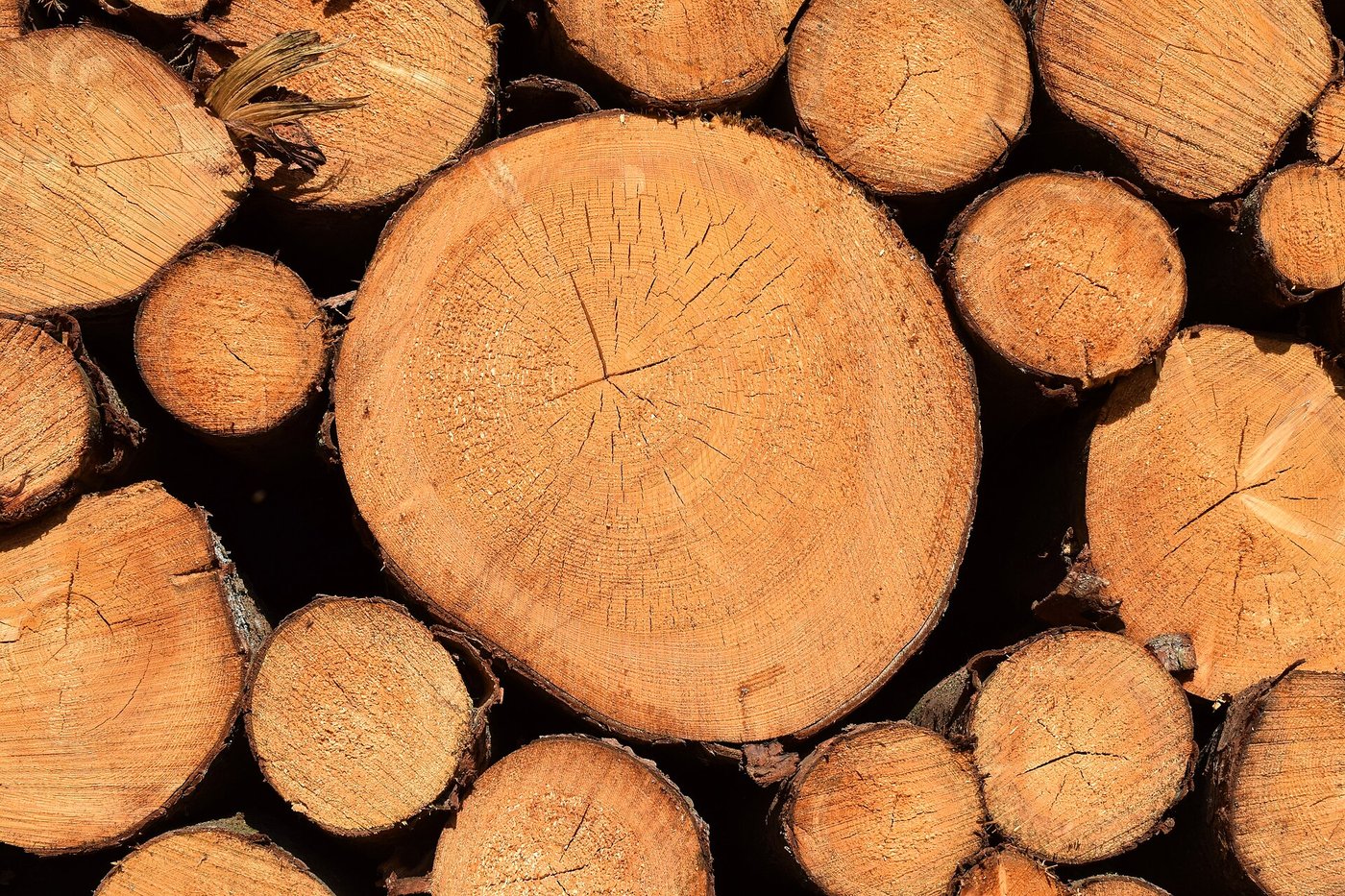
Every commercial timber species falls into one of two groups. Softwoods are conifers - gymnosperms - which bear seeds in cones and mostly keep their needles. Hardwoods are broadleaved flowering trees - angiosperms - which mostly shed their leaves in temperate climates. That is the whole of the distinction. It says nothing directly about how hard the wood is.
Why the distinction still matters commercially
Even though it does not predict hardness, the division predicts almost everything else about how a species is grown, sold and used.
| Softwood | Hardwood | |
|---|---|---|
| Typical rotation to sawtimber | Roughly 25-40 years in managed plantations | Roughly 50-100 years or more |
| How it is grown | Often planted in even-aged stands and thinned | Often naturally regenerated, mixed-species, uneven-aged |
| Main volume market | Structural framing and panels | Appearance and industrial uses |
| Graded for | Strength | Appearance - clear face area |
| Demand driver | Housing starts and repair-and-remodel | Furniture, cabinets, flooring, pallets, exports |
| Price series to watch | Framing lumber composites and lumber futures | Species-and-grade price reports |
Structural comparison, not time-specific · Characteristics as described in USDA Forest Service Wood Handbook (FPL-GTR-190) and Forest Inventory and Analysis programme documentation
Rotation lengths vary enormously with site quality, region, species and management objective. The ranges are orders of magnitude, not planning figures.
The difference in rotation length is the most important line in that table. A softwood plantation is a crop with a human planning horizon. A walnut or white oak sawlog is the product of a century, which means nobody alive planted it for the market it is being sold into. Hardwood supply cannot respond to price at all on any timescale that matters, and the entire hardwood market follows from that.
The structure of a log
- Bark
- Outer protective layer. At the mill it is removed first and sold - lesson 10 covers where it goes.
- Cambium
- The thin living layer just under the bark where growth happens. Everything inside it is dead tissue.
- Sapwood
- The outer wood, still conducting water. Usually paler, and in most species less durable and more prone to staining.
- Heartwood
- Inner wood that has ceased conducting and become chemically altered. Usually darker, more dimensionally stable and, in some species, markedly more decay resistant - which is the entire commercial case for western red cedar, redwood and black locust.
- Growth rings
- One per growing season in temperate species, each with faster, lighter earlywood and denser, darker latewood. Ring spacing is a direct read on growth rate, and in softwoods tighter rings generally mean denser, stronger wood.
- Rays
- Radial tissue running across the rings. In oak they are large, and cutting to expose them produces the quartersawn figure that the trade pays for.
Moisture, the property that ruins everything
Freshly cut wood is full of water - green wood can weigh far more than the same wood dry, which is why pulpwood is sold by weight and why haul economics depend on how long a log has been sitting. As wood dries below roughly 30% moisture content, it begins to shrink, and it shrinks unequally: much more around the rings than across them, and almost not at all along the grain.
That inequality is the cause of nearly every defect a woodworker fights. Cupping, bowing, twisting, checking and splitting are all differential shrinkage. It is why lumber is dried before it is sold for most uses, why the sawing pattern in lesson 9 matters, and why wood delivered at the wrong moisture content for its destination will move after installation however good the board looked.
Density and hardness
Within either group, the property that predicts most mechanical behaviour is density. Denser wood is generally stronger, stiffer, harder and heavier, holds fasteners better, machines differently and burns hotter. The trade's usual hardness measure is the Janka test: the force needed to embed a steel ball half its diameter into the wood.
| Species | Group | Janka, lbf (dry) |
|---|---|---|
| Hickory (shagbark) | Hardwood | 1,880 |
| Sugar (hard) maple | Hardwood | 1,450 |
| White oak | Hardwood | 1,360 |
| White ash | Hardwood | 1,320 |
| American beech | Hardwood | 1,300 |
| Northern red oak | Hardwood | 1,290 |
| Yellow birch | Hardwood | 1,260 |
| Black walnut | Hardwood | 1,010 |
| Black cherry | Hardwood | 950 |
| Red (soft) maple | Hardwood | 950 |
| Sweetgum | Hardwood | 850 |
| Longleaf pine | Softwood | 870 |
| Loblolly pine | Softwood | 690 |
| Douglas-fir (coast) | Softwood | 660 |
| Yellow-poplar | Hardwood | 540 |
| Western hemlock | Softwood | 540 |
| Sitka spruce | Softwood | 510 |
| Ponderosa pine | Softwood | 460 |
| Eastern cottonwood | Hardwood | 430 |
| Basswood | Hardwood | 410 |
| Eastern white pine | Softwood | 380 |
| Quaking aspen | Hardwood | 350 |
| Western redcedar | Softwood | 350 |
Side hardness at 12% moisture content · USDA Forest Service, Wood Handbook (FPL-GTR-190), mechanical properties of commercially important species
Rounded. Published values differ by a few per cent between sources and between samples, and vary within a species group - hickory and the southern yellow pines especially, where several species are sold under one trade name. Use these to rank species, not to specify one.
Read the table and the botanical point makes itself: four softwoods are harder than three of the hardwoods below them, and the softest wood in the list is a hardwood. Hardness is also not the only thing a buyer wants. A flooring buyer wants hardness; a carver wants basswood precisely because it is soft; a pattern maker wants stability above everything.
- Softwood and hardwood are botanical categories; several softwoods are harder than several hardwoods.
- Softwood rotations run decades and hardwood rotations run lifetimes, which is why hardwood supply cannot respond to price.
- Differential shrinkage as wood dries causes nearly every defect in a board, and wood never stops moving.
- Softwood / hardwood
- Conifer / broadleaved flowering tree. Botanical categories, not hardness ratings.
- Heartwood / sapwood
- Inner, chemically altered, often durable wood / outer, still-conducting, usually less durable wood.
- Janka hardness
- The force needed to embed a steel ball half its diameter into the wood.
- Green
- Freshly cut and still at high moisture content.
- USDA Forest Service Wood Handbookprimary source
- What is a supply chain?on this site
Check yourself
1. Balsa is classified as a hardwood because it:
The division is botanical - angiosperm against gymnosperm - and says nothing directly about mechanical hardness.
2. Why does hardwood supply respond so poorly to a price rise?
A white oak sawlog is the product of a century. No price signal today can create more of them within a useful timeframe.
3. Cupping and twisting in a drying board are caused by:
Wood shrinks much more tangentially than radially and scarcely at all along the grain, and that inequality distorts the board.
4. Heartwood is commercially valuable in species such as western red cedar mainly because it is:
Durability is the selling point. The extractives deposited in heartwood are what resist decay, which is why only the heartwood of those species is specified for exterior use.