Module 1 · What wood is, and how it is measured
The board foot, and the units that sit next to it
Level 1 · Foundation 9 min read 4 questions
One board foot is 144 cubic inches of wood. Everything confusing about lumber measurement comes from what happens to that definition in practice.
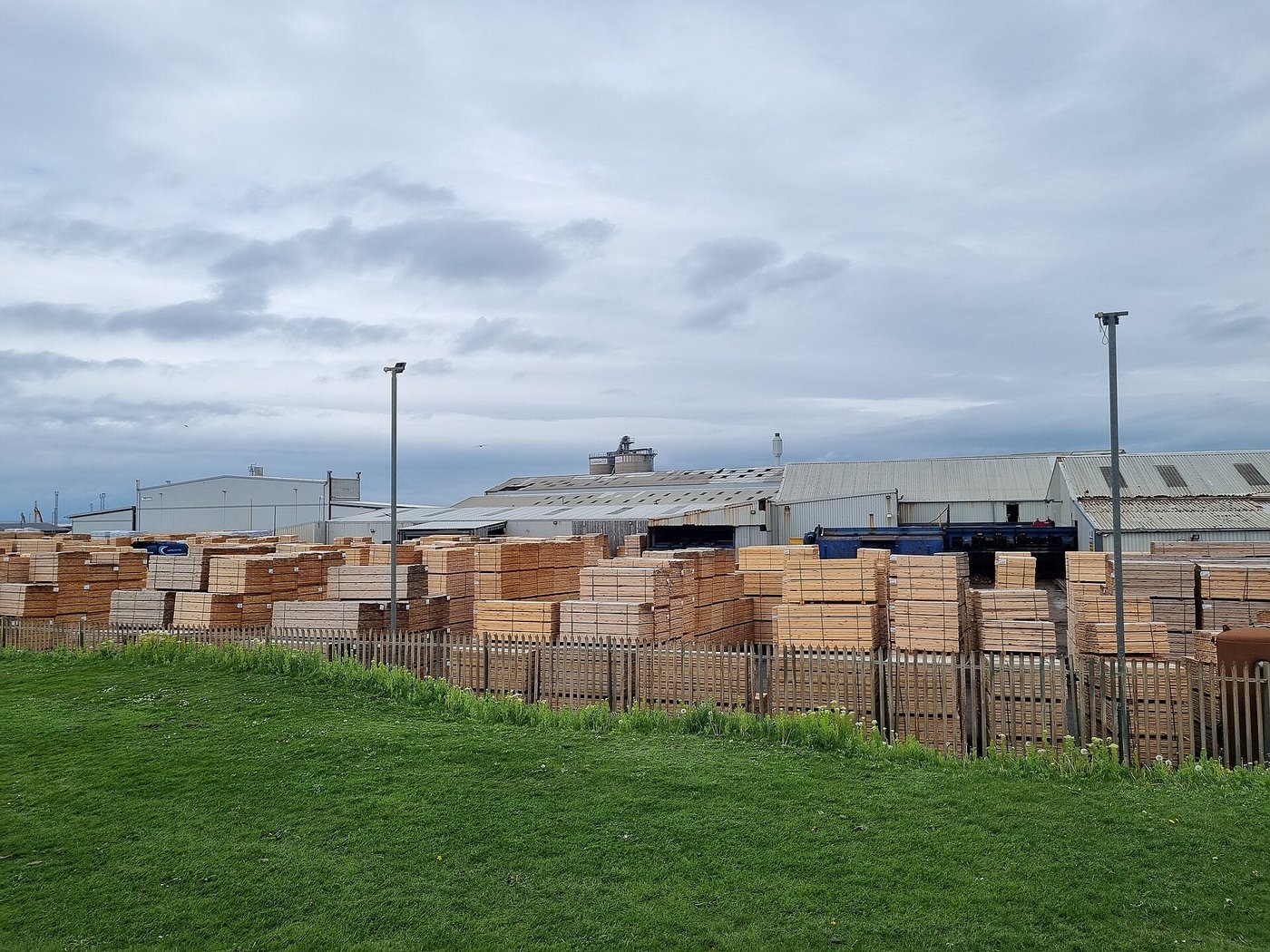
The board foot is the volume unit of the North American lumber trade. One board foot is a piece one inch thick, twelve inches wide and twelve inches long: 144 cubic inches. It is a volume, not an area, and the formula follows directly.
| Unit | What it is | Used for |
|---|---|---|
| Board foot (bf) | 144 cubic inches | The base unit for lumber |
| MBF | One thousand board feet | How lumber is priced and how mill output is reported |
| MMBF | One million board feet | Mill capacity, regional production, annual harvest |
| Cord | A stack 4 ft x 4 ft x 8 ft, 128 cubic feet gross | Firewood and pulpwood; includes the air between the pieces |
| Cunit | 100 cubic feet of solid wood | Pulpwood and chips in some regions |
| Green ton / dry ton | Weight, wet or oven-dry | Pulpwood, chips, biomass - most residual streams are sold by weight, not volume |
| Cubic metre | One m3 of solid wood, about 424 board feet nominal | The international unit; FAO reports everything this way |
Standard trade definitions · FAO Forest Products Definitions; and standard North American trade usage
The cubic metre to board foot conversion depends on whether you are converting solid volume or nominal lumber tally, and sources differ. Always check which is meant before converting a published figure.
Nominal and actual: the two-by-four that is not
A construction two-by-four is not two inches by four inches. It is nominal 2 x 4 and actual 1½ x 3½ inches, because the piece was sawn at roughly full size green and then shrank in drying and lost more to planing. The trade kept the original name, standardised the finished size, and prices by the nominal dimension.
| Nominal | Actual, dry | Board feet per linear foot (nominal basis) |
|---|---|---|
| 1 x 4 | 3/4 x 3-1/2 in | 0.33 |
| 1 x 6 | 3/4 x 5-1/2 in | 0.50 |
| 2 x 4 | 1-1/2 x 3-1/2 in | 0.67 |
| 2 x 6 | 1-1/2 x 5-1/2 in | 1.00 |
| 2 x 8 | 1-1/2 x 7-1/4 in | 1.33 |
| 2 x 10 | 1-1/2 x 9-1/4 in | 1.67 |
| 2 x 12 | 1-1/2 x 11-1/4 in | 2.00 |
| 4 x 4 | 3-1/2 x 3-1/2 in | 1.33 |
Standard dressed dry sizes under the American Softwood Lumber Standard · US Department of Commerce, Voluntary Product Standard PS 20, American Softwood Lumber Standard
Green-sawn sizes are slightly larger than the dry sizes shown, because the piece is expected to shrink to them. Board-foot volume is always computed on the nominal dimension, so you pay for the wood that was planed away.
Two worked examples
- A single board. A rough hardwood board 8/4 thick, 9 inches wide and 10 feet long: 2 x 9 x 10 / 12 = 15 board feet.
- A framing package. One hundred 2 x 6 studs, each 8 feet long: 2 x 6 x 8 / 12 = 8 board feet each, so 800 board feet, or 0.8 MBF. At a framing price quoted per MBF, multiply.
Those two calculations account for most of the arithmetic anyone does in this industry. What makes wood measurement genuinely difficult is not the board foot. It is working out how many board feet are inside a log that has not been sawn yet - which is the next lesson, and it has three different answers.
- A board foot is 144 cubic inches; MBF is a thousand of them and MMBF a million.
- Softwood is sold at nominal dimensions and actual sizes are smaller; hardwood is sold rough in quarters and random widths.
- Residual streams are sold by weight, not volume, which is why moisture content is a commercial term.
- Board foot
- 144 cubic inches of wood.
- MBF / MMBF
- One thousand / one million board feet.
- Nominal / actual
- The size a piece is called / the size it measures after drying and planing.
- Quarters
- Hardwood thickness in quarter-inches: 4/4, 5/4, 8/4.
- FAO forest products definitionsprimary source
Check yourself
1. How many board feet are in a rough board 2 inches thick, 8 inches wide and 12 feet long?
2 x 8 x 12 / 12 = 16 board feet. Using length in feet means dividing by 12; using inches means dividing by 144.
2. A price quoted at $520 per MBF is a price per:
M is the Roman thousand here. MMBF is the million.
3. A nominal 2 x 4 measures 1-1/2 by 3-1/2 inches actual because:
It is a historical artefact that got standardised. Board footage is still computed on the nominal size.
4. Hardwood lumber thickness written as 5/4 means:
Hardwood thicknesses are quoted in quarter-inches: 4/4 is one inch, 5/4 is an inch and a quarter, 8/4 is two inches.