From blasted rock to saleable powder
Picture a truck tipping a load of freshly blasted porphyry copper ore — grey, dusty, laced with specks of chalcopyrite that make up less than one part in two hundred of the total mass. That rock is worthless to a smelter. What arrives at the smelter gate is a dry powder containing perhaps a quarter to a third copper by mass. The mill's entire purpose is to perform that transformation: break the rock down until individual mineral grains are free of the surrounding waste, and then separate the wanted grains from the unwanted ones. Crushing, grinding and flotation are the three sequential stages that do it.
Crushing: coarse breakage in stages
Ore arrives at the primary crusher — typically a gyratory or jaw crusher — at run-of-mine size, which can mean boulders of half a metre or more across. The crusher accepts this feed and produces a product in the range of a few centimetres. One stage of crushing is rarely enough. Most mills follow primary crushing with secondary and sometimes tertiary crushers, using cone crushers or horizontal shaft impactors, progressively reducing particle size. The goal at this stage is not fine grinding; it is to produce a uniform feed size that the grinding circuit can handle efficiently. Crushers use mechanical compression and are relatively energy-efficient for the coarse range they handle.
Grinding: the biggest electricity bill on site
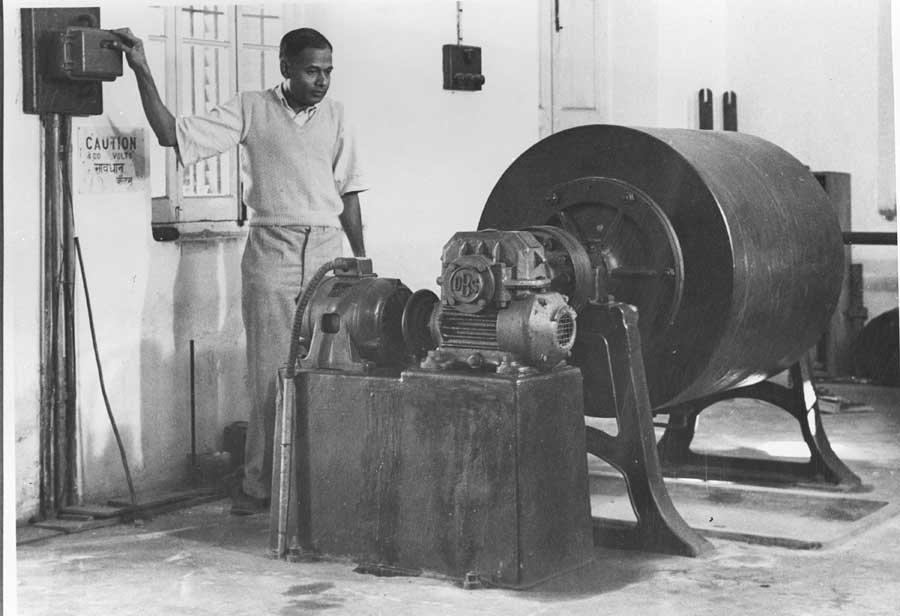
Grinding is where the economics become severe. Once ore is crushed to centimetre scale, it must be reduced further — often to below 100 micrometres, sometimes much finer — before mineral grains are genuinely liberated from gangue. The workhorse machine is the tumbling mill: a rotating cylinder charged with a grinding medium. In a ball mill, that medium is steel balls; in a SAG (semi-autogenous grinding) mill, the ore itself does much of the grinding, supplemented by large steel balls. AG (fully autogenous) mills use no added medium at all, relying entirely on the ore.
Grinding is energy-intensive because it is fundamentally inefficient. The energy delivered by impact and attrition that actually creates new mineral surface area is a small fraction of the total electrical energy drawn. The rest becomes heat. Because grinding mills run continuously, at high power draw, for the life of the mine, they dominate the site's electricity consumption — typically more than any other single process step. This is why ore hardness is one of the most important parameters a mine planner considers: a harder ore requires more energy per tonne to reach the same liberation size, directly raising operating cost.
The circuit is usually closed. Mill discharge passes over a screen or through a cyclone classifier. Coarse particles are returned to the mill — this return fraction is called the circulating load — while the fine fraction, now a water-based slurry, passes forward to flotation. Managing the circulating load is a continuous balancing act: too high and the mill is overwhelmed; too low and product is too coarse for effective flotation.
An illustrative example: thinking about recovery and grade
Suppose, illustratively, that a mill processes ore at a grade of 0.5% copper. For every 1,000 tonnes of rock fed in, roughly 5 tonnes of copper metal is present, locked inside mineral grains dispersed through 995 tonnes of silica, feldspar and other gangue. After grinding and flotation, the mill might produce a concentrate at 28% copper with a recovery of 85% — meaning 85% of the copper present in the feed ends up in the concentrate, and 15% is lost to tailings. Working through the arithmetic: 85% of 5 tonnes is 4.25 tonnes of copper recovered. That copper sits inside a concentrate mass of 4.25 ÷ 0.28, which is approximately 15.2 tonnes. So 1,000 tonnes of ore has become roughly 15 tonnes of concentrate. The remaining 985 tonnes leaves the mill as tailings slurry. The exact figures in any real operation will differ, but the ratio — a very large tonnage of rock producing a small tonnage of concentrate — is characteristic of low-grade porphyry deposits and explains why throughput capacity matters so much.
Flotation: exploiting surface chemistry
Flotation works because mineral surfaces differ in their affinity for water. The slurry from the grinding circuit enters large flotation cells — agitated tanks through which air is continuously bubbled. Before the slurry reaches these cells, chemical reagents are added. Collectors are molecules that adsorb onto the target mineral surface, making it hydrophobic: repellent to water, attractive to air bubbles. Frothers stabilise the bubbles at the surface. Depressants can selectively suppress minerals you do not want to float.
When hydrophobic mineral particles collide with rising air bubbles, they attach and are carried to the froth layer at the top of the cell. The froth, loaded with mineral, overflows into a launder and is collected. The hydrophilic gangue minerals, preferring water, remain in suspension and exit as tailings. The process is rarely complete in a single cell. A rougher stage makes an initial, impure concentrate. This goes forward to cleaner cells, where the froth is re-processed to upgrade grade, while the tailings from cleaners — the scavenger stream — are often recycled to recover additional mineral. The circuit architecture depends on the ore's mineralogy, the target grade and recovery specifications.
Reagent selection is ore-specific and is adjusted constantly in response to changes in feed mineralogy. An ore containing both chalcopyrite and molybdenite, for instance, requires a selective circuit that can separate the two, because they have different economic value and the smelter pays for them separately.
Where the circuit ends
Concentrate leaving the final cleaner cells is thickened — water is removed in a thickener — and then filtered to reduce moisture further before transport. The tailings stream goes to a tailings storage facility. Both streams carry implications well beyond the mill boundary: tailings management and concentrate logistics are subjects in their own right.
For the reader going deeper
The treatment above describes conventional sulphide flotation. Readers working with oxide ores, complex polymetallic deposits or fine-grained refractory minerals will find that liberation and recovery behave differently, and that heap leaching, pressure oxidation or ultra-fine grinding circuits may enter the picture. The thermodynamics of mineral surface chemistry — the quantitative basis for collector–mineral interaction — and the modelling of grinding energy using the Bond Work Index and its successors are natural next steps for a more rigorous treatment.