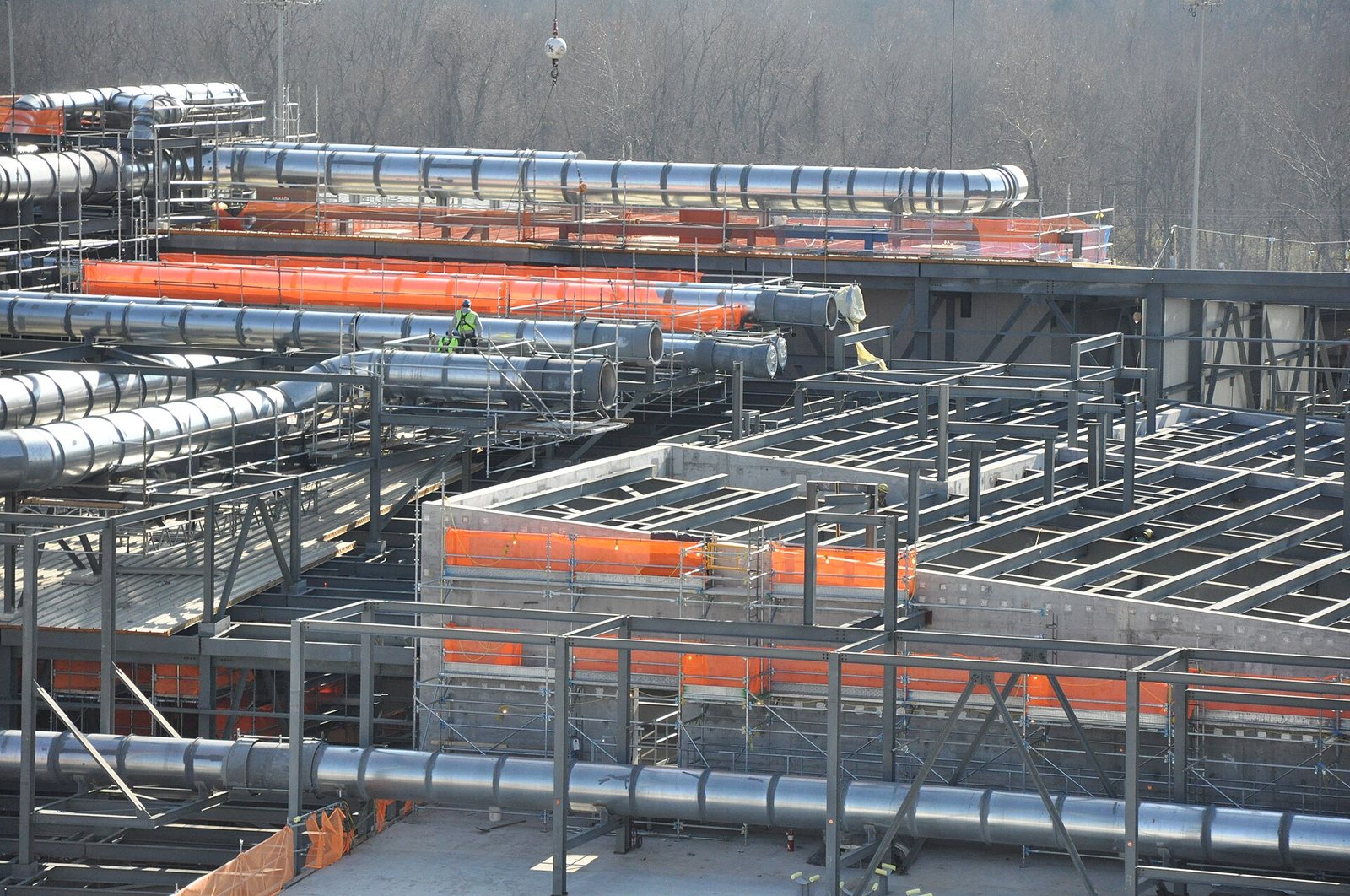
In a solvent extraction plant processing a mixed rare earth solution, adjacent tanks hold liquids whose compositions differ by perhaps a fraction of a percent. An operator walking the row sees what looks like the same pale yellow fluid repeated dozens of times. That repetition is not inefficiency — it is the only way chemistry currently offers to pull apart elements that nature made almost indistinguishable from one another.
Why the rare earths resist separation
The seventeen elements grouped as rare earths — the fifteen lanthanides plus scandium and yttrium — sit in a peculiar position on the periodic table. The lanthanides in particular fill an inner electron shell, the 4f shell, rather than the outermost one. Because chemical behaviour is governed almost entirely by outer electrons, the lanthanides present nearly identical faces to every reagent you introduce. Lanthanum and cerium, neodymium and praseodymium: each pair is more alike chemically than sodium and potassium, yet industry needs them separated to high purity because a magnet-grade neodymium oxide contaminated with cerium performs measurably worse. The similarity is not approximate — it is systematic, and it tightens as atomic number increases through the heavy rare earths, where differences in ionic radius become vanishingly small.
This ionic radius argument is worth holding onto. As the lanthanide series progresses from lanthanum to lutetium, each successive element has a slightly smaller ion because the added nuclear charge contracts the electron cloud — a phenomenon called the lanthanide contraction. The contraction is real but gradual, and it is the only significant handle separators have to work with. Every separation technique in industrial use is, at bottom, an attempt to exploit that small and slowly varying difference in ionic radius across a long series.
From ore to mixed chloride: the upstream steps
Before separation begins, ore must be concentrated and cracked open. Bastnäsite, monazite, and xenotime — the principal ore minerals — each require different treatment. Bastnäsite is commonly roasted and then leached with dilute acid. Monazite, which contains thorium alongside the rare earths, demands a caustic or acid digestion that also has to manage the radioactive fraction. The product of these steps is typically a mixed rare earth solution or a mixed carbonate or chloride precipitate. At this point all seventeen elements are still together. Separation proper has not yet started.
Solvent extraction: the workhorse
The dominant industrial method is liquid–liquid solvent extraction, usually called SX. An aqueous solution carrying dissolved rare earth ions is contacted with an organic phase — a mixture of an extractant molecule dissolved in a diluent — in a series of mixer-settler units. The extractant, commonly an organophosphorus acid such as D2EHPA or PC88A, has a mild preference for certain rare earth ions over others based on their ionic radius. The organic phase loads preferentially with some elements; the aqueous phase retains others. By scrubbing and stripping the organic phase and recycling streams, the plant gradually enriches one fraction and depletes another.
The problem is that the selectivity per stage is small. To make this concrete, consider an illustrative example. Suppose a particular extractant, under controlled pH and temperature, moves only a few percent more of element A into the organic phase than element B per contact. To reach a product of, say, 99.9% purity, a simple calculation shows the number of theoretical stages required is very large — easily in the hundreds when the separation factor between adjacent lanthanides is close to one. Real plants string together dozens of mixer-settler units in series, and a full separation circuit handling the whole lanthanide suite may contain several hundred individual stages arranged in interconnected banks. The circuit is not one line but a branching network: light rare earths and heavy rare earths are first split into broad groups, each group then subdivided, each fraction refined further.
pH control is not decorative. The distribution ratio of each element between organic and aqueous phases changes with acidity, and operators tune pH at each stage to maximise the separation factor for whichever pair they are trying to split at that point. Reagent consumption, aqueous effluent chemistry, and the organic phase's long-term loading behaviour all depend on keeping conditions tightly controlled across a circuit that may run continuously for months.
Ion exchange and other routes
Ion exchange chromatography can achieve higher resolution than SX and is used where very high purities are needed or where the volume of material is small enough to make batch column processing economic. Resin columns exploit similar ionic-radius differences, but the selectivity sequence can be tuned by choosing different functional groups. The method is slower and more labour-intensive than continuous SX, so it tends to appear at the back end of a circuit — polishing a fraction to final specification — rather than as the primary workhorse.
Fractional precipitation and selective reduction are older techniques still used in specific contexts. Cerium is unusual among the light lanthanides in that it can be oxidised to the +4 state under mild conditions, making it possible to precipitate it selectively from a mixed solution — a useful shortcut that does not depend on the small radius differences exploited everywhere else. Europium can similarly be reduced to the +2 state and selectively precipitated. These chemical anomalies are welcomed precisely because most of the series offers no such shortcuts.
The cumulative cost of stages
Each additional stage adds capital equipment, reagent consumption, energy, water treatment, and process complexity. The economic weight of separation is substantial relative to mining and concentration, and it scales differently from most mineral processing — doubling the number of elements you wish to separate does not double the circuit; it can multiply it, because every new cut interacts with every preceding one. This is why integrated rare earth producers who control both ore and separation have a structural advantage over those who buy mixed concentrates: the value added in separation is large, and the knowledge required to run a multi-hundred-stage circuit reliably accumulates slowly over years of operation.
Where to go next
Readers wanting to go deeper should look at the thermodynamic treatment of distribution coefficients and McCabe-Thiele analysis as applied to liquid–liquid systems — the same graphical framework used in distillation describes SX stage requirements and makes the relationship between separation factor and stage count precise. From there, the literature on mixer-settler hydrodynamics and third-phase formation addresses the engineering constraints that translate theoretical stages into physical equipment.