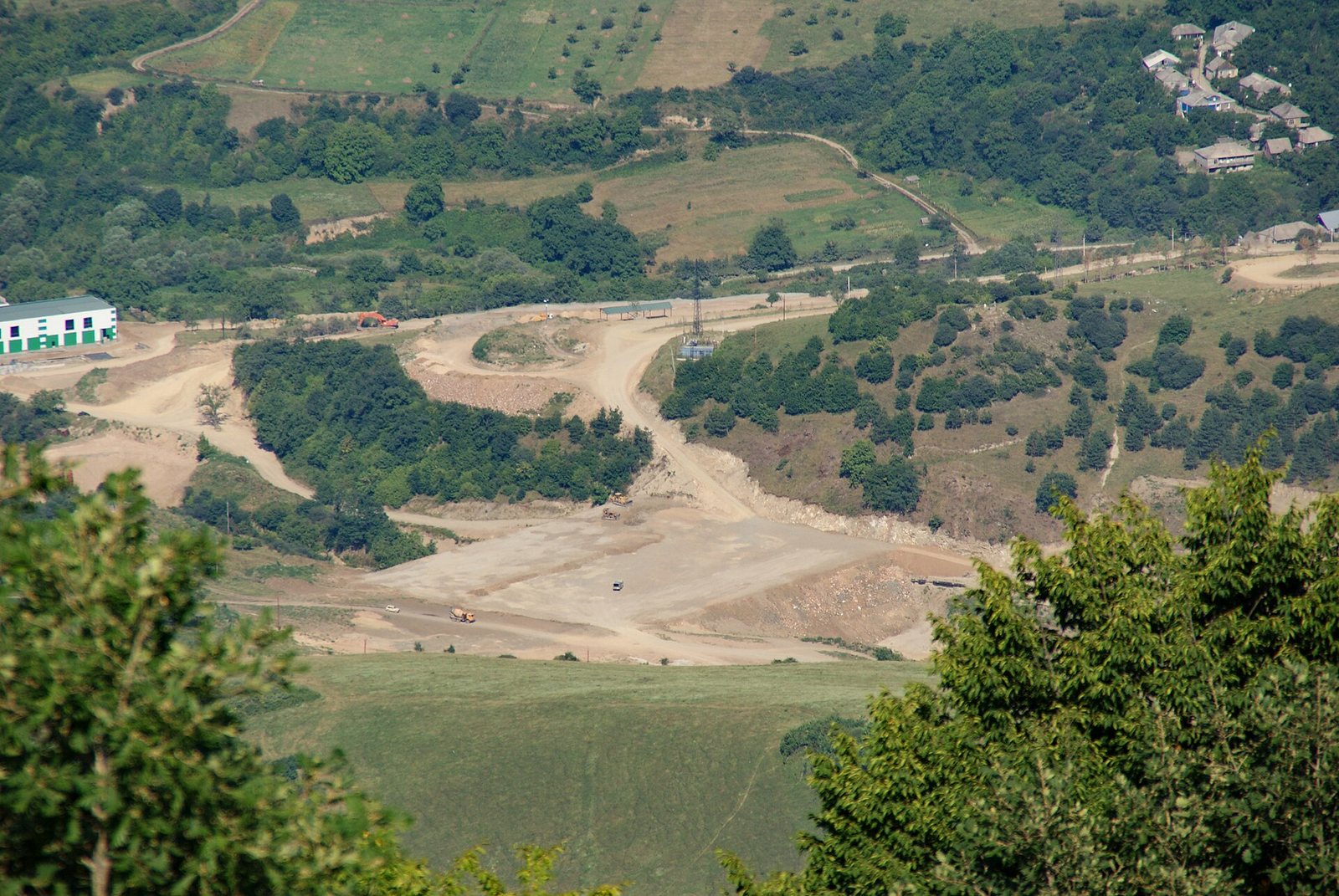
What the mountain leaves behind
Picture a copper mine processing a thousand tonnes of rock every hour. At the end of that hour, perhaps ten tonnes of copper concentrate leaves the site on a truck. The other nine hundred and ninety tonnes — crushed, wet, chemically altered — have to go somewhere. That somewhere is one of the defining environmental and engineering challenges of the mining industry, and it shapes the physical footprint of a mine far more than the pit or the shaft itself.
The material left over after valuable minerals have been extracted is divided into two broad categories: waste rock and tailings. Understanding the difference between them is the first step to understanding what happens to the mountain that does not become the product.
Waste rock: the material that never enters the mill
Before ore can be processed, miners must remove overlying or surrounding rock that contains too little mineralisation to be worth treating. This is waste rock. It is blasted, loaded and trucked to a designated pile — often called a waste dump or overburden dump — somewhere on the mine lease. Because it has not been crushed finely or exposed to processing chemicals, waste rock tends to be coarser than tailings, and the dumps can grow into substantial landforms visible from a distance.
The environmental concern with waste rock is not simply its volume. Many ore bodies are associated with sulfide minerals, and when sulfide-bearing rock is broken up and exposed to air and water, a chemical reaction begins that produces sulfuric acid. This is called acid rock drainage (ARD), sometimes acid mine drainage when it flows off a site. The acid can dissolve heavy metals from the surrounding rock and carry them into waterways. Managing waste dumps to limit oxygen and water infiltration — through compaction, covers, or careful placement of low-sulfide material on the outside of a dump — is a significant part of mine planning, though the specifics of how that is done fall to geotechnical and environmental engineers.
Tailings: what the mill leaves behind
Tailings are what remain after the ore has been ground fine and the target minerals extracted. The extraction process — whether flotation, leaching, or another method — leaves behind a slurry of fine particles mixed with water and, depending on the process, residual reagents. This slurry is pumped to a tailings storage facility (TSF), commonly an engineered dam or a series of raised embankments that grow upward as more tailings are deposited over the life of the mine.
Because tailings are ground to a fine powder — sometimes approaching the consistency of flour — they behave very differently from waste rock. Dry, they can be carried by wind. Wet, they can behave almost like a liquid, which is why TSF embankment stability is taken seriously. Failures have occurred at facilities around the world, with consequences for downstream communities and ecosystems. The engineering of these structures is a specialised field in its own right.
A worked example: where the numbers go
This example is illustrative and uses invented figures to show the arithmetic. Suppose a mine processes ore at a grade of 0.4% copper. That means for every tonne of ore fed into the mill, four kilograms of copper can theoretically be recovered (in practice, recovery is never complete, but set that aside for a moment). The remaining 996 kilograms — nearly all of that tonne — becomes tailings. If the mill treats ten thousand tonnes of ore per day, roughly nine thousand nine hundred and sixty tonnes of tailings solids are generated daily, before the water used in processing is added. Over a mine life of twenty years at that rate, the accumulated tailings solids would reach into the tens of millions of tonnes. The TSF needed to contain that material is not a pond; it is a major engineered landform that will remain on the landscape long after the mine has closed.
Lower ore grades mean the ratio becomes more extreme. If the same copper were extracted from ore grading 0.2% rather than 0.4%, twice as much rock would need to be milled to produce the same amount of metal, and approximately twice the tailings would be generated. As easily-mined high-grade deposits are exhausted and the industry moves to lower-grade resources, the volume of tailings per unit of metal produced tends to rise.
What is in tailings, and why it matters
Tailings are not inert. Depending on the ore body and the process used, they may contain residual sulfides (with the same acid-generating potential as waste rock), processing reagents such as cyanide used in gold recovery, naturally occurring heavy metals, and fine silica particles. Some of these constituents diminish over time through natural processes; others persist. Regulators in most jurisdictions require monitoring of TSF seepage and water quality for this reason.
Tailings also retain a material value that is increasingly recognised. The same facility that stores waste from one generation of processing may contain grades of certain metals that become economically interesting as extraction technology improves or commodity conditions change. Retreatment of old tailings — sometimes called tailings reprocessing — occurs at various sites around the world, and it has the secondary effect of reducing the volume of stored material.
Closure and the long term
A TSF does not simply disappear when a mine closes. The embankments must be stabilised, the surface covered to reduce erosion and limit oxidation, and water management maintained, sometimes for decades or longer. The cost and complexity of this closure work is substantial, and regulators in many countries now require mining companies to set aside funds during the operating life of a mine to cover it. What constitutes adequate closure for a TSF — whether that means a stable, revegetated landform or something more actively managed — is an ongoing area of technical and regulatory discussion.
Waste rock dumps are managed at closure too, though their coarser, more permeable nature can make water management different in character from the finer-grained challenges of a tailings facility. In some cases, waste rock is used to backfill open pits at closure, reducing both the footprint of the dump and the volume of the open void left in the ground.
Where to go next
Readers with a professional or technical interest will find that this topic branches quickly into geotechnical engineering (embankment stability and failure modes), hydrogeology (seepage prediction and groundwater interaction), geochemistry (acid rock drainage prediction and prevention), and the regulatory frameworks — which vary considerably between jurisdictions — that govern facility design, operation and closure. The Global Industry Standard on Tailings Management, published in 2020, is one reference point for understanding how the industry has attempted to formalise expectations in the wake of high-profile failures.