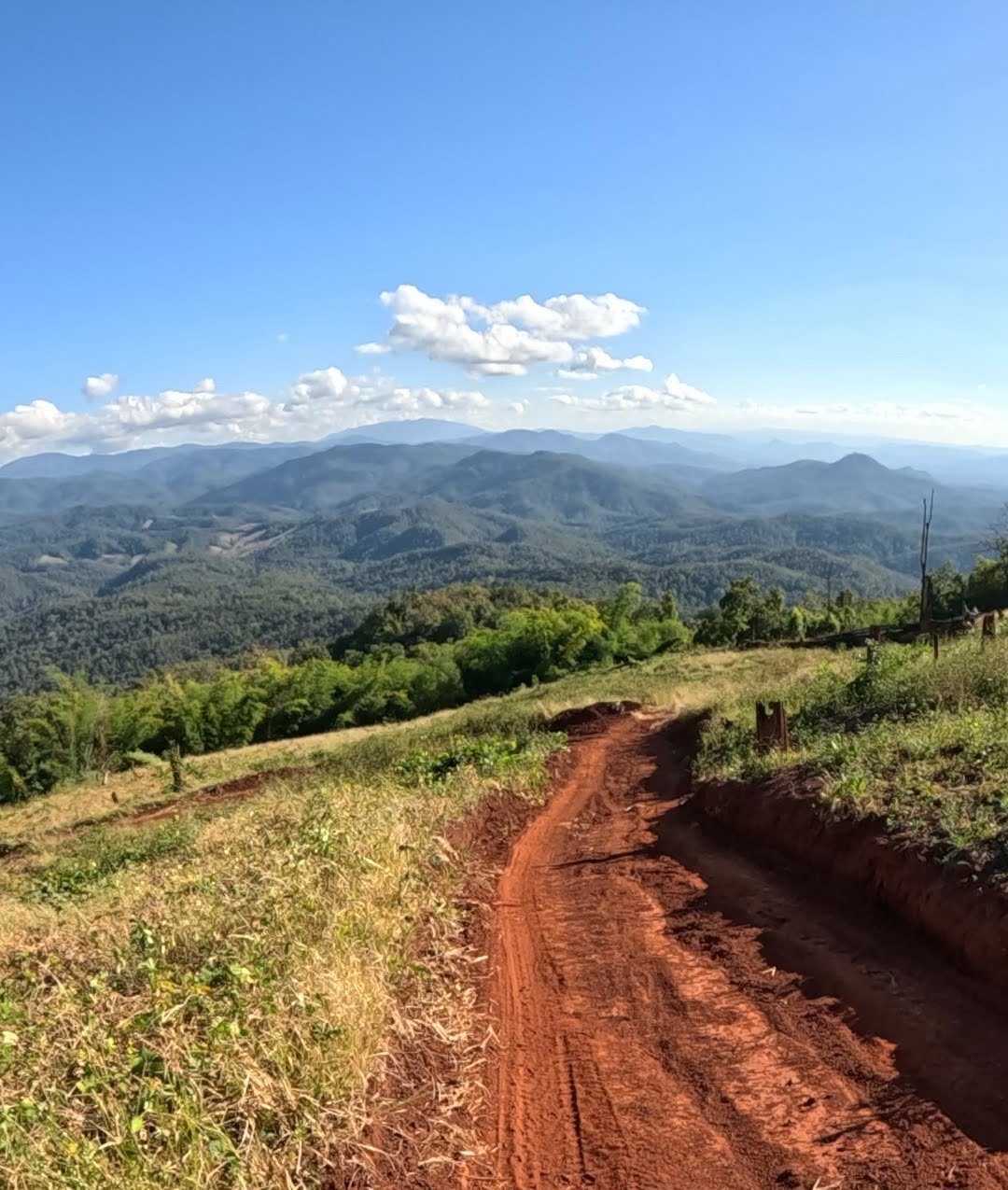
Picture a hillside in Sulawesi after a heavy monsoon. The red-brown water running off it carries iron and silica down toward the valley, leaving the slope itself a little richer in nickel than it was before. This is not a dramatic event — it is the same process that has been running, rain season after rain season, for tens of millions of years. The result is one of the world's major sources of nickel ore. Weathering, in other words, is not merely the decay of rock. Under the right conditions it is a concentrating machine.
What weathering actually does to rock
Fresh rock is a mixture of minerals, each with its own chemical stability. When rainwater — slightly acidic from dissolved carbon dioxide — seeps into cracks and reacts with those minerals, it does not dissolve everything equally. Some elements go into solution readily and are carried away by groundwater and rivers. Others are far less soluble and stay behind, accumulating in the residual material as everything around them is removed. A third group may be dissolved partway down the profile but then reprecipitate when conditions change — when the water becomes less acidic, or meets a different mineral surface, or simply runs out of room to travel.
The thickness of the weathered layer, called the regolith, depends on how long the rock has been exposed, how warm and wet the climate is, and how stable the land surface has been — a landscape that erodes quickly never builds up a deep profile. This is why the most economically interesting weathering deposits tend to sit on old, geologically quiet cratons in the tropics, where heat accelerates chemical reactions and rainfall supplies the reagent in abundance.
Nickel: iron goes, nickel stays
The rock that produces lateritic nickel deposits is usually peridotite or dunite — mantle material rich in the mineral olivine, which contains magnesium, iron, silicon, and a modest amount of nickel. Olivine is not very stable at the surface. Rainwater attacks it, releasing all its constituents into solution. Magnesium and silica are highly mobile and drain away almost entirely. Iron is less mobile; it oxidises quickly and forms iron oxyhydroxides — the minerals goethite and limonite — which stay put and give laterites their characteristic red colour. Nickel, being chemically similar to magnesium, initially follows the magnesium downward, but it does not escape the profile entirely. Near the base of the weathered zone, where the chemistry changes and the rock is only partly decomposed, nickel is reabsorbed onto clay minerals and into a hydrated magnesium silicate called garnierite. The result is a vertical zonation: iron-rich, nickel-lean material at the top (the limonite zone), and a saprolite zone below where nickel grades are higher.
To see how concentration works in principle, consider an illustrative example. Suppose fresh peridotite contains a certain amount of nickel spread through a large mass of rock. If weathering removes roughly three-quarters of the original rock mass as soluble material, the nickel that remains behind is now present in a much smaller mass — so its concentration in the residual material rises, even though no nickel has been added from outside. The grade of the ore goes up simply because the denominator has shrunk. The absolute numbers here are illustrative, but the mechanism is real and is why laterite grades can be multiples of the fresh-rock value.
Bauxite: almost everything leaves except aluminium
Bauxite forms by a similar logic but from a different starting material — typically granite, basalt, or other aluminosilicate rocks. Aluminium is one of the least mobile elements in the weathering system. Silicon, despite being the backbone of most rock-forming minerals, is dissolved and carried away over long timescales under intense tropical leaching. Calcium, sodium, potassium, and magnesium all leave readily. What remains is essentially aluminium, combined with oxygen and hydroxyl groups, in minerals such as gibbsite, boehmite, and diaspore. A mature bauxite profile can sit many metres thick above the parent rock, and the conversion from, say, a feldspar-bearing granite to a bauxite requires an enormous volume loss — the rock literally shrinks as its mobile constituents depart.
The grade of bauxite is described in terms of its available alumina content, and this rises as the profile matures. Regions that have sat under a warm, wet climate for a very long time — parts of West Africa, the Guiana Shield in South America, Western Australia — have had the time needed to produce thick, high-grade deposits.
Rare-earth clays: a subtler kind of concentration
Ion-adsorption rare-earth deposits, found extensively in southern China and increasingly explored elsewhere, work by a mechanism distinct from either nickel laterites or bauxite. The source rock is typically granite that already contains slightly elevated rare-earth elements locked into resistant minerals such as monazite or xenotime, or simply hosted in the feldspar structure. As the granite weathers into a thick clay profile, these resistant minerals may remain undissolved for a long time, but the rare earths that were loosely bound in the rock structure are released into solution. Clay minerals — particularly halloysite and kaolinite — have surfaces that carry an electrical charge. Rare-earth ions, being positively charged, are attracted to those surfaces and adsorb onto the clay particles rather than washing away. The rare earths are not present in high concentrations by the standards of a hard-rock deposit, but they can be recovered relatively simply because they are loosely held on the clay surface rather than locked into a refractory mineral lattice.
What makes these deposits notable is their rare-earth profile: because the process selectively retains the heavier rare earths (which have a stronger affinity for the clay surface) over lighter ones, ion-adsorption clays are a significant source of elements such as dysprosium and terbium that are otherwise difficult to obtain.
What a more advanced reader should look at next
The descriptions above treat the weathering profile as a relatively static column, but the reality involves moving water tables, episodic erosion, and multiple generations of weathering that may overprint one another. Readers wanting to go further should look into the geochemistry of the supergene zone — the part of an orebody that has been modified by downward-percolating surface water — and the distinction between supergene enrichment, which concentrates metals already present in a primary sulphide deposit, and the purely residual concentration described here. The behaviour of individual elements under varying pH and oxidation-reduction conditions is the key to understanding why different metals end up where they do.