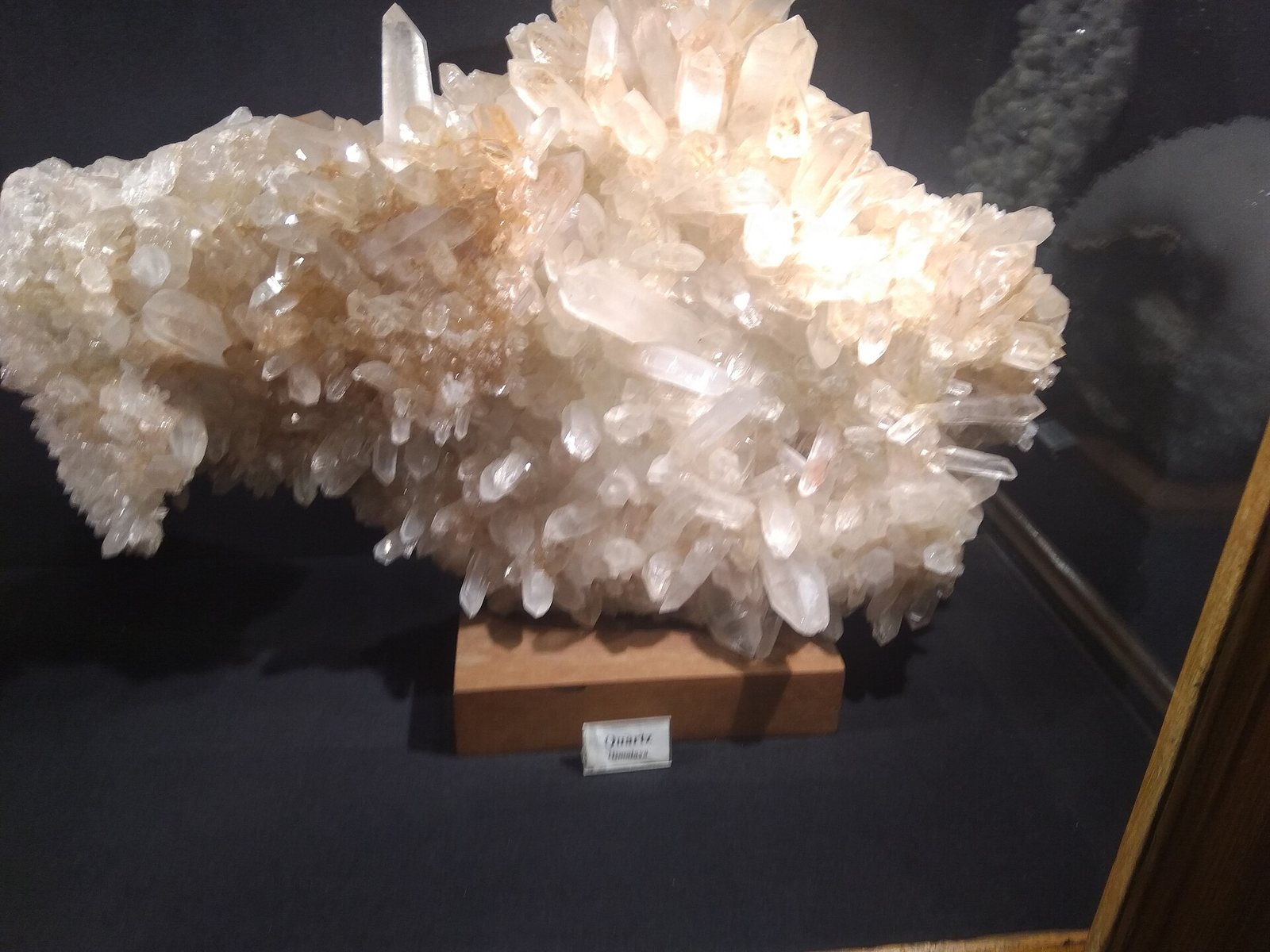
Pick up a piece of granite and look at it closely. You will see at least three different colours glinting back at you: pale grey or white, pink or cream, and tiny black flecks. Each of those colours is a separate substance with its own internal structure, its own chemistry, its own melting point. The grey glassy patches are quartz. The pink or cream patches are feldspar. The black flecks are often a mineral called biotite. The granite itself is not any one of those things — it is a mixture of all of them, and that mixture is what we call a rock.
What makes something a mineral?
A mineral is a naturally occurring solid that formed by geological processes — not by a living thing — and has a definite chemical make-up and an ordered internal arrangement of atoms. That last part is important. The atoms in a mineral stack themselves into a repeating pattern called a crystal structure, and that structure controls almost everything: how hard the mineral is, how it cleaves when you hit it, what colour it appears, how it behaves when heated. Quartz, for instance, is always silicon and oxygen in a fixed ratio, arranged the same way whether the crystal came from Brazil or Norway. Change the ratio or scramble the arrangement and you no longer have quartz.
The word definite chemical make-up does not mean a mineral is always perfectly pure. Small amounts of other elements can slot into the crystal structure as impurities, shifting the colour without changing the fundamental identity. Pure corundum is colourless, but a trace of chromium turns it red — and we call that red variety ruby. The mineral is still corundum; the impurity just redecorated it.
What is a rock, then?
A rock is an aggregate — a physical mixture of one or more minerals (occasionally also including organic material or volcanic glass, which are not minerals by strict definition). Because rocks are mixtures, their composition is variable. Two lumps of granite from the same quarry can have noticeably different proportions of quartz and feldspar. A mineral, by contrast, has a composition that stays within defined limits. This is why geologists need both words: minerals are the ingredients, rocks are the result of those ingredients being pressed, cooked or crystallised together by geological processes over time.
So where does ore fit in?
Ore is an economic idea more than a geological one. An ore is a rock or accumulation of minerals from which a useful substance — usually a metal — can be extracted at a profit under current conditions. The same body of rock can be ore in one decade and not in the next, depending on what the metal is worth, what it costs to dig and process, and what technology is available. This makes ore a moving target in a way that a mineral is not.
To understand why grade matters, consider an illustrative example. Suppose a hypothetical mine is digging rock that contains, on average, five grams of gold for every tonne of rock — a grade of 0.0005%. For every tonne of rock blasted and hauled to the surface, almost all of it is waste material that must be dealt with before the gold can be recovered. The economic question is whether the value of those five grams of gold, after paying for all that work, leaves anything over. If the answer is yes, the rock is ore. If costs rise or the gold price falls enough, the identical rock stops being ore. The geology has not changed; the economics have.
The same principle applies to copper, lithium, nickel and every other metal people mine. Illustratively, if a copper deposit contains a lower grade than a mine can process economically with current technology, it sits in the ground as ordinary rock. When processing technology improves and costs fall, that same rock may cross the line into ore. Historically, ores that would have been considered too lean to bother with in earlier centuries have become the backbone of modern mining as equipment and chemistry have improved.
And a metal?
A metal is what you are usually after. Metals are elements (or sometimes alloys of elements) that conduct electricity, reflect light with a characteristic lustre, and can generally be drawn into wire or hammered into sheets. Iron, aluminium, copper, gold and lithium are all metals, though lithium is so light and reactive it barely seems to behave like one in everyday experience.
Metals rarely sit in the ground in pure, ready-to-use form. Gold is one of the exceptions — it can occur as native metal. Most others are locked inside mineral compounds. Copper, for example, is commonly found in a mineral called chalcopyrite, which is a compound of copper, iron and sulfur. To get usable copper metal you must first find a rock body rich enough in chalcopyrite to count as ore, mine that rock, crush and concentrate the chalcopyrite mineral away from the waste rock, and then smelt and refine it to free the copper. Each of those steps has a name, a cost and a point where things can go wrong.
Why does any of this matter?
The four words — mineral, rock, ore, metal — draw lines around four very different stages in the chain between something in the ground and something in a product. Confusing them leads to confused thinking about where materials come from and how difficult they are to obtain. When someone says a country has large deposits of a certain mineral, that tells you something about geology. Whether those deposits will ever become ore — and eventually refined metal — depends on economics, technology, infrastructure and a great deal of engineering work that the geological fact alone cannot settle.
Where to go next
Readers comfortable with the distinctions above may want to look at how ore grades and tonnages are formally estimated and reported, which involves resource and reserve classification — a system with specific technical meanings that differ significantly from everyday usage of words like deposit or reserve. The article on mineral resource classification in the Foundations track covers this in more detail.