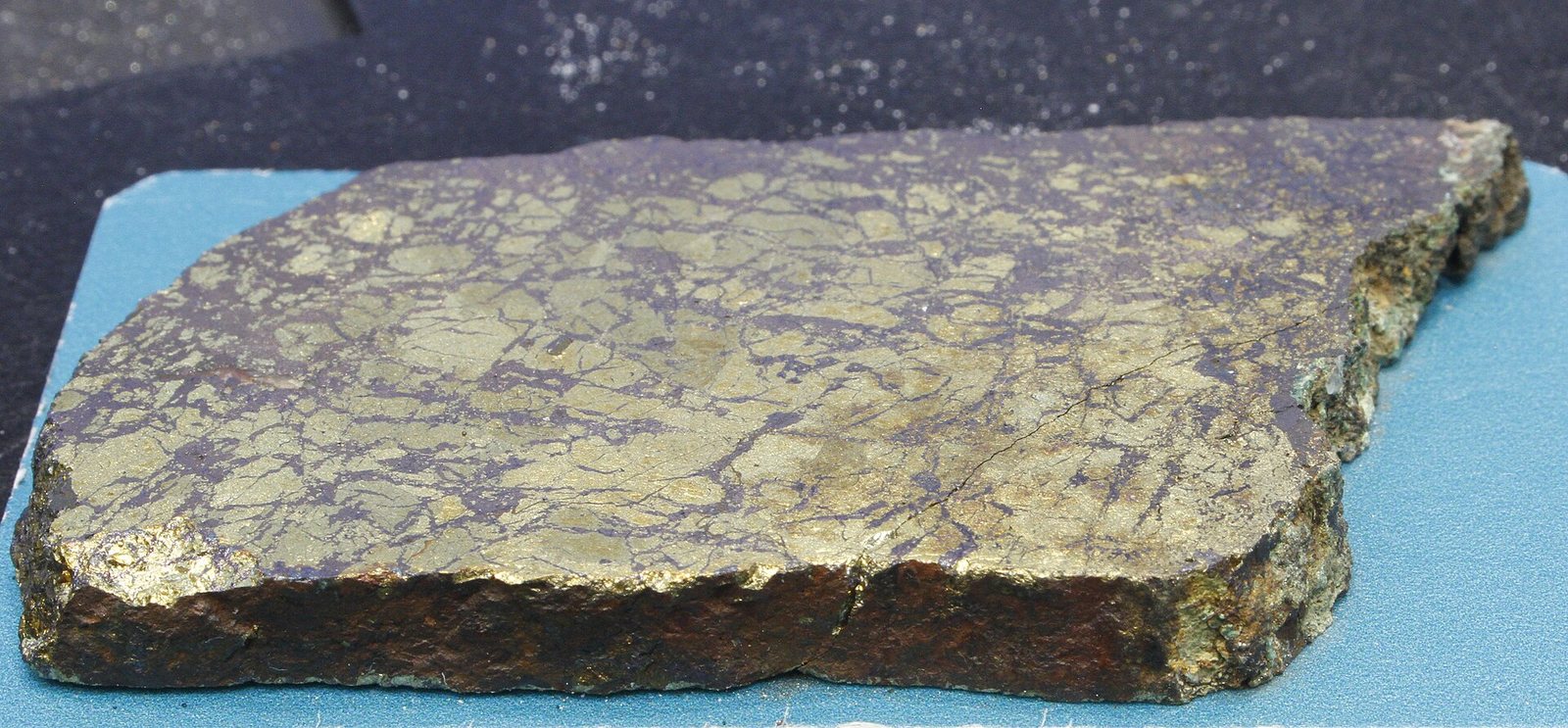
A mountain of rock, a handful of metal
Imagine picking up two lumps of grey rock from the side of a mountain. They look almost the same — same weight, same dull colour, same rough texture. But one of them will end up in a smelter, and the other will sit on the ground forever. The difference has nothing to do with the rock itself and everything to do with numbers: how much metal is locked inside, how hard it is to get out, and what that metal is worth once you have it.
The word ore describes rock or sediment that contains a useful mineral in a large enough quantity, and in a recoverable enough form, that digging it up and processing it makes economic sense. Strip away the jargon and the idea is simple: ore is rock that pays for the effort of mining it. Rock that does not pay is just rock — geologists call it waste.
What decides whether rock becomes ore?
Three things have to line up at the same time.
The first is grade — how much of the valuable mineral is actually present. Grade is usually expressed as a percentage by weight, or for very scarce metals as grams per tonne. A rock with a tiny trace of copper is not necessarily ore; a rock with a much higher concentration might be. The same mineral species can appear in both, so you cannot judge ore by looking at it alone.
The second is recovery — how much of what is in the ground you can actually extract once you have dug it up. Some minerals release their metal easily when crushed and chemically treated. Others grip it tightly. Two rocks with identical grades can behave completely differently in a processing plant, meaning one yields far more usable metal per tonne than the other.
The third is cost versus value. Mining, crushing, and refining all cost money. The metal you end up with has a market price. If the cost of getting the metal out is higher than the price you can sell it for, the rock is not ore — it is a loss. If the price rises, or a cheaper processing method is invented, exactly the same body of rock can suddenly become ore without anyone moving a single stone.
A worked example (illustrative)
Suppose a small deposit contains rock where, on average, every tonne of material holds five kilograms of copper. That is a grade of 0.5%. Now suppose it costs a certain amount to mine, crush, and smelt each tonne, and the copper recovered from that tonne sells for more than that cost. The deposit is ore, and it makes sense to mine it.
Now imagine the same deposit but with the grade halved — say 0.25%, so only 2.5 kilograms of copper per tonne. The processing costs are essentially unchanged, because you still have to handle the same mass of rock. But you get half as much copper out the other end. If that halved revenue no longer covers the costs, the deposit is no longer ore. The rock did not change. The economics did.
This is why ore is not a fixed geological category. It is a moving boundary set by engineering, chemistry, and markets all at once.
The cut-off grade
Mining companies use a number called the cut-off grade to draw that boundary in practice. Any block of rock above the cut-off grade goes to the processing plant; any block below it goes to the waste dump. The cut-off grade is calculated from costs and metal prices, so it shifts over time. When metal prices rise, the cut-off grade falls, because lower-grade material becomes worth treating. When prices fall, the cut-off grade rises, and some blocks that were ore yesterday become waste today.
This is why a mine is not simply a hole in the ground full of ore. It is a constantly renegotiated boundary between rock that pays and rock that does not.
What about the type of mineral, not just the amount?
Grade and cost are not the whole story. The form the metal takes inside the rock matters too. Copper, for example, can appear as a pure native metal, or locked inside sulfide minerals, or combined with oxygen in oxide minerals. Each form responds differently to the same processing methods. A processing plant designed for sulfide ore may extract very little copper from oxide ore of the same grade — and vice versa. So two samples with identical copper content can have very different values depending on what compound the copper is sitting in.
This is part of why geologists do not just measure how much metal is present. They also study the mineralogy — the actual minerals present and how they are intergrown with the surrounding rock — because that determines what processing route will work, and therefore what the real recovery will be.
Ore is a human judgement, not a natural fact
It is worth pausing on something that surprises many people when they first encounter it: a geologist does not go into the field and find ore the way you might find a fossil. They measure concentrations, map mineralogy, collect cost data, and then apply a cut-off. The boundary between ore and waste is drawn by people, using economics, not by nature.
This means the same mountain can be described differently by two different companies with different costs, different processing technologies, or operating in different countries with different energy prices. There is no single correct answer to the question of where an ore body begins and ends.
Where to go next
Readers who want to go further will find that the concepts here — grade, recovery, cut-off — connect directly to the formal language of mineral resources and mineral reserves, which are the classified categories used in financial reporting to describe how confident a company is in its ore estimates. Those categories, and the reporting codes that govern them, are the subject of the next article in this track.