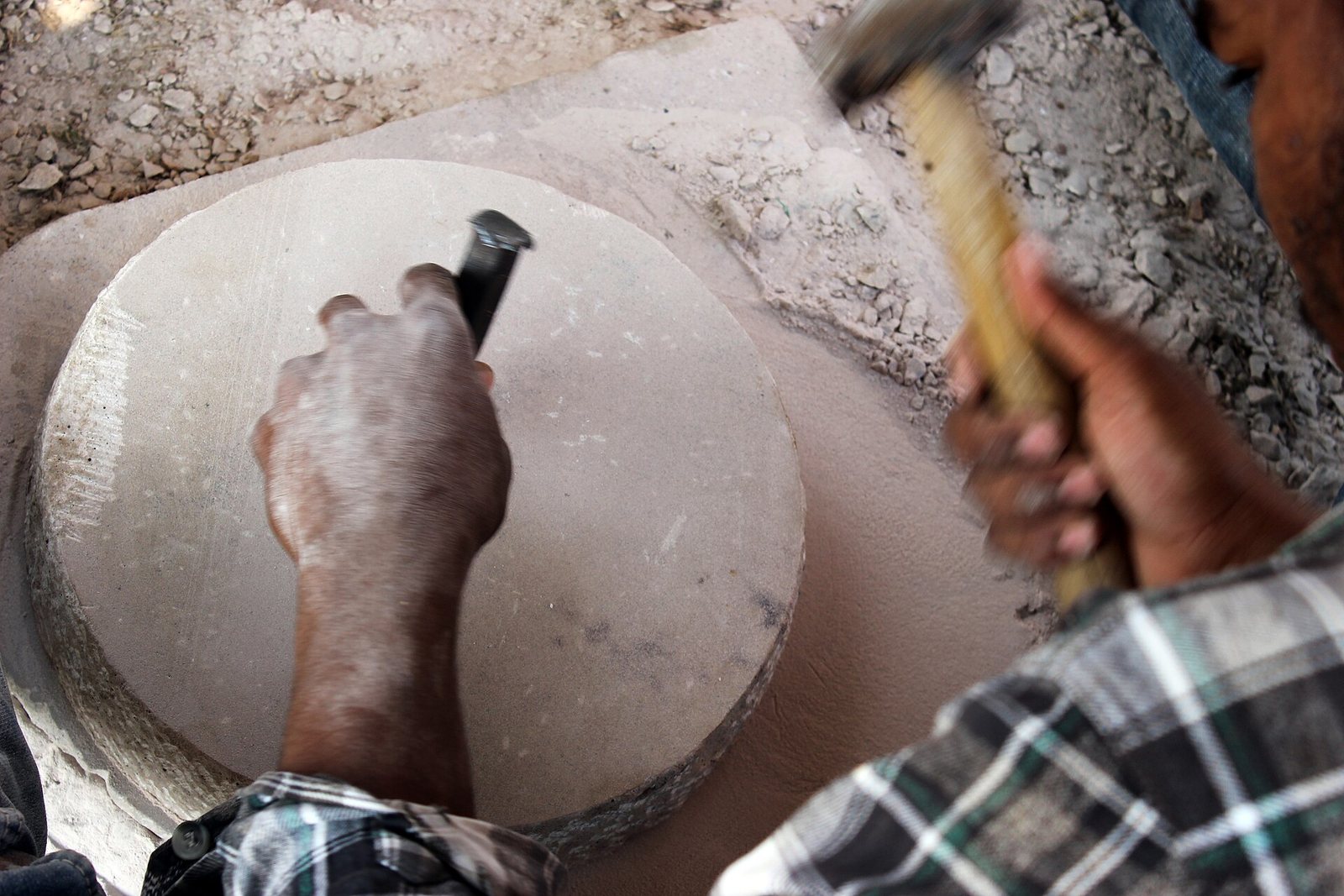
これは何か
Man-made grit — silicon carbide and fused alumina — harder than almost every natural mineral, used to cut and grind everything else.
なぜ重要なのか
Silicon carbide is also a power semiconductor: the same compound that grinds steel now switches the current in an electric car's inverter.
Where it is in the Earth
Silicon carbide and fused aluminium oxide — the two workhorses of the synthetic abrasives industry — do not occur in nature in usable quantities. This is the first thing that separates them from most minerals on this site: there is no orebody to discover, no geological formation to map. Both materials are manufactured from raw feedstocks that do exist in nature, and understanding the supply chain means understanding those feedstocks rather than hunting for veins of the finished compound.
Silicon carbide is made by reacting silica — essentially high-purity quartz sand — with carbon, typically in the form of petroleum coke or coal. Quartz is one of the most abundant minerals in the Earth's crust, forming by crystallisation from silica-rich magmas and hydrothermal fluids, and occurring in enormous beds of quartzite and sandstone on every continent. The constraint is not finding quartz but finding quartz pure enough: iron, aluminium, and other trace elements interfere with the reaction and with the electrical properties of the resulting carbide. Petroleum coke, the carbon source, is a by-product of oil refining, so its availability is tied to the refining industry rather than to any geological deposit of its own.
Fused aluminium oxide is made by melting bauxite — the principal aluminium ore, a mixture of aluminium hydroxide minerals that forms by intense tropical weathering of aluminous rocks. Where rainfall is high and drainage is good over millions of years, silica and other elements leach away, leaving behind a residue enriched in aluminium. The distribution of bauxite deposits therefore follows ancient tropical weathering belts across Africa, the Caribbean, South America, and parts of Asia and Australia. The quality of fused alumina depends on the chemistry of the starting bauxite, particularly its iron and titanium content, which is why some bauxite sources are preferred for abrasive production while others go primarily to the aluminium smelting industry.
Getting it out
Because both major synthetic abrasives are manufactured rather than mined directly, the extraction stage looks different from most industrial minerals. What is being mined are the feedstocks: silica sand and quartzite for silicon carbide, and bauxite for fused aluminium oxide. Silica operations are typically open-pit or open-cast quarries, working relatively flat-lying sedimentary beds or massive quartzite outcrops. The overburden — the rock and soil sitting above the useful material — is stripped away by excavators and trucks, and the silica beneath is blasted or ripped loose, then loaded for transport. Because quartz is so abundant, individual deposits tend to be large and the ratio of waste removed to product shipped is modest compared with metallic ore mines, though it varies considerably with local geology.
Bauxite mining is similarly dominated by open-pit methods, often in relatively shallow deposits close to the surface in tropical and subtropical regions. The weathered bauxite layer can sometimes be scraped with bulldozers rather than blasted, since the material is soft. Grade in this context refers primarily to the aluminium oxide content of the bauxite and the levels of reactive silica, iron, and titanium, which determine how suitable it is for a given end use. Higher reactive silica, for instance, increases processing costs substantially. Large volumes of overburden and the bauxite layer itself must be moved, and land rehabilitation after mining is a significant part of operating costs and permitting requirements in most producing countries.
Petroleum coke, the carbon source for silicon carbide production, arrives at the manufacturing plant as a by-product of crude oil refining and is not mined at all in the conventional sense. Its supply therefore depends on the throughput and configuration of refineries, and shifts in refinery operations — including the long-term pressure to reduce heavy fuel oil output — affect how much petroleum coke is available and at what specification. This makes the carbon supply side of silicon carbide production somewhat decoupled from geology and more dependent on the economics of petroleum refining.
What pulls on it
The largest traditional use of silicon carbide and fused aluminium oxide is in abrasive applications: cutting wheels, grinding wheels, coated abrasives such as sandpaper, and loose grain for lapping and polishing. These applications span almost every manufacturing industry — metalworking, automotive parts production, construction materials, optical glass, and electronics — and their aggregate demand therefore tracks broad industrial activity. Fused aluminium oxide tends to dominate the grinding of steels and other tough metals, while silicon carbide is better suited to hard, brittle materials such as ceramics, glass, and cast iron, and to non-ferrous metals. This is because the two abrasives differ in their hardness, crystal structure, and the way their edges break during use, a property called friability.
The more rapidly growing demand for silicon carbide is in power semiconductors. Silicon carbide can operate at higher voltages, higher temperatures, and higher switching frequencies than conventional silicon, and these properties make it attractive for the power inverters used in electric vehicles, industrial motor drives, solar inverters, and charging infrastructure. A power device is not made from crushed abrasive grain but from a single-crystal wafer of very high purity, representing a distinct product and a distinct part of the market. The transition from silicon to silicon carbide in power electronics has accelerated the growth of wafer demand considerably, even as abrasive demand grows more slowly in line with general manufacturing output.
A sharp contraction in demand would most plausibly follow either a prolonged slowdown in global manufacturing — reducing abrasive consumption — or a technological shift in power electronics away from silicon carbide toward gallium nitride or other wide-bandgap semiconductors for certain applications. Neither of those conditions is present today, but the semiconductor market in particular is sensitive to changes in electric vehicle adoption rates, since that application has become a significant driver of wafer demand growth.
Turning ore into product レベル 3
The conversion of raw feedstocks into abrasive-grade silicon carbide is an energy-intensive electrochemical process known as the Acheson process, named for the American inventor who developed it in the 1890s. A mixture of silica and petroleum coke is packed around a graphite core electrode in a large open furnace. Electrical current passed through the core generates temperatures well above two thousand degrees Celsius at the centre, at which point silica and carbon react to form silicon carbide and carbon monoxide gas. The reaction proceeds outward from the core over several days, and when the furnace is cooled and dismantled, the resulting mass contains a gradient of product quality: a pure green or black crystalline core of silicon carbide grading outward into incompletely reacted material. The core is crushed and the unreacted outer material is recycled back into the furnace charge. Recovery of usable abrasive grain from the furnace mass is therefore a sorting and comminution problem as much as a chemical one.
After crushing, the crude silicon carbide grain is milled, classified by size through screening and air classification, and treated to remove metallic impurities — typically by acid washing, a wet chemical step that dissolves iron and other contaminants. The sized and purified grain is then sold as abrasive grit directly, or further processed into bonded abrasive products such as grinding wheels, where the grain is mixed with vitrified or resin bond material and fired or cured to shape. Losses occur at each stage: fines generated during crushing that are too small for most abrasive uses, off-specification material rejected at classification, and acid-washing residues. The cost structure is dominated by electricity for the Acheson furnace, the cost of petroleum coke, and the capital intensity of the furnaces themselves.
Semiconductor-grade silicon carbide wafers occupy a different part of the processing chain entirely. Here the starting material is not crushed abrasive grain but high-purity silicon carbide powder, which is used to grow large single crystals by a physical vapour transport method. The crystal is then sliced into wafers, which undergo multiple grinding and polishing steps — using, in an irony of the supply chain, abrasive slurries — to achieve the surface quality required for semiconductor device fabrication. The yield of usable wafers from a single crystal boule is limited by defect density within the crystal, and improving that yield is a central technical challenge for producers. Fused aluminium oxide production follows a broadly analogous arc: electric arc furnace melting of bauxite, cooling, crushing, and classification, with the key quality variables being hardness, toughness, and friability of the resulting grain.
Substitution and recycling レベル 3
Within abrasive applications, silicon carbide and fused aluminium oxide compete with each other and with several other materials. Cubic boron nitride, which is synthesised under high pressure and temperature, is harder than both and is used for grinding hardened steels where conventional abrasives wear too quickly, though its cost is substantially higher. Diamond abrasives — both natural and synthetic — are harder still and are used for the most demanding applications, including cutting stone, concrete, and advanced ceramics. The performance penalty for using a cheaper abrasive is primarily one of grinding efficiency and wheel life: a lower-grade abrasive removes material more slowly and wears faster, increasing cycle times and the frequency of wheel changes. Manufacturers therefore choose among abrasives on a cost-per-part basis rather than on material cost alone, which means substitution is a continuous economic calculation rather than a discrete switch.
Recycling of abrasive grain is limited in practice. Once abrasive grain has been used in a bonded wheel or coated product and worn down, the fragments are too small and too contaminated with workpiece material to reclaim economically for further abrasive use. Spent grain from loose-grain lapping operations is occasionally recovered and reprocessed, but the volumes are small relative to primary production. The situation is different for refractory applications of silicon carbide, where material from demolished kiln linings is sometimes reclaimed and reprocessed, though purity requirements restrict where reclaimed material can be used. In the semiconductor wafer context, the polishing slurries containing silicon carbide or diamond abrasive that are used in chip fabrication are subject to increasing recirculation and recovery efforts, driven partly by cost and partly by the challenge of disposing of spent slurry, but this represents a small fraction of overall abrasive consumption. The absence of a meaningful recycling loop means demand is almost entirely met by primary production.
価格
average unit value of imports, dollars per metric ton: Silicon carbide, crude
年間平均dollars per metric ton
基準: average unit value of imports, dollars per metric ton: Silicon carbide, crude. 以下に公表された年間平均値: USGS Mineral Commodity Summaries 2026 · 出典 ↗. これらは参照用の年間平均値であり、リアルタイムの市況相場ではない。
average unit value of imports, dollars per metric ton: Metallic abrasives
年間平均dollars per metric ton
基準: average unit value of imports, dollars per metric ton: Metallic abrasives. 以下に公表された年間平均値: USGS Mineral Commodity Summaries 2026 · 出典 ↗. これらは参照用の年間平均値であり、リアルタイムの市況相場ではない。
average unit value of imports, dollars per metric ton: Fused aluminum oxide, crude
年間平均dollars per metric ton
基準: average unit value of imports, dollars per metric ton: Fused aluminum oxide, crude. 以下に公表された年間平均値: USGS Mineral Commodity Summaries 2026 · 出典 ↗. これらは参照用の年間平均値であり、リアルタイムの市況相場ではない。
average unit value of imports, dollars per metric ton: Fused aluminum oxide, ground and refined
年間平均dollars per metric ton
基準: average unit value of imports, dollars per metric ton: Fused aluminum oxide, ground and refined. 以下に公表された年間平均値: USGS Mineral Commodity Summaries 2026 · 出典 ↗. これらは参照用の年間平均値であり、リアルタイムの市況相場ではない。
用途
全エンドマーケット →| 最終市場 | そこでの機能 | 重要度 |
|---|---|---|
| Semiconductors | Silicon carbide power devices and wafer polishing | 重要 |