O que é?
Almost one percent of the air you are breathing, and the cheapest way to keep oxygen away from hot metal.
Por que razão é importante?
Argon shielding is what makes modern welding, silicon crystal growth and titanium melting possible at all.
Where it is in the Earth
Argon is not a mineral and it does not form deposits in rock. It is a noble gas — meaning its outer electron shell is completely full, which makes it chemically inert: it does not bond with other elements under any ordinary conditions. Almost all of the argon available to industry comes from the atmosphere, where it makes up just under one percent of every breath of air. That concentration is the result of billions of years of radioactive decay inside the Earth. The isotope potassium-40, present in rocks throughout the crust and mantle, decays slowly into argon-40, which seeps upward through the rock and accumulates in the atmosphere because it is too heavy to escape into space and too unreactive to be locked away in minerals.
Because argon is genuinely everywhere in the atmosphere at a consistent concentration, the concept of a deposit or a reserve does not apply to it the way it does to lithium or copper. There is no grade to measure, no ore body to map, and no geological survey that could meaningfully say one country is richer in argon than another. The atmosphere is shared and essentially inexhaustible on any human timescale. What determines how much argon a country can access is not geology but industrial infrastructure: specifically, how much large-scale air separation capacity has been built.
Getting it out
Argon is not mined. It is recovered as a co-product — the industry term is by-product — during the separation of air into its component gases. Air separation is an industrial process, not an extractive one, and the raw material is simply the atmosphere drawn in through large compressors at a plant. Because the starting material is free and ubiquitous, there is no waste rock, no tailings, and no stripping ratio of the kind that governs a conventional mine. The economic logic is entirely different: the cost is the energy needed to compress, cool and distil the air, not the cost of finding or accessing a resource.
The practical implication is that argon production is tied directly to the production of oxygen and nitrogen. Air separation units are built primarily to supply oxygen — for steelmaking, glassmaking, hospital use and many other applications — and nitrogen, which is used in food packaging, electronics manufacturing and chemical processes. Argon emerges from the same distillation columns as a secondary stream. If demand for oxygen and nitrogen supports the construction and operation of a separation unit, argon becomes available almost automatically. Conversely, argon cannot easily be produced on its own; a plant built solely for argon would have no economic basis.
What pulls on it
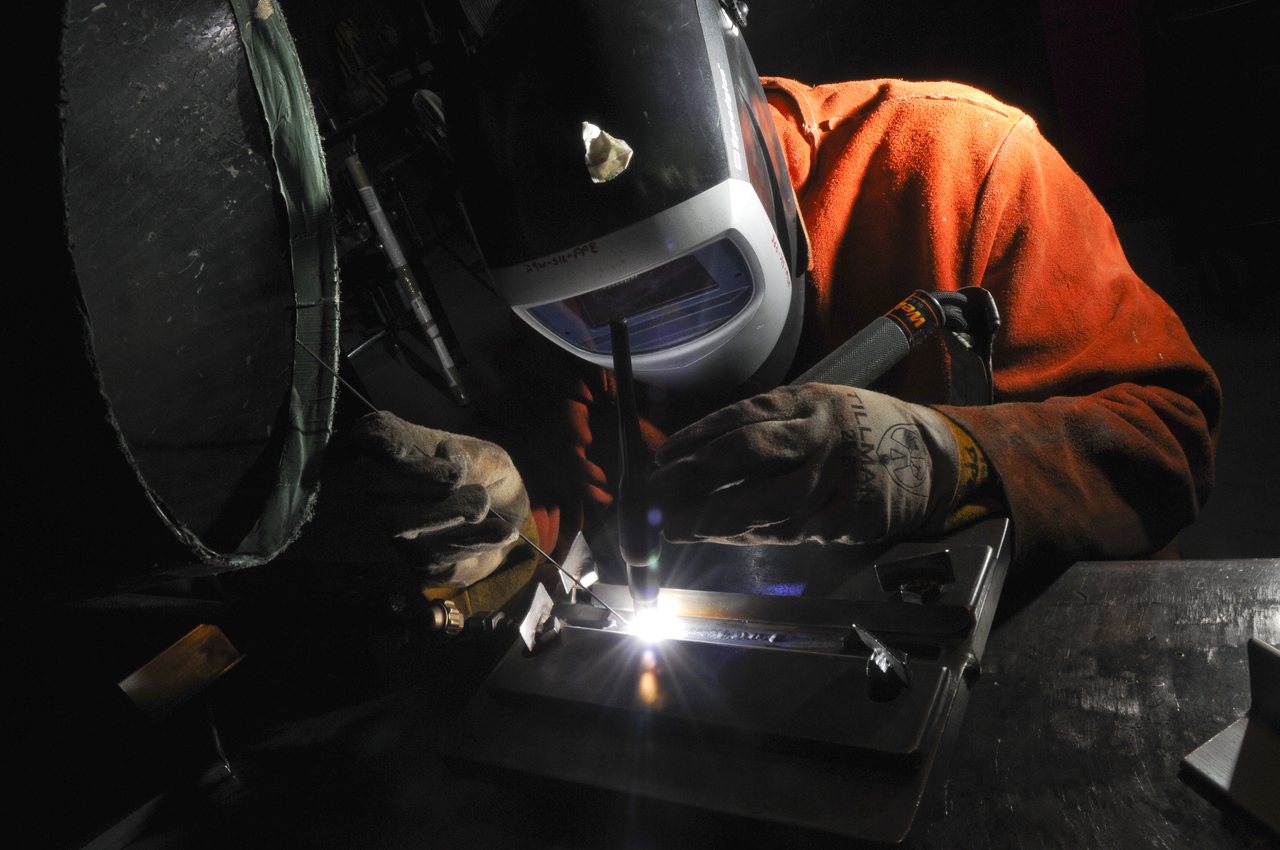
The largest single use of argon is as a shielding gas in welding. When a metal is heated to welding temperature, it becomes highly reactive with oxygen and nitrogen in the surrounding air, and the resulting oxides and nitrides weaken the joint. Flowing argon around the weld arc displaces the air and prevents this contamination. Argon is preferred over other shielding gases in many applications because its inertness is absolute — unlike carbon dioxide, which is cheaper but does react slightly with the weld pool at high temperatures. The quality of the weld, and therefore the mechanical properties of the finished structure, depends directly on the purity of the shielding atmosphere.
A second major area of demand is the semiconductor and electronics industry. Silicon crystals for computer chips are grown from molten silicon inside furnaces flooded with argon. The argon atmosphere prevents the silicon melt from reacting with anything in the furnace environment, which would introduce impurities into the crystal and ruin the electrical properties of the chips cut from it. As chip manufacturing has moved toward ever smaller feature sizes, the tolerances on crystal purity have tightened, and the quality requirements placed on the argon supply have increased alongside them. Flat-panel display glass production and certain thin-film deposition processes also consume argon for the same reason: a controlled inert atmosphere.
Argon also appears in lighting, where it fills incandescent and fluorescent lamps to suppress evaporation of the filament or electrode material; in the production of reactive metals such as titanium, where any contact with air during melting would cause immediate oxidation; and in specialised analytical instruments. Demand would change sharply downward if arc welding were displaced by joining methods that do not require atmospheric control, but that is a slow-moving structural question rather than an immediate prospect. On the growth side, expansion of semiconductor fabrication capacity is the clearest driver, because each new large fab requires substantial, continuous argon supply.