这是什么?
Almost one percent of the air you are breathing, and the cheapest way to keep oxygen away from hot metal.
为何重要?
Argon shielding is what makes modern welding, silicon crystal growth and titanium melting possible at all.
Where it is in the Earth
Argon is not a mineral and it does not form deposits in rock. It is a noble gas — meaning its outer electron shell is completely full, which makes it chemically inert: it does not bond with other elements under any ordinary conditions. Almost all of the argon available to industry comes from the atmosphere, where it makes up just under one percent of every breath of air. That concentration is the result of billions of years of radioactive decay inside the Earth. The isotope potassium-40, present in rocks throughout the crust and mantle, decays slowly into argon-40, which seeps upward through the rock and accumulates in the atmosphere because it is too heavy to escape into space and too unreactive to be locked away in minerals.
Because argon is genuinely everywhere in the atmosphere at a consistent concentration, the concept of a deposit or a reserve does not apply to it the way it does to lithium or copper. There is no grade to measure, no ore body to map, and no geological survey that could meaningfully say one country is richer in argon than another. The atmosphere is shared and essentially inexhaustible on any human timescale. What determines how much argon a country can access is not geology but industrial infrastructure: specifically, how much large-scale air separation capacity has been built.
Getting it out
Argon is not mined. It is recovered as a co-product — the industry term is by-product — during the separation of air into its component gases. Air separation is an industrial process, not an extractive one, and the raw material is simply the atmosphere drawn in through large compressors at a plant. Because the starting material is free and ubiquitous, there is no waste rock, no tailings, and no stripping ratio of the kind that governs a conventional mine. The economic logic is entirely different: the cost is the energy needed to compress, cool and distil the air, not the cost of finding or accessing a resource.
The practical implication is that argon production is tied directly to the production of oxygen and nitrogen. Air separation units are built primarily to supply oxygen — for steelmaking, glassmaking, hospital use and many other applications — and nitrogen, which is used in food packaging, electronics manufacturing and chemical processes. Argon emerges from the same distillation columns as a secondary stream. If demand for oxygen and nitrogen supports the construction and operation of a separation unit, argon becomes available almost automatically. Conversely, argon cannot easily be produced on its own; a plant built solely for argon would have no economic basis.
What pulls on it
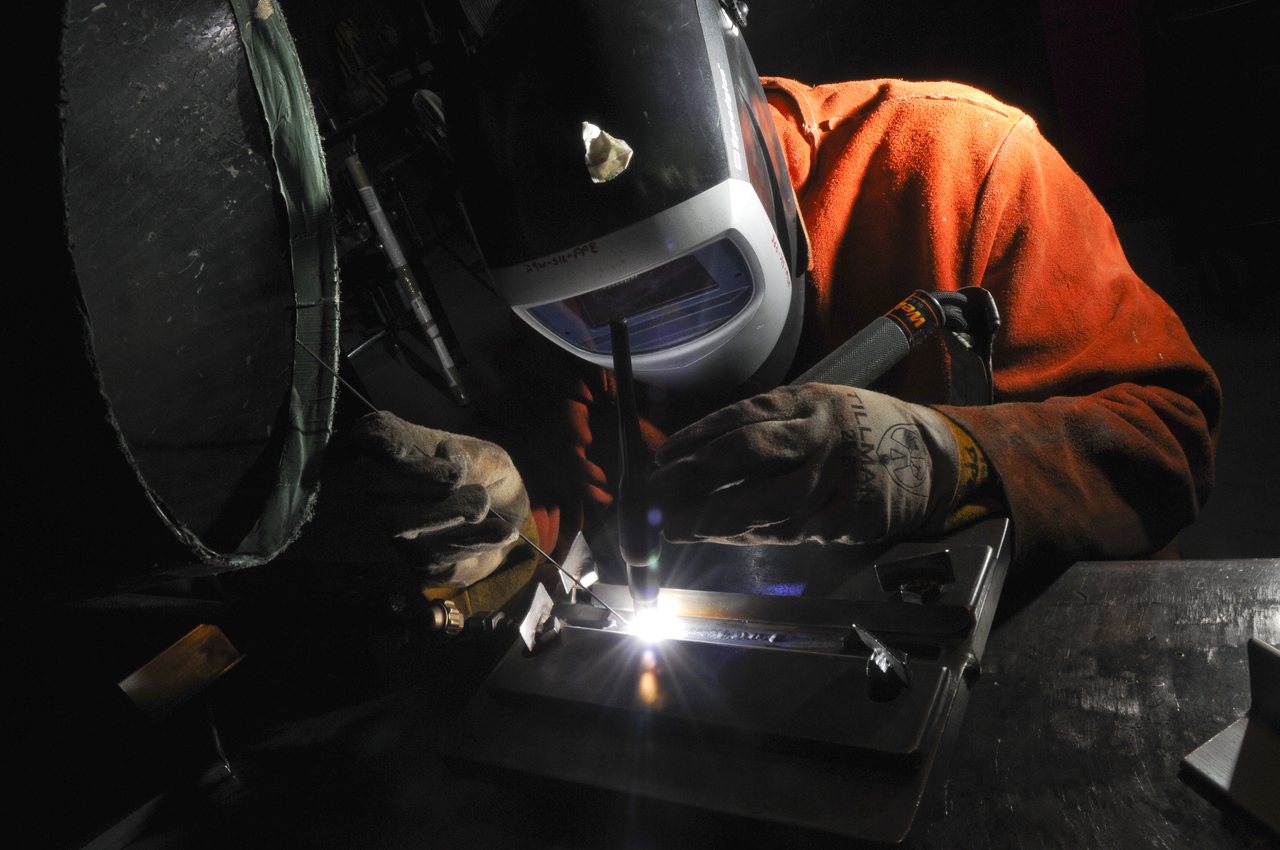
The largest single use of argon is as a shielding gas in welding. When a metal is heated to welding temperature, it becomes highly reactive with oxygen and nitrogen in the surrounding air, and the resulting oxides and nitrides weaken the joint. Flowing argon around the weld arc displaces the air and prevents this contamination. Argon is preferred over other shielding gases in many applications because its inertness is absolute — unlike carbon dioxide, which is cheaper but does react slightly with the weld pool at high temperatures. The quality of the weld, and therefore the mechanical properties of the finished structure, depends directly on the purity of the shielding atmosphere.
A second major area of demand is the semiconductor and electronics industry. Silicon crystals for computer chips are grown from molten silicon inside furnaces flooded with argon. The argon atmosphere prevents the silicon melt from reacting with anything in the furnace environment, which would introduce impurities into the crystal and ruin the electrical properties of the chips cut from it. As chip manufacturing has moved toward ever smaller feature sizes, the tolerances on crystal purity have tightened, and the quality requirements placed on the argon supply have increased alongside them. Flat-panel display glass production and certain thin-film deposition processes also consume argon for the same reason: a controlled inert atmosphere.
Argon also appears in lighting, where it fills incandescent and fluorescent lamps to suppress evaporation of the filament or electrode material; in the production of reactive metals such as titanium, where any contact with air during melting would cause immediate oxidation; and in specialised analytical instruments. Demand would change sharply downward if arc welding were displaced by joining methods that do not require atmospheric control, but that is a slow-moving structural question rather than an immediate prospect. On the growth side, expansion of semiconductor fabrication capacity is the clearest driver, because each new large fab requires substantial, continuous argon supply.
Turning ore into product 级别 3
Air separation works by exploiting the small differences in boiling point between the gases that make up air. The incoming air is filtered, compressed and then cooled progressively until it liquefies. The liquid mixture is fed into a distillation column — essentially the same physical principle as a whisky still, but operating at temperatures around the boiling point of argon, which is minus 185.9 degrees Celsius. Oxygen, nitrogen and argon each vaporise at slightly different temperatures, so they separate into distinct fractions as the liquid flows down the column and vapour rises through it. Nitrogen, with the lowest boiling point, exits at the top; oxygen, with the highest, collects at the bottom; argon, intermediate between the two, is drawn off as a side stream.
The crude argon stream recovered at this stage still contains residual oxygen and nitrogen, and must be purified further. The oxygen is removed first, typically by catalytic reaction with hydrogen, which converts the oxygen to water that can then be condensed and drained away. The remaining nitrogen and traces of other impurities are removed by a second, smaller distillation column. The result is argon at purities appropriate for most industrial uses. For semiconductor and specialty applications where contamination at the parts-per-billion level matters, additional purification steps using getters — materials that chemically absorb remaining impurities — bring the product to higher specification. The losses in the process occur mainly at the crude argon stage: not all of the argon present in the incoming air is recovered, and the recovery rate is a key efficiency parameter for plant operators balancing energy input against yield.
The finished product leaves the plant either as compressed gas in cylinders, or as liquid argon in vacuum-insulated tanks for bulk delivery. Liquid argon has a density far greater than the gas at atmospheric pressure, so liquid transport is used wherever volumes are large enough to justify the insulated equipment. The choice between gas and liquid supply is largely one of customer volume and geography rather than a difference in specification.
Substitution and recycling 级别 3
For welding, the practical alternatives to pure argon are mixtures of argon with carbon dioxide or oxygen, and, for some applications, pure carbon dioxide or helium. Argon-rich mixtures are common because they retain most of the arc stability and weld quality of pure argon at lower cost. Pure carbon dioxide is cheaper and is used extensively for welding mild steel, but it produces a more turbulent arc and more spatter, and cannot be used where surface finish or metallurgical sensitivity matters. Helium offers better heat transfer and is sometimes blended with argon for welding aluminium or thick sections, but helium is more expensive and its supply is subject to its own separate set of constraints. The substitution possibilities exist, therefore, but each involves a trade-off in process control or cost that limits how far the substitution actually goes in practice.
In semiconductor crystal growth there is no practical substitute. The combination of complete chemical inertness, availability in very high purity, and acceptable cost makes argon the only realistic choice for that application. Nitrogen is inert enough for many industrial purposes but reacts with silicon at elevated temperatures, which rules it out for crystal growth furnaces. For the most demanding analytical and research uses, helium is sometimes preferred because of its different physical properties, but again the cost differential is significant. Recycling of argon is practised at large semiconductor facilities, where the gas exhausted from furnaces is collected, repurified and returned to the process. This recycle loop reduces consumption per unit of product and is economically sensible at the scale of a major fab, but it depends on capture infrastructure that smaller users cannot justify. Outside the semiconductor sector, argon is generally not recycled: welding exhaust and lamp fill gas are released to atmosphere, where the argon simply rejoins the one percent it came from.
Where the chain is fragile 级别 4
The supply risk picture for argon is unusual compared with most industrial materials because the geological scarcity argument does not apply. The atmosphere contains more argon than industry could consume over any foreseeable period. The fragility in the chain lies elsewhere. Because argon is only produced as a by-product of oxygen and nitrogen separation, its supply is structurally dependent on the economics of those primary gases. If a steelworks shuts down and its associated air separation unit is idled, the local argon supply disappears regardless of demand for argon itself. This coupling means argon supply can tighten in a region not because of any shortage in the raw material but because the industrial infrastructure producing the primary gases has changed. The statistical consequence is visible in how production figures are reported: because argon is not the driver of plant investment decisions, output data are often incomplete, and the figures shown in the production table should be understood as partial rather than comprehensive counts of actual volumes separated worldwide.
Geographic concentration of supply is a secondary risk. Air separation units large enough to produce argon economically tend to cluster near the heavy industries — steel, chemicals, glass — that consume the oxygen they co-produce. Regions without substantial heavy industry have fewer separation units and therefore thinner argon supply, which increases dependence on long-distance transport of liquid argon. Liquid argon transport is energy-intensive and requires specialised cryogenic equipment, so supply chains to remote or industrial-light regions are less redundant than those serving major industrial centres. The semiconductor industry's sensitivity to argon purity adds a further layer: not all argon production reaches the specification required for crystal growth, and the purification capacity needed to upgrade standard-grade argon to electronic grade is not uniformly distributed. A sudden surge in fab construction in a region where electronic-grade purification capacity is limited creates a genuine bottleneck that cannot be resolved simply by pointing to ample atmospheric argon above the same geography.
Published figures on argon production carry meaningful uncertainty for reasons that are worth being explicit about. Air separation operators report argon output inconsistently across jurisdictions: some report only marketed volumes, others include internal consumption, and some do not report at all because argon is considered a secondary output of no separate regulatory interest. Where a national figure appears to be missing or withheld in the data accompanying this entry, the absence reflects reporting practice rather than a genuine zero. Researchers working from multiple primary sources will commonly find that aggregated national totals differ between the major compilers, and that the discrepancies are largest for countries where the industry is fragmented among many smaller operators rather than dominated by the large multinational industrial gas companies whose reporting is more systematic.