Qu'est-ce que c'est ?
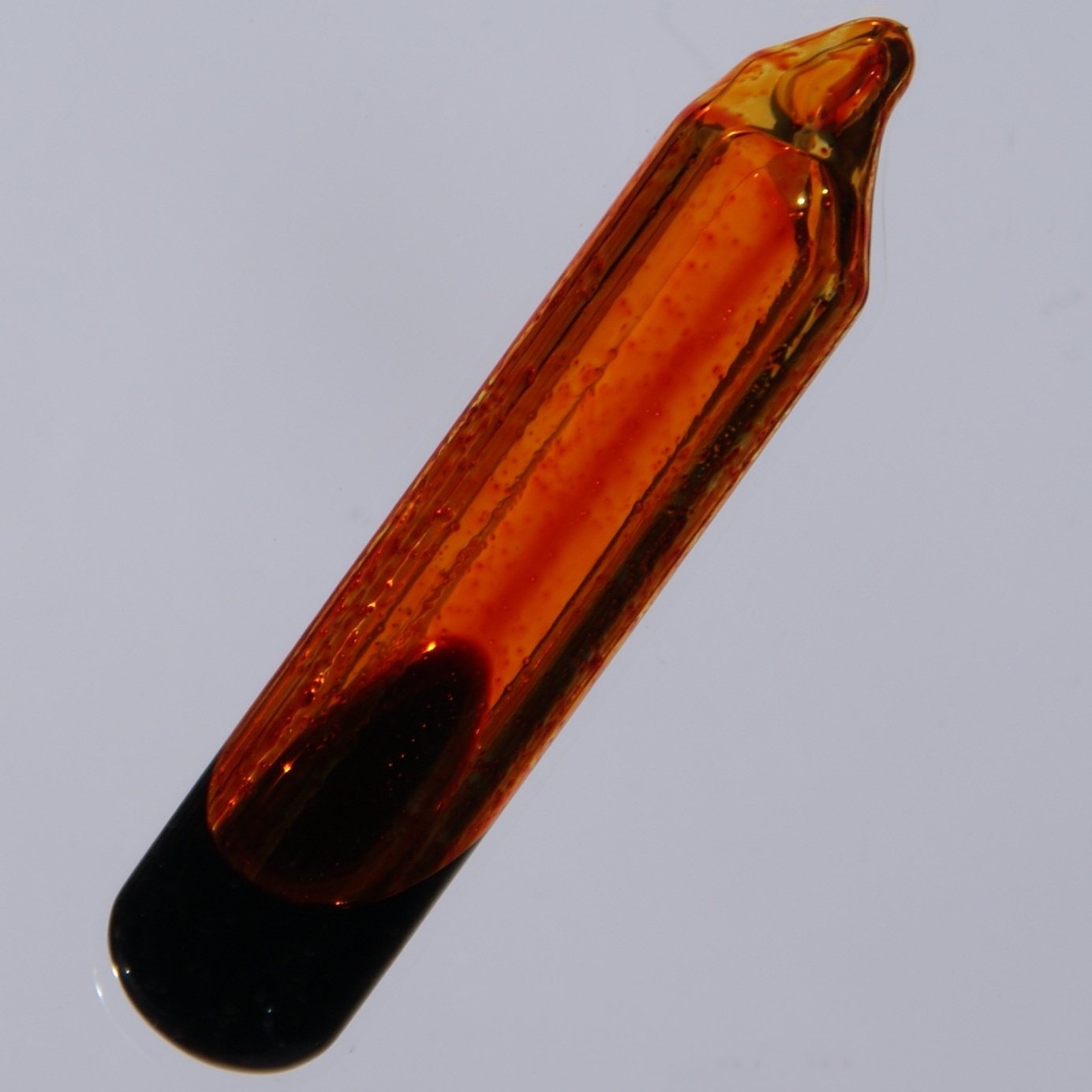
The only non-metal that is liquid at room temperature, pulled out of very salty water.
Pourquoi est-ce important ?
Brominated flame retardants slow fires in electronics and furniture; bromine also goes into drilling fluids and into some grid-battery chemistries.
Where it is in the Earth
Bromine does not concentrate in solid rock the way most metals do. It is a halogen — a family of reactive non-metals that includes chlorine and fluorine — and it behaves chemically much like chlorine, readily dissolving in water as the bromide ion. Over geological time, bromine that was dispersed through ordinary seawater became concentrated wherever seawater was trapped and then evaporated. As a body of seawater shrinks, salts crystallise out in a predictable sequence: calcium carbonate first, then gypsum, then common salt (halite), and finally, because bromide stays in solution longer than chloride, the residual brine grows progressively richer in bromine. The thick salt sequences left behind by ancient dried-up seas — called evaporite basins — are therefore the primary source of the world's bromine, either locked into halite beds underground or still dissolved in the brines that saturate those beds.
The geography of production follows directly from this. The Dead Sea basin, shared by Israel and Jordan, sits in one of the world's most extreme natural evaporation environments and is fed by a catchment that has concentrated salts over millions of years; the Dead Sea brine contains bromine at levels vastly higher than ordinary seawater. China's production comes from saline lakes and underground brines in its interior basins, formed by similar evaporative processes in enclosed continental depressions. Japan extracts bromine from deep formation waters — brines trapped in sedimentary rock — that were concentrated by geological processes over a long period. The United States holds large declared reserves, principally in Arkansas, where Pennsylvanian-age evaporite brines lie beneath the surface, though current U.S. output is withheld from public reporting.
What matters practically is that bromine's geology is almost entirely a story of water chemistry rather than hard-rock mineralogy. There are no distinct bromine ore minerals in the conventional sense — the ore mineral table for bromine is empty precisely because bromine is won from brine, not from a crystalline solid. The "grade" of a deposit is the concentration of bromide in the brine, and the richness of the Dead Sea brine is the main reason Israel and Jordan together account for the large majority of world output.
Getting it out
Because bromine occurs in brine rather than solid rock, the extraction method is closer to water pumping than to conventional mining. Wells are drilled into the brine-bearing formation or, in the Dead Sea case, the lake itself is the source. Brine is pumped to the surface, sometimes after solar evaporation ponds have raised its concentration further, and then piped directly to a chemical plant. There is no blasting, no crushing, and effectively no solid waste in the sense that hard-rock mining produces waste rock or tailings. The energy cost of pumping and the capital cost of wells and pipelines are the main physical constraints on how much brine a producer can move.
In the Dead Sea operations, the southern basin is managed as a series of large evaporation pans where brine is allowed to concentrate before being collected. This solar concentration step reduces the volume of liquid that must be processed chemically, which matters because the subsequent treatment steps consume energy and reagents. For underground formation brines — as in Arkansas or Japan — the approach is more purely extractive: injection of water may be used to keep the formation pressure high enough to sustain flow, though the specifics of those operations are not detailed in publicly available data for every site. The grade of brine that is economic to process depends on the cost of the downstream chemistry; richer brines need less concentration work before treatment, which shifts the economics considerably.
What pulls on it
The largest single use for bromine has historically been in brominated flame retardants — compounds added to plastics, circuit boards, and upholstered furniture to slow ignition and reduce flame spread. When a material containing these compounds is exposed to heat, bromine-containing gases are released that interrupt the chemical chain reactions sustaining a flame. Electronics manufacturing is the dominant outlet here: printed circuit boards, connectors, and housings all rely on flame retardant treatments to meet international safety standards. The volume of bromine going into this use is sensitive to electronics production rates globally, and to regulatory decisions about which specific brominated compounds are acceptable, since some have faced restrictions on environmental or health grounds in certain jurisdictions.
A second substantial demand stream is drilling fluids. Dense bromide solutions — particularly zinc bromide and calcium bromide brines — are used in oil and gas well completion to control pressure in the wellbore without allowing solid particles to damage the reservoir. This use is tightly coupled to the rate of drilling activity, particularly for high-pressure, high-temperature wells where the density advantage of bromide brines over alternatives is most pronounced. A third, structurally different demand stream is emerging in grid-scale energy storage: certain flow battery chemistries use bromine compounds as one electrode material, and as electricity grids add more intermittent renewable generation, interest in long-duration storage has drawn attention to bromine-based systems. This use remains small relative to the flame retardant and drilling markets, but it represents a qualitatively different driver — one tied to energy infrastructure investment rather than consumer electronics cycles.
Demand could shift sharply in either direction if regulatory frameworks changed. A broadening of restrictions on specific brominated flame retardants would redirect demand toward alternative chemistries, though many brominated compounds in current use have passed review and remain approved. Conversely, a sustained increase in grid storage deployment could add demand that has little historical precedent in bromine markets. The agricultural use of bromine — once large, centred on methyl bromide as a soil fumigant — has declined substantially following its phase-out under the Montreal Protocol due to its ozone-depleting properties, a reminder that regulatory action can structurally close an end market.
Turning ore into product Niveau 3
Once brine reaches the plant, the standard extraction route is chlorination followed by steaming out. Chlorine gas is bubbled through the acidified brine; because chlorine is more reactive than bromine, it displaces bromide ions from solution, liberating elemental bromine as a dissolved vapour. Steam or air is then blown through the liquid to strip the bromine vapour out of solution — a step called blowing out or steaming out — and the vapour is collected and condensed. The condensed bromine, at this stage a crude liquid, is then distilled to remove residual water and chlorine compounds. The product that leaves the plant as elemental bromine has a density of 3.1 grams per cubic centimetre and a melting point of −7.2 °C, which means it is a dense, dark red-brown liquid under normal handling conditions — a physical fact that influences storage and transport design considerably.
Many bromine compounds are made at or near the extraction site rather than shipped as elemental bromine, because elemental bromine is corrosive and volatile enough to make long-distance transport more expensive and more tightly regulated than shipping the finished compound. Hydrobromic acid, sodium bromide, and various organic bromide intermediates are therefore common traded forms. The conversion chemistry for these compounds is well-established, but each step introduces a yield loss and a reagent cost. Where a producer is also making potash or other salts from the same brine — as is common in the Dead Sea — the bromine operation shares infrastructure costs, and the economics of any one product depend partly on the revenues from the others.
Recovery efficiency from brine is high relative to hard-rock mineral processing because the target element is already in solution and the chemistry is selective, but it is not complete: some bromide remains in the spent brine after blowing out, and the degree to which that residual is recovered in a second pass depends on plant design and the economics of marginal recovery. Published production figures are stated on an elemental bromine content basis, which allows comparison across producers who sell different compound mixes, but it requires each producer to account for bromine across multiple product streams — a source of minor inconsistency in reported totals.
Substitution and recycling Niveau 3
In flame retardants, bromine's main competitors are phosphorus-based and nitrogen-based compounds, as well as aluminium hydroxide and other mineral fillers that work by absorbing heat rather than by chemical interference. The substitution is technically feasible for many applications, and it has already happened at scale in some product categories — certain consumer electronics brands have moved toward halogen-free board designs driven by customer and regulatory pressure. The trade-off is typically performance: halogen-free alternatives often require higher loadings to achieve equivalent flame retardancy ratings, which can affect the mechanical and electrical properties of the finished component. For some high-layer-count or high-frequency circuit board constructions, the performance gap remains significant enough that brominated systems are retained. The cost of reformulation and re-qualification under product safety standards also creates inertia that slows substitution even where the chemistry is available.
In drilling fluids, the density advantage of zinc bromide and calcium bromide brines is difficult to replicate without using similarly dense fluids; formate brines (potassium or caesium formate) can substitute in some completions but at considerably higher cost. For bromine-based flow batteries, vanadium flow and iron-air systems are the principal alternatives, each with different energy density, cycle life, and cost characteristics — the competition among these chemistries is unresolved and depends heavily on site-specific requirements.
Recycling of bromine from products at end of life is limited. Brominated flame retardants are distributed throughout plastics in small concentrations, and recovering bromine from mixed electronic waste streams involves either high-temperature processing that risks forming unwanted by-products or solvent extraction steps that add cost. Some bromine is recovered from spent drilling fluids on-site — the fluid is filtered and reconcentrated before reuse — but this is fluid management rather than recycling in the material-recovery sense. The structural reason recycling rates are low is dispersion: bromine enters products in small proportions and is mixed with many other materials, making concentration back to a usable form expensive relative to the cost of primary bromine.
Qui le produit
Voir sur une carte →Production
Productionmetric tons 2025 (estimé) Total mondial 430,000 metric tons
USGS Mineral Commodity Summaries 2026 · Elemental bromine content. · source ↗
Faire défiler le tableau latéralement pour afficher les colonnes restantes.
| Pays | Production | Part mondiale |
|---|---|---|
| Israel | 200,000 | 46.5% |
| Jordan | 110,000 | 25.6% |
| China | 90,000 | 20.9% |
| Japan | 20,000 | 4.7% |
| India | 7,000 | 1.6% |
| Ukraine | 6,000 | 1.4% |
| United States | Withheld | — |
| Total mondial | 430,000 | 100% |
« Withheld » signifie que l'USGS a supprimé le chiffre afin de ne pas divulguer les données d'une entreprise individuelle — cela ne signifie pas zéro. La somme des lignes par pays ne correspond pas toujours au total mondial, car la source arrondit chaque chiffre de manière indépendante et ne détaille pas toujours une ligne « autres pays ».
Qui détient les réserves
Reserves
Reservesmetric tons 2025
USGS Mineral Commodity Summaries 2026 · source ↗
| Pays | Réserves | Part mondiale |
|---|---|---|
| United States | 11,000,000 | — |
| Jordan | 360,000 | — |
| China | 130,000 | — |
| Ukraine | Not applicable | — |
| Japan | Not applicable | — |
| India | Not applicable | — |
| Israel | Large | — |
| Total mondial | Large | 100% |
Prix
average unit value of imports (cost, insurance, and freight), dollars per kilogram, bromine content
Moyenne annuelledollars per kilogram
Base: average unit value of imports (cost, insurance, and freight), dollars per kilogram, bromine content. Moyennes annuelles telles que publiées dans USGS Mineral Commodity Summaries 2026 · source ↗. Il s'agit de moyennes annuelles de référence, et non de cotations de marché en temps réel.