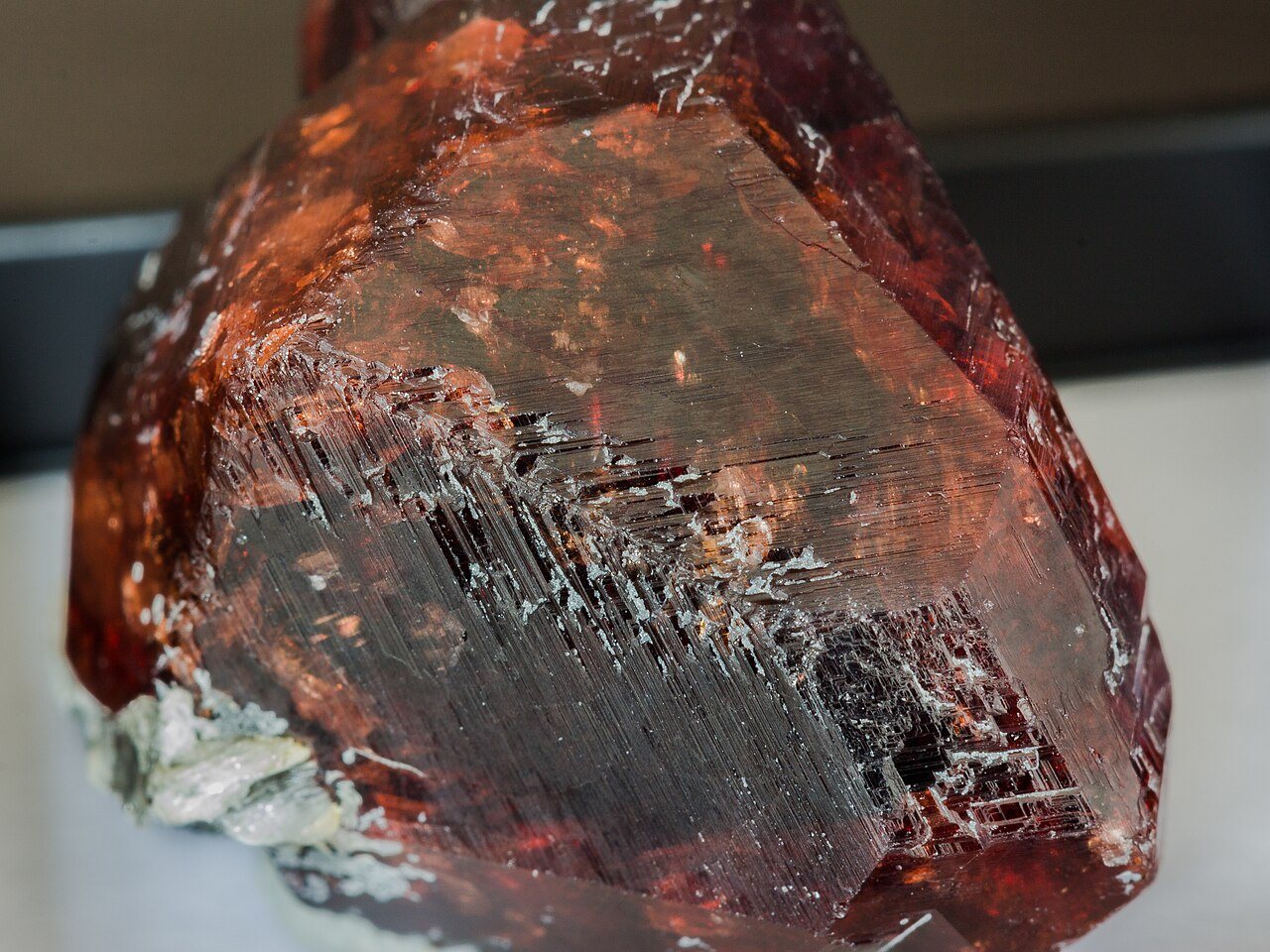
¿Qué es?
A hard, sharp-edged mineral more familiar as a gemstone, used industrially as the grit in waterjet cutting and sandblasting.
¿Por qué importa?
Garnet replaced silica sand in abrasive blasting because breathing silica dust causes silicosis; the substitution is a public-health story as much as a technical one.
Where it is in the Earth
Garnet is not a single mineral but a family of silicate minerals sharing the same crystal structure. The members most important to industry are almandine (an iron-aluminium silicate) and andradite, though almandine dominates abrasive production. What makes garnet useful as an abrasive — hardness, angular fracture, and chemical inertness — also reflects its geology: it forms under high pressure and temperature, conditions that drive its constituent atoms into a dense, tightly bonded arrangement.
Most economically significant garnet accumulates in one of two settings. The first is metamorphic rock — schist and gneiss — where the original sedimentary or igneous material has been recrystallised deep in the crust by heat and pressure. The garnet grows as distinct crystals within the foliated (layered) rock fabric, and because it resists weathering better than the surrounding minerals, it tends to survive when the host rock is eroded. That resistance leads to the second important setting: alluvial and beach placer deposits, where rivers and ocean waves have concentrated liberated garnet grains by winnowing away lighter minerals. Australia's large production comes predominantly from coastal and inland placer deposits in Western Australia, where ancient erosion has done much of the sorting work. India's deposits are also largely placer in character, while the United States produces both hard-rock garnet from metamorphic terranes in New York and Idaho and some alluvial material.
The geological distribution of garnet is therefore tied to the distribution of old, deeply eroded mountain belts and the sedimentary basins and coastlines downslope from them. China's large reserve base reflects extensive metamorphic terranes across several provinces. The correlation between reserve size and current production rate is loose: India holds the second-largest stated reserves but produces far less than Australia, which does not report a precise reserve figure at all, illustrating that accessible deposit geometry and infrastructure matter as much as in-ground abundance.
Getting it out
Because so much commercial garnet occurs as placer deposits — loose grains already separated from their host rock by natural processes — a large share of global production requires no blasting or hard-rock excavation. Placer mining typically uses earthmoving equipment, sometimes dredges or water monitors, to shift the sand or gravel into a processing stream. The effort is concentrated on moving material to a wet-separation plant rather than breaking rock. Hard-rock operations, by contrast, quarry or open-pit mine the garnet-bearing schist, crush it, and then separate the garnet from the waste minerals.
Grade in garnet mining is expressed as the weight of recoverable garnet per unit of ore or sand processed. In rich placer deposits this can be high enough that the raw feed is already partly sorted by natural hydraulic action; in hard-rock deposits, the garnet content of the schist can vary considerably across the orebody, and lower-grade zones may be left in place or stockpiled. Because placer operations are shallow and the overburden thin, the ratio of waste moved to product recovered is often modest compared with metallic-ore mines. Hard-rock garnet operations generate more waste rock, but the absence of flotation chemicals or smelting keeps the processing circuit simpler than at most metal mines.
Australia's dominance in production — it accounts for roughly half of world output in 2025 — rests largely on accessible coastal placer deposits that allow high-volume, low-complexity extraction. The United States produces garnet primarily from open-pit and quarry operations in the north-eastern states, where the metamorphic geology is well-suited but the deposits are smaller in scale than Australia's. India's placer operations in the south of the country feed both domestic consumption and export, though its production is modest relative to its reserve base.
What pulls on it
Industrial garnet sits at the intersection of two large end-use categories: waterjet cutting and abrasive blasting. In waterjet cutting, a high-pressure stream of water carries garnet particles that erode through metal, stone, glass, and composite materials without introducing heat, which matters whenever thermal distortion or hardening of the cut edge would be a problem. In abrasive blasting, garnet is directed at a surface — typically steel — to clean rust and mill scale or to create a surface profile that helps paint or coating adhere. Both applications consume the garnet during use; it is not recovered and reused in the way that, say, a cutting tool is.
The shift from silica sand to garnet in blasting has been one of the sustained drivers of demand growth and is rooted in occupational health regulation rather than economics alone. Silica dust causes silicosis, a progressive and incurable lung disease; garnet, being an aluminium silicate rather than free silica, does not carry the same hazard at normal working conditions. As regulations tightened across Europe, North America, and parts of Asia, operators who might have chosen cheaper silica on price grounds switched to garnet. Where regulation is less stringent, silica sand and coal slag still compete. The pace at which garnet displaces remaining silica use is therefore tied to regulatory change as much as to industrial output.
Waterjet cutting demand grows broadly in line with fabrication activity in industries such as aerospace, automotive, and construction, where the ability to cut hard or heat-sensitive materials cleanly is valued. A sharp contraction in capital spending on infrastructure or manufacturing would reduce garnet consumption, as would a technology shift toward laser or plasma cutting for applications where those processes are competitive. Neither of those alternatives handles thick stone, glass, or certain composites as well as waterjet, which limits substitution from the cutting side. The United States relies on imports for the large majority of its garnet consumption — net import reliance is estimated at 71 percent for 2025 — despite being a producing country itself, reflecting the scale difference between domestic output and domestic need.
Turning ore into product Nivel 3
For placer garnet, the processing flowsheet begins with wet screening to remove coarse debris and fine clays, followed by gravity separation — using spirals, shaking tables, or hydrocyclones — to exploit the density difference between garnet and lighter silicate gangue minerals such as quartz and feldspar. Because garnet is appreciably denser than most common sand minerals, gravity circuits can achieve good initial concentration without chemicals. Magnetic separation is then used to remove weakly magnetic minerals such as ilmenite; garnet itself is weakly paramagnetic, which means the separator settings must be tuned carefully to avoid garnet loss at this stage. Electrostatic separation may follow to further clean the concentrate. The final steps are drying and classification by mesh size, since customers buy garnet graded to a specific particle-size distribution — waterjet cutting demands a tighter size range than blasting abrasive, and the two markets may be served by different screen fractions from the same plant.
Hard-rock processing begins with comminution (crushing and milling) to liberate garnet crystals from the schist matrix. Liberation size — the particle size at which most garnet grains are freed from surrounding rock — governs how finely the ore must be ground, and grinding too fine destroys the angular grain shape that gives industrial garnet its cutting efficiency. Over-grinding is therefore a real process cost: it wastes energy, reduces the value of the product, and shifts the particle-size distribution toward fractions with lower per-tonne prices. Once liberated, the concentrate follows a similar gravity-and-magnetic circuit to placer operations. Recovery rates and concentrate purity are the two principal quality metrics; a high-purity concentrate commands a better price and can be classified into more product grades.
The unit basis for all reported production figures is gross weight of concentrate, not run-of-mine ore. This is straightforward for placer operations where the feed is already largely mineral grains, but it means that comparing concentrate tonnages across operations with different feed grades overstates the similarity of their underlying mining effort. Published production statistics — including those in the data underlying this page — do not separate waterjet-grade from blasting-grade output, so shifts in the product mix within a country's total are invisible in aggregate figures.
Substitution and recycling Nivel 3
In abrasive blasting, the principal alternatives to garnet are silica sand, copper slag, coal slag, steel grit, and aluminium oxide. Silica sand is cheaper but carries the silicosis hazard that has driven much of garnet's market growth; where it remains legal and unregulated it undercuts garnet on price. Slags can be used once and are often cheap where they arise as industrial by-products, but they may contain heavy metals and can create disposal complications for the spent abrasive. Steel grit and aluminium oxide are harder and can be recycled through closed-loop blasting systems, which changes the economics: the higher upfront cost is offset by multiple reuse cycles, but only in enclosed facilities where collection is practical. Open-air blasting, which is common in shipyards and on structures, is not amenable to grit recovery, and garnet competes on single-use cost and hazard profile in those settings.
In waterjet cutting, garnet has no direct single-mineral substitute in common industrial use. The combination of hardness, fracture toughness, and the angular particle shape produced by garnet's conchoidal fracture (a shell-like breakage pattern that produces sharp cutting edges) is difficult to replicate cheaply. Aluminium oxide abrasives can cut effectively but cost substantially more per tonne, and their economics only work where the cutting precision justifies the expense. The waterjet process itself can in principle be replaced by laser or plasma cutting for thinner metals, but each technology has ranges of material and thickness where it is preferred, and full substitution of the process would require capital investment in different equipment.
Recycling of spent garnet is practised in some waterjet cutting facilities where the abrasive is collected from the cutting tank, dried, and re-screened. The angular edges that make garnet effective are blunted after one pass through the cut, so recycled material performs less well on fine or demanding work. In practice, recycling extends the usable life of garnet to a modest degree in controlled settings but does not amount to a closed industrial loop. Spent blasting garnet is rarely recovered because the contamination from removed coatings, rust, and substrate material makes cleaning impractical and the open-site logistics do not support collection.
Quién lo produce
Verlo en un mapa →Mine production
Mine productionmetric tons 2025 (estimado) Total mundial 730,000 metric tons
USGS Mineral Commodity Summaries 2026 · Gross weight of concentrate. · fuente ↗
Desplace la tabla lateralmente para ver las columnas restantes.
| País | Producción | Cuota mundial |
|---|---|---|
| Australia | 350,000 | 47.9% |
| China | 280,000 | 38.4% |
| United States | 77,000 | 10.5% |
| India | 15,000 | 2.1% |
| Czechia | 4,000 | 0.5% |
| Pakistan | 1,900 | 0.3% |
| South Africa | Zero | — |
| Total mundial | 730,000 | 100% |
«Withheld» significa que el USGS suprimió el dato para evitar revelar información de una empresa concreta — no equivale a cero. Las filas por país no siempre suman el total mundial porque la fuente redondea cada cifra de forma independiente y no siempre desglosa una línea de «otros países».
Quién posee las reservas
Reserves
Reservesmetric tons 2025
USGS Mineral Commodity Summaries 2026 · fuente ↗
| País | Reservas | Cuota mundial |
|---|---|---|
| China | 37,000,000 | — |
| India | 8,600,000 | — |
| United States | 5,000,000 | — |
| South Africa | 1,300,000 | — |
| Czechia | Not applicable | — |
| Australia | Moderate to large | — |
| Pakistan | Not applicable | — |
| Total mundial | Moderate to large | 100% |
Precio
average import unit value, dollars per metric ton
Promedio anualdollars per metric ton
Base: average import unit value, dollars per metric ton. Promedios anuales publicados en USGS Mineral Commodity Summaries 2026 · fuente ↗. Estos son promedios anuales de referencia, no una cotización de mercado en tiempo real.