鉱石から製品まで、経路を追跡
The Materials Atlas
素材 鉱山・鉱床 処理・精製 管理移転経路 サプライチェーン 企業 ニュース
棚別素材 バッテリー材料 希土類元素 銅・電気 半導体材料 核物質 航空宇宙・防衛 貴金属 鉄鋼・合金金属 工業用鉱物 農業用鉱物 エネルギー原材料 鉱石鉱物 周期表
需要 最終市場 技術 素材計算機 地図 スクリーナー
学習・ツール 学ぶ用語集 データに質問するAIエージェント 調査・データAPI ★ 保存済み
概要 運営について方法論 データソースお問い合わせ 免責事項
表示オプション
🧭 ガイドビュー 鉱石品位、精鉱、精錬、副産物といった用語が初めての方へ。閲覧しながらすべての用語をわかりやすく解説します。同じデータを、解説付きでご覧いただけます。
⚡ 専門家向け解説 業界の知識はお持ちのはず。データのみを——簡潔、迅速、コンパクトに、余分な説明なしで。これがデフォルト表示です。
テーマ
インターフェース言語
深度 素材ページは4段階のレベルで構成されている。任意の素材ページでレベルを選択すると、その設定が記憶される。
★ 保存済み 調査・データ
Garnet (Industrial)

工業用鉱物

Garnet (Industrial)

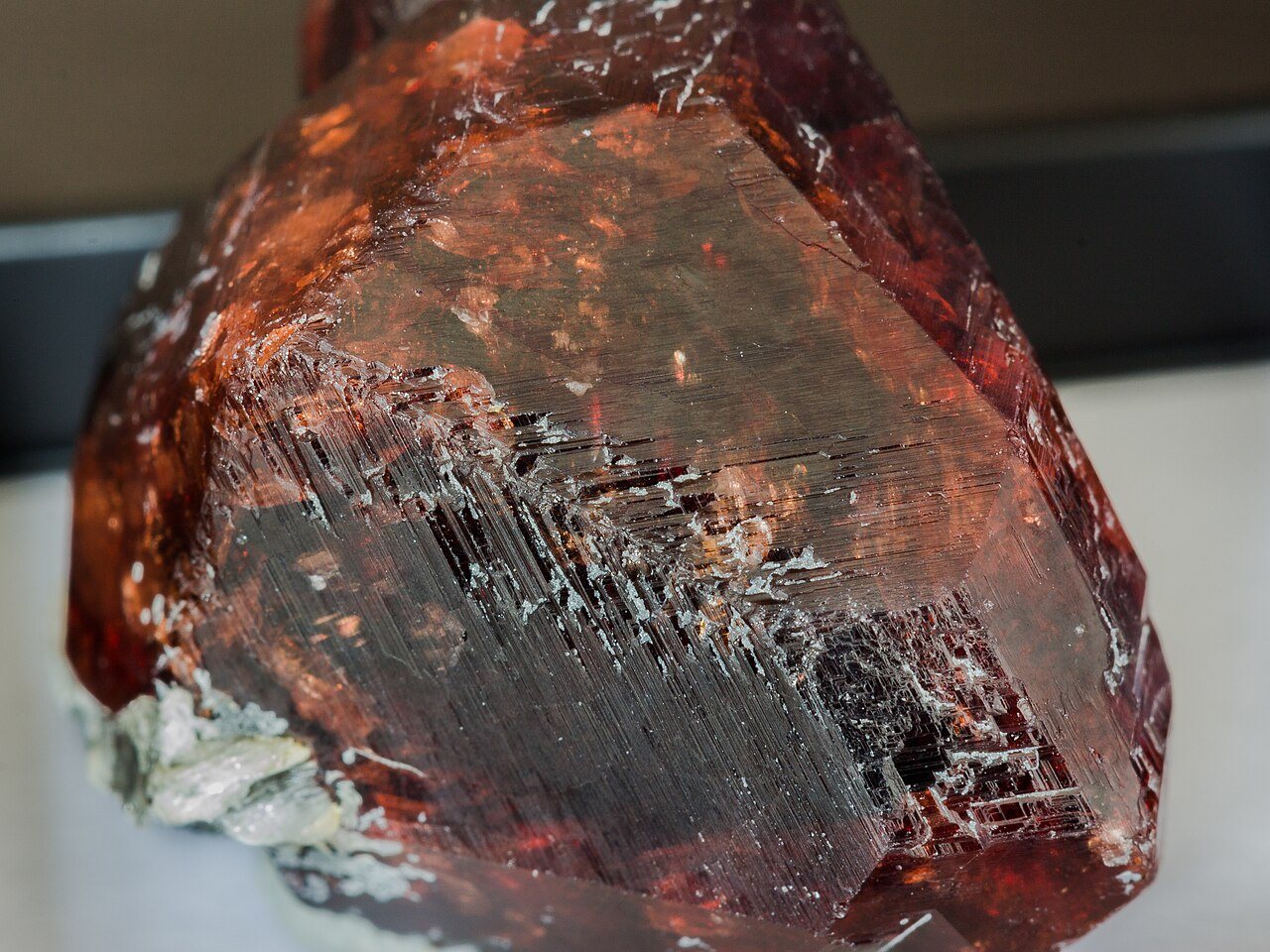
A hard, sharp-edged mineral more familiar as a gemstone, used industrially as the grit in waterjet cutting and sandblasting.

Garnet - Spessartine crystal detail · ButtShark · CC0 · Wikimedia Commons

これは何か

A hard, sharp-edged mineral more familiar as a gemstone, used industrially as the grit in waterjet cutting and sandblasting.

なぜ重要なのか

Garnet replaced silica sand in abrasive blasting because breathing silica dust causes silicosis; the substitution is a public-health story as much as a technical one.

Where it is in the Earth

Garnet is not a single mineral but a family of silicate minerals sharing the same crystal structure. The members most important to industry are almandine (an iron-aluminium silicate) and andradite, though almandine dominates abrasive production. What makes garnet useful as an abrasive — hardness, angular fracture, and chemical inertness — also reflects its geology: it forms under high pressure and temperature, conditions that drive its constituent atoms into a dense, tightly bonded arrangement.

Most economically significant garnet accumulates in one of two settings. The first is metamorphic rock — schist and gneiss — where the original sedimentary or igneous material has been recrystallised deep in the crust by heat and pressure. The garnet grows as distinct crystals within the foliated (layered) rock fabric, and because it resists weathering better than the surrounding minerals, it tends to survive when the host rock is eroded. That resistance leads to the second important setting: alluvial and beach placer deposits, where rivers and ocean waves have concentrated liberated garnet grains by winnowing away lighter minerals. Australia's large production comes predominantly from coastal and inland placer deposits in Western Australia, where ancient erosion has done much of the sorting work. India's deposits are also largely placer in character, while the United States produces both hard-rock garnet from metamorphic terranes in New York and Idaho and some alluvial material.

The geological distribution of garnet is therefore tied to the distribution of old, deeply eroded mountain belts and the sedimentary basins and coastlines downslope from them. China's large reserve base reflects extensive metamorphic terranes across several provinces. The correlation between reserve size and current production rate is loose: India holds the second-largest stated reserves but produces far less than Australia, which does not report a precise reserve figure at all, illustrating that accessible deposit geometry and infrastructure matter as much as in-ground abundance.

Getting it out

Because so much commercial garnet occurs as placer deposits — loose grains already separated from their host rock by natural processes — a large share of global production requires no blasting or hard-rock excavation. Placer mining typically uses earthmoving equipment, sometimes dredges or water monitors, to shift the sand or gravel into a processing stream. The effort is concentrated on moving material to a wet-separation plant rather than breaking rock. Hard-rock operations, by contrast, quarry or open-pit mine the garnet-bearing schist, crush it, and then separate the garnet from the waste minerals.

Grade in garnet mining is expressed as the weight of recoverable garnet per unit of ore or sand processed. In rich placer deposits this can be high enough that the raw feed is already partly sorted by natural hydraulic action; in hard-rock deposits, the garnet content of the schist can vary considerably across the orebody, and lower-grade zones may be left in place or stockpiled. Because placer operations are shallow and the overburden thin, the ratio of waste moved to product recovered is often modest compared with metallic-ore mines. Hard-rock garnet operations generate more waste rock, but the absence of flotation chemicals or smelting keeps the processing circuit simpler than at most metal mines.

Australia's dominance in production — it accounts for roughly half of world output in 2025 — rests largely on accessible coastal placer deposits that allow high-volume, low-complexity extraction. The United States produces garnet primarily from open-pit and quarry operations in the north-eastern states, where the metamorphic geology is well-suited but the deposits are smaller in scale than Australia's. India's placer operations in the south of the country feed both domestic consumption and export, though its production is modest relative to its reserve base.

What pulls on it

Industrial garnet sits at the intersection of two large end-use categories: waterjet cutting and abrasive blasting. In waterjet cutting, a high-pressure stream of water carries garnet particles that erode through metal, stone, glass, and composite materials without introducing heat, which matters whenever thermal distortion or hardening of the cut edge would be a problem. In abrasive blasting, garnet is directed at a surface — typically steel — to clean rust and mill scale or to create a surface profile that helps paint or coating adhere. Both applications consume the garnet during use; it is not recovered and reused in the way that, say, a cutting tool is.

The shift from silica sand to garnet in blasting has been one of the sustained drivers of demand growth and is rooted in occupational health regulation rather than economics alone. Silica dust causes silicosis, a progressive and incurable lung disease; garnet, being an aluminium silicate rather than free silica, does not carry the same hazard at normal working conditions. As regulations tightened across Europe, North America, and parts of Asia, operators who might have chosen cheaper silica on price grounds switched to garnet. Where regulation is less stringent, silica sand and coal slag still compete. The pace at which garnet displaces remaining silica use is therefore tied to regulatory change as much as to industrial output.

Waterjet cutting demand grows broadly in line with fabrication activity in industries such as aerospace, automotive, and construction, where the ability to cut hard or heat-sensitive materials cleanly is valued. A sharp contraction in capital spending on infrastructure or manufacturing would reduce garnet consumption, as would a technology shift toward laser or plasma cutting for applications where those processes are competitive. Neither of those alternatives handles thick stone, glass, or certain composites as well as waterjet, which limits substitution from the cutting side. The United States relies on imports for the large majority of its garnet consumption — net import reliance is estimated at 71 percent for 2025 — despite being a producing country itself, reflecting the scale difference between domestic output and domestic need.

Turning ore into product レベル 3

For placer garnet, the processing flowsheet begins with wet screening to remove coarse debris and fine clays, followed by gravity separation — using spirals, shaking tables, or hydrocyclones — to exploit the density difference between garnet and lighter silicate gangue minerals such as quartz and feldspar. Because garnet is appreciably denser than most common sand minerals, gravity circuits can achieve good initial concentration without chemicals. Magnetic separation is then used to remove weakly magnetic minerals such as ilmenite; garnet itself is weakly paramagnetic, which means the separator settings must be tuned carefully to avoid garnet loss at this stage. Electrostatic separation may follow to further clean the concentrate. The final steps are drying and classification by mesh size, since customers buy garnet graded to a specific particle-size distribution — waterjet cutting demands a tighter size range than blasting abrasive, and the two markets may be served by different screen fractions from the same plant.

Hard-rock processing begins with comminution (crushing and milling) to liberate garnet crystals from the schist matrix. Liberation size — the particle size at which most garnet grains are freed from surrounding rock — governs how finely the ore must be ground, and grinding too fine destroys the angular grain shape that gives industrial garnet its cutting efficiency. Over-grinding is therefore a real process cost: it wastes energy, reduces the value of the product, and shifts the particle-size distribution toward fractions with lower per-tonne prices. Once liberated, the concentrate follows a similar gravity-and-magnetic circuit to placer operations. Recovery rates and concentrate purity are the two principal quality metrics; a high-purity concentrate commands a better price and can be classified into more product grades.

The unit basis for all reported production figures is gross weight of concentrate, not run-of-mine ore. This is straightforward for placer operations where the feed is already largely mineral grains, but it means that comparing concentrate tonnages across operations with different feed grades overstates the similarity of their underlying mining effort. Published production statistics — including those in the data underlying this page — do not separate waterjet-grade from blasting-grade output, so shifts in the product mix within a country's total are invisible in aggregate figures.

Substitution and recycling レベル 3

In abrasive blasting, the principal alternatives to garnet are silica sand, copper slag, coal slag, steel grit, and aluminium oxide. Silica sand is cheaper but carries the silicosis hazard that has driven much of garnet's market growth; where it remains legal and unregulated it undercuts garnet on price. Slags can be used once and are often cheap where they arise as industrial by-products, but they may contain heavy metals and can create disposal complications for the spent abrasive. Steel grit and aluminium oxide are harder and can be recycled through closed-loop blasting systems, which changes the economics: the higher upfront cost is offset by multiple reuse cycles, but only in enclosed facilities where collection is practical. Open-air blasting, which is common in shipyards and on structures, is not amenable to grit recovery, and garnet competes on single-use cost and hazard profile in those settings.

In waterjet cutting, garnet has no direct single-mineral substitute in common industrial use. The combination of hardness, fracture toughness, and the angular particle shape produced by garnet's conchoidal fracture (a shell-like breakage pattern that produces sharp cutting edges) is difficult to replicate cheaply. Aluminium oxide abrasives can cut effectively but cost substantially more per tonne, and their economics only work where the cutting precision justifies the expense. The waterjet process itself can in principle be replaced by laser or plasma cutting for thinner metals, but each technology has ranges of material and thickness where it is preferred, and full substitution of the process would require capital investment in different equipment.

Recycling of spent garnet is practised in some waterjet cutting facilities where the abrasive is collected from the cutting tank, dried, and re-screened. The angular edges that make garnet effective are blunted after one pass through the cut, so recycled material performs less well on fine or demanding work. In practice, recycling extends the usable life of garnet to a modest degree in controlled settings but does not amount to a closed industrial loop. Spent blasting garnet is rarely recovered because the contamination from removed coatings, rust, and substrate material makes cleaning impractical and the open-site logistics do not support collection.

Where the chain is fragile レベル 4

The supply picture for industrial garnet is geographically concentrated in a way the reserve figures alone do not fully capture. Australia produces roughly 350,000 metric tons per year — close to half of the 730,000 metric-ton world total for 2025 — from a relatively small number of operations. China produces most of the remainder. The rest of the world, including India with its large stated reserve of 8,600,000 metric tons, contributes a modest share of current output, meaning that operational or regulatory disruption in Australia or China would have an outsized effect on supply availability even though alternative in-ground resources exist elsewhere. The gap between India's reserve base and its production rate is a recurring feature of industrial-mineral statistics and typically reflects a combination of infrastructure limitations, mine permitting timelines, and the economics of developing new operations against incumbents with established logistics.

Unlike most critical minerals, garnet is not a by-product of another mining operation: it is the primary product. This simplifies the supply economics in one sense — production is not contingent on the market for a co-product — but it means that investment decisions are made directly against garnet prices, which are relatively low per tonne. The average import unit value has moved between $170 and $280 per metric ton over 2021–2025, a range that reflects both quality mix and market conditions. At these price levels, the capital cost of opening a new hard-rock mine and processing plant is recovered slowly, which makes producers cautious about capacity expansion and creates a lag between demand growth and new supply. Lead times from initial resource definition to production for a new hard-rock garnet mine are typically measured in years rather than months.

Reporting conventions introduce their own uncertainty. Production figures are stated on a concentrate basis, but what constitutes saleable concentrate varies: some operations report all material passing a certain screen as concentrate, while others report only material meeting a purity specification. South Africa's production is withheld by the data source, making it impossible to track from public figures. Australia's reserves are described as moderate to large without a numeric estimate, which is common for commodities where the operator considers detailed reserve data commercially sensitive. Any analysis that treats the aggregate world reserve figure as a precise resource inventory is reading more certainty into the data than the underlying reports justify.

数値の読み方に注意してください。 Gross weight of concentrate. Alluvial and hard-rock garnet, graded by mesh size.

Mine production

Mine productionmetric tons 2025 (推定値) 世界合計 730,000 metric tons

USGS Mineral Commodity Summaries 2026 · Gross weight of concentrate. · 出典 ↗

テーブルを横にスクロールすると残りの列が表示されます。

生産 世界に占める割合
Australia 350,000 47.9%
China 280,000 38.4%
United States 77,000 10.5%
India 15,000 2.1%
Czechia 4,000 0.5%
Pakistan 1,900 0.3%
South Africa Zero
世界合計 730,000100%

「非開示」とは、個別企業のデータが特定されないようUSGSが数値を公表しなかったことを意味し、ゼロを意味するものではありません。出典が各数値を独立して丸め処理しており、「その他の国」の内訳を常に示しているわけではないため、各国の数値の合計が世界合計と一致しないことがあります。

埋蔵量の保有者

「埋蔵量」は厳密な用語です。既知の鉱床のうち、現在の価格と現在の技術で経済的に採掘できる部分を指し、地中に存在するすべてのものを意味するわけではありません。埋蔵量は、価格が上昇するか新たなプロセスが開発されると増加し、逆の場合は減少します。

Reserves

Reservesmetric tons 2025

USGS Mineral Commodity Summaries 2026 · 出典 ↗

埋蔵量世界に占める割合
China 37,000,000
India 8,600,000
United States 5,000,000
South Africa 1,300,000
Czechia Not applicable
Australia Moderate to large
Pakistan Not applicable
世界合計 Moderate to large100%

価格

average import unit value, dollars per metric ton

年間平均dollars per metric ton

2021 · 280.0 高 280.0 dollars per metric ton 2025 · 170.0

基準: average import unit value, dollars per metric ton. 以下に公表された年間平均値: USGS Mineral Commodity Summaries 2026 · 出典 ↗. これらは参照用の年間平均値であり、リアルタイムの市況相場ではない。

素材

全素材 重要鉱物 レアアース バッテリー材料 鉱石鉱物 周期表 スクリーナー

地下

鉱山・鉱床 処理・精製 地図

経済

管理移転経路 サプライチェーン 最終市場 技術 企業 素材計算機

学ぶ

学ぶ用語集 データに質問するAIエージェント 調査・データオープンAPI ニュース★ 保存済み

運営について

運営についてお問い合わせ 方法論データソース 編集方針 プライバシーポリシー利用規約 免責事項