Что это такое?
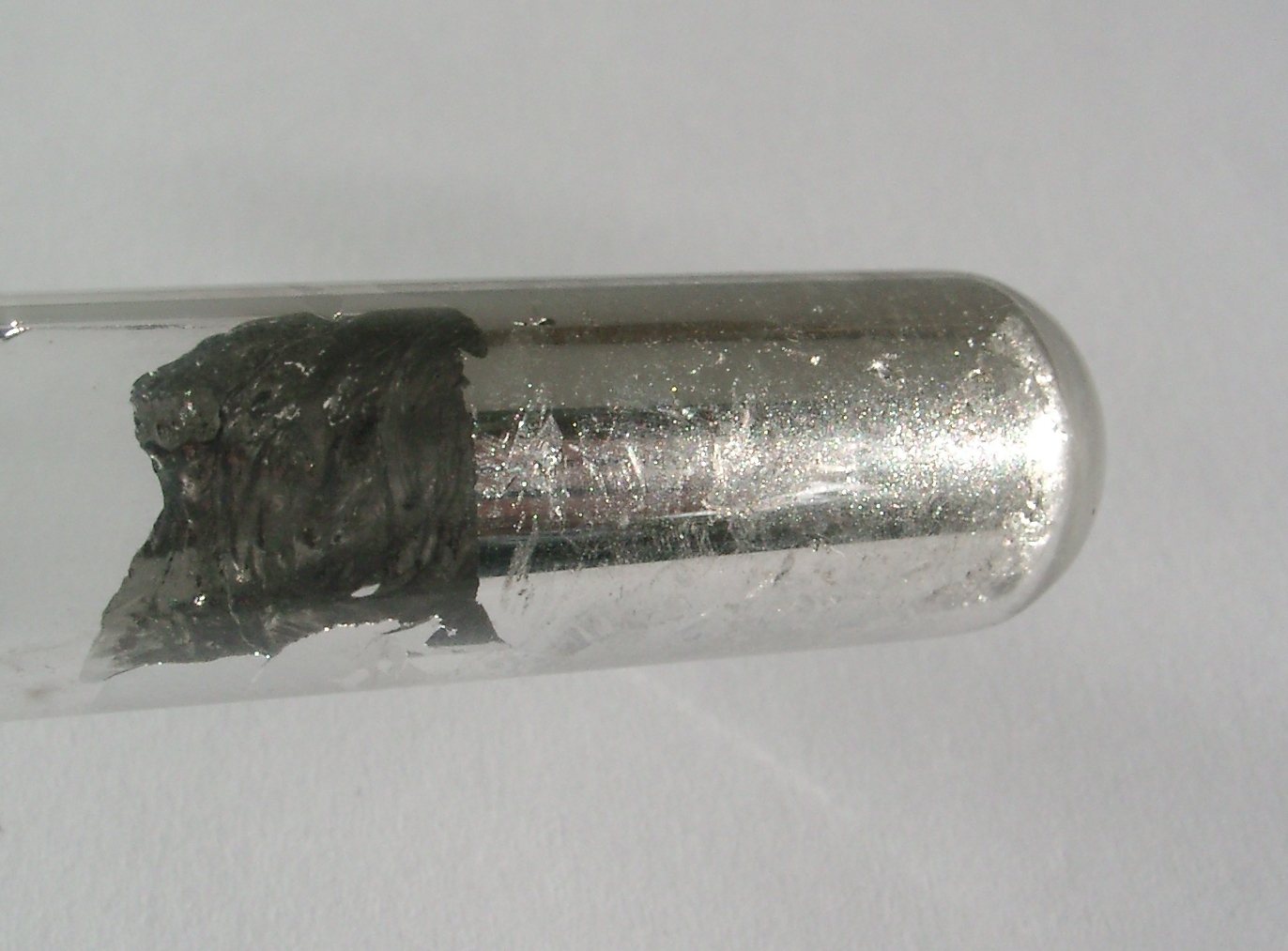
A soft metal whose oxide is both transparent and electrically conductive — the invisible wiring on top of every touchscreen.
Почему это важно?
Indium tin oxide is the reason a screen can be conductive and see-through at the same time. Substitutes exist but none has matched it commercially at scale.
Where it is in the Earth
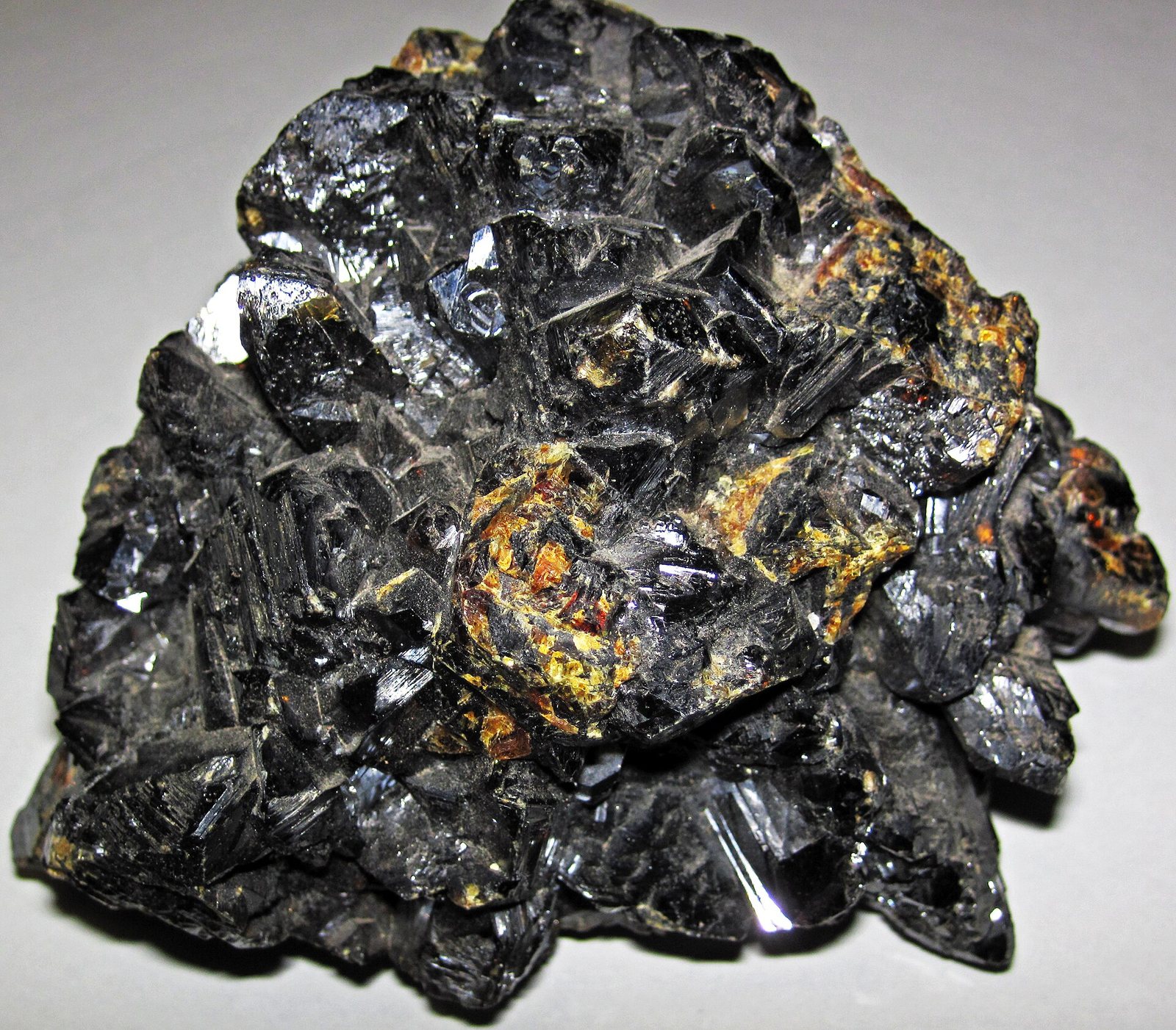
Indium is one of the rarest stable elements in the Earth's crust, and it never forms ore deposits of its own. It has no minerals in which it is the principal component at economic concentrations; instead, it hides inside the crystal lattice of sphalerite, the iron-zinc sulfide that is the world's main ore of zinc. Sphalerite forms in hydrothermal deposits — places where hot, mineral-laden water circulated through fractures in the rock and deposited sulfide minerals as it cooled. Indium substitutes for zinc atoms within the sphalerite structure because the two elements are chemically similar enough in size and charge to swap places, at least in small quantities. The result is a trace enrichment: the indium is dispersed through the sphalerite grain by grain, invisible to the eye and detectable only by chemical analysis.
The deposits that carry the most indium tend to be polymetallic sulfide bodies — masses of mixed zinc, lead, copper and tin sulfides — rather than simple zinc-only orebodies. Tin-bearing hydrothermal systems in particular seem to favour higher indium concentrations, probably because the chemistry that precipitates tin also keeps conditions right for indium uptake into sphalerite. This is why certain zinc districts in southern China, which have a long history of polymetallic and tin-associated mineralisation, happen to host sphalerite with relatively elevated indium contents compared with zinc deposits elsewhere. The geology does not guarantee that a zinc mine will yield useful indium; the indium grade in the sphalerite varies enormously from one deposit to another, and even within a single orebody it can be patchy.
Because indium is so dispersed and so dependent on the character of the host zinc deposit, there is no meaningful concept of an indium reserve in the way one would speak of a copper or nickel reserve. The world's published reserve figures for indium are largely absent or provisional, a fact that reflects the difficulty of quantifying something that is incidental to the primary ore rather than the target of exploration in its own right.
Getting it out
Indium is not mined. That sentence needs a little unpacking. No mine anywhere on Earth has ever been opened with indium as its target. Every tonne of indium that enters the supply chain comes out of zinc mining as an accidental companion — a by-product that would simply stay in the waste stream if there were no economic reason to recover it. The zinc ore is mined by whatever method the geometry and depth of the orebody dictate: open-pit extraction for large, shallow deposits near the surface, and underground methods for deeper or narrower bodies. The choice between these approaches is made entirely on the economics of zinc, with indium having no say in the matter.
What matters for indium recovery is not the mining method but the character of the ore being processed. Sphalerite grains carrying elevated indium concentrations look identical to ordinary sphalerite. A mine can only know what its ore contains through systematic sampling and assay. Where the indium content of the sphalerite is high enough to justify the additional processing steps needed to capture it, the smelter or refinery will set up to recover it. Where it is not, the indium passes through the plant unrecovered, ending up in slag or residue. The practical consequence is that indium supply is governed by decisions made about zinc production capacity, zinc ore grades and zinc market conditions, none of which are influenced in any meaningful way by indium demand or indium price.
What pulls on it
The overwhelming share of indium consumption goes into indium tin oxide, or ITO, the transparent conductive coating that makes touchscreens and liquid crystal displays function. When a finger touches a screen, it disturbs a weak electric field carried by an ITO layer — a layer that must conduct electricity without blocking light. Indium is present in that layer because its oxide, when mixed with a small proportion of tin oxide, combines two properties that almost no other material offers simultaneously at useful scale: electrical conductivity and optical transparency in the visible spectrum. The flat-panel display industry built its manufacturing processes around ITO over several decades, and that accumulated infrastructure represents a large and relatively stable source of demand.
Alongside displays, indium plays a role in thin-film photovoltaics, specifically the technology known as CIGS — copper indium gallium selenide — where indium is a stoichiometric component of the light-absorbing semiconductor layer rather than a coating. CIGS cells have achieved high efficiency in laboratory settings and have found commercial use in applications where flexibility or low weight matters, though their share of total solar capacity installed globally has remained well below that of silicon-based panels. Indium is also used in compound semiconductors of the III-V family, particularly indium phosphide and indium gallium arsenide, which appear in high-frequency electronics, laser diodes and certain specialist detector applications. These uses are smaller in volume than displays but tend to involve applications where indium is difficult to replace.
What would have to change for demand to shift sharply? On the upside, a significant acceleration in CIGS solar deployment or a broadening of III-V semiconductor use into mass-market consumer chips would increase demand noticeably. On the downside, if the display industry were to find a commercially workable ITO substitute and retrofit existing production lines, the largest single source of demand would contract. Both directions of change depend on technology choices made by industries where indium itself is a minor input cost, meaning the decisions are unlikely to be made on the basis of indium availability or price alone.
Turning ore into product Уровень 3
Zinc ore leaving the mine is first crushed and ground — comminution — to liberate the sphalerite grains from the surrounding rock. The sphalerite is then concentrated by froth flotation, a process in which air bubbles are used to selectively carry hydrophobic (water-repelling) sulfide particles to the surface of a tank while gangue minerals sink. The resulting zinc concentrate, typically containing a substantial fraction of sphalerite, is the feedstock for the smelter. Indium follows the sphalerite into the concentrate, but at this stage it is still only a trace impurity measured in grams per tonne of concentrate rather than as a marketable commodity.
At the zinc smelter, the concentrate is roasted to convert sulfides to oxides, then leached with sulfuric acid. Most zinc smelters use an electrolytic route — the hydrometallurgical process — in which zinc is deposited from solution onto aluminium cathodes. Indium does not plate efficiently under the same conditions as zinc and instead accumulates in the leach residues, jarosite precipitates or iron-removal stages of the circuit. It must be selectively leached from these residues, typically with dilute acid, and then purified through solvent extraction or cementation before being cast into small ingots of high-purity metal. Each additional step introduces losses; overall recovery of indium from ore to refined metal is substantially lower than zinc recovery, and the losses are spread across multiple stages where they are difficult to account for precisely.
The refined indium ingot is rarely the final traded form for the most important applications. Manufacturers of flat-panel displays require indium tin oxide, a ceramic compound, in the form of sputtering targets — dense discs or rectangular tiles from which a thin conductive film is deposited onto glass by a physical vapour deposition process. Producing sputtering targets from indium ingot requires blending with tin oxide, pressing, sintering and machining to tight dimensional tolerances. This conversion step adds lead time and cost, and the targets themselves generate significant indium-bearing scrap during both manufacture and use that forms the basis for secondary recovery.
Substitution and recycling Уровень 3
In flat-panel displays, the search for ITO alternatives has been active for many years, driven partly by concern about indium supply concentration and partly by the difficulty of depositing ITO on flexible substrates. Candidates include aluminium-doped zinc oxide, which is cheaper and more abundant but has not matched ITO's conductivity-transparency combination in high-volume production; carbon nanotube films and graphene layers, which offer flexibility but face challenges in uniformity and contact resistance at scale; and metal mesh conductors, which work well in large-format touch panels but are less suited to very fine-pitch applications. None of these has displaced ITO in mainstream display manufacturing in a commercially significant way, though some have found niches in specific product formats. The cost of qualifying a new transparent conductor through an entire display supply chain — from deposition equipment settings to panel assembly and testing — is substantial, which creates a natural inertia in favour of the established material.
Recycling of indium from end-of-life products is technically possible but limited in practice. The most accessible recycling stream is the off-cuts and used sputtering targets generated within display manufacturing itself — new scrap, in industry terminology. This material is relatively clean, indium-rich compared with ore, and produced in large facilities already set up to handle it, so recovery rates from this stream are meaningful. End-of-life recycling from consumer electronics — recovering indium from discarded phones and televisions — is another matter. The ITO layer in a display is extremely thin, the indium content per device is small, and separating the glass-ITO-liquid crystal assembly from the rest of a device and then extracting the indium economically requires collection systems, dismantling infrastructure and hydrometallurgical capacity that do not exist at the necessary scale in most markets. The consequence is that most indium in discarded consumer goods is lost, and primary production remains the dominant source of supply to industry.
Откуда берётся в породе
Все рудные минералы →Это минералы, которые реально содержат indium. Залежь является рудным телом лишь в том случае, если концентрация одного из компонентов достаточна, чтобы окупить добычу.
Кто производит
Посмотреть на карте →Refinery production
Refinery productionmetric tons 2025 (оценочный) Мировой итог 1,100 metric tons
USGS Mineral Commodity Summaries 2026 · Refinery production of primary indium; a by-product of zinc. · источник ↗
Прокрутите таблицу вправо, чтобы увидеть остальные столбцы.
| Страна | Производство | Доля мирового |
|---|---|---|
| China | 760.0 | 69.1% |
| Korea, Republic of | 180.0 | 16.4% |
| Japan | 65.00 | 5.9% |
| Canada | 40.00 | 3.6% |
| France | 21.00 | 1.9% |
| Belgium | 19.00 | 1.7% |
| Russia | 5.00 | 0.5% |
| Uzbekistan | 1.00 | 0.1% |
| United States | Zero | — |
| Мировой итог | 1,100 | 100% |
«Withheld» означает, что USGS скрыл данные во избежание раскрытия сведений об отдельной компании, — это не равнозначно нулю. Суммы по строкам стран не всегда совпадают с мировым итогом, поскольку источник округляет каждый показатель независимо и не всегда выделяет строку «прочие страны» отдельно.
Цена
annual average, dollars per kilogram: U.S. warehouse, free on board
Среднегодовое значениеdollars per kilogram
Основание: annual average, dollars per kilogram: U.S. warehouse, free on board. Среднегодовые значения в том виде, в каком опубликованы в USGS Mineral Commodity Summaries 2026 · источник ↗. Приведены справочные годовые средние значения, а не котировки текущего рынка.
annual average, dollars per kilogram: Rotterdam, duties unpaid
Среднегодовое значениеdollars per kilogram
Основание: annual average, dollars per kilogram: Rotterdam, duties unpaid. Среднегодовые значения в том виде, в каком опубликованы в USGS Mineral Commodity Summaries 2026 · источник ↗. Приведены справочные годовые средние значения, а не котировки текущего рынка.
Для чего применяется
Все конечные рынки →| Конечный рынок | Что он делает там | Значимость |
|---|---|---|
| Consumer Electronics | Transparent touchscreen electrode | Определение |
| Semiconductors | Transparent contacts and III-V devices | Важно |
| Solar Power | CIGS thin film and transparent contacts | Настоящее время |
Экспортный контроль
| Страна | Контроль | Применяется к |
|---|---|---|
| China | Export licensing requirement for materials and technologies | Antimony (2024), bismuth (2025), synthesized diamond (2025), gallium (2023), germanium (2023), graphite (2023), indium (2025), magnesium materials (2024), molybdenum (2025), rare earths (2025), silver (2026), tellurium (2025), tungsten (2025), and items related to lithium batteries and artificial graphite anode materials (2025). ↗ |
USGS Mineral Commodity Summaries 2026, table 4 — controls in effect as of January 2026, excluding controls since lifted.