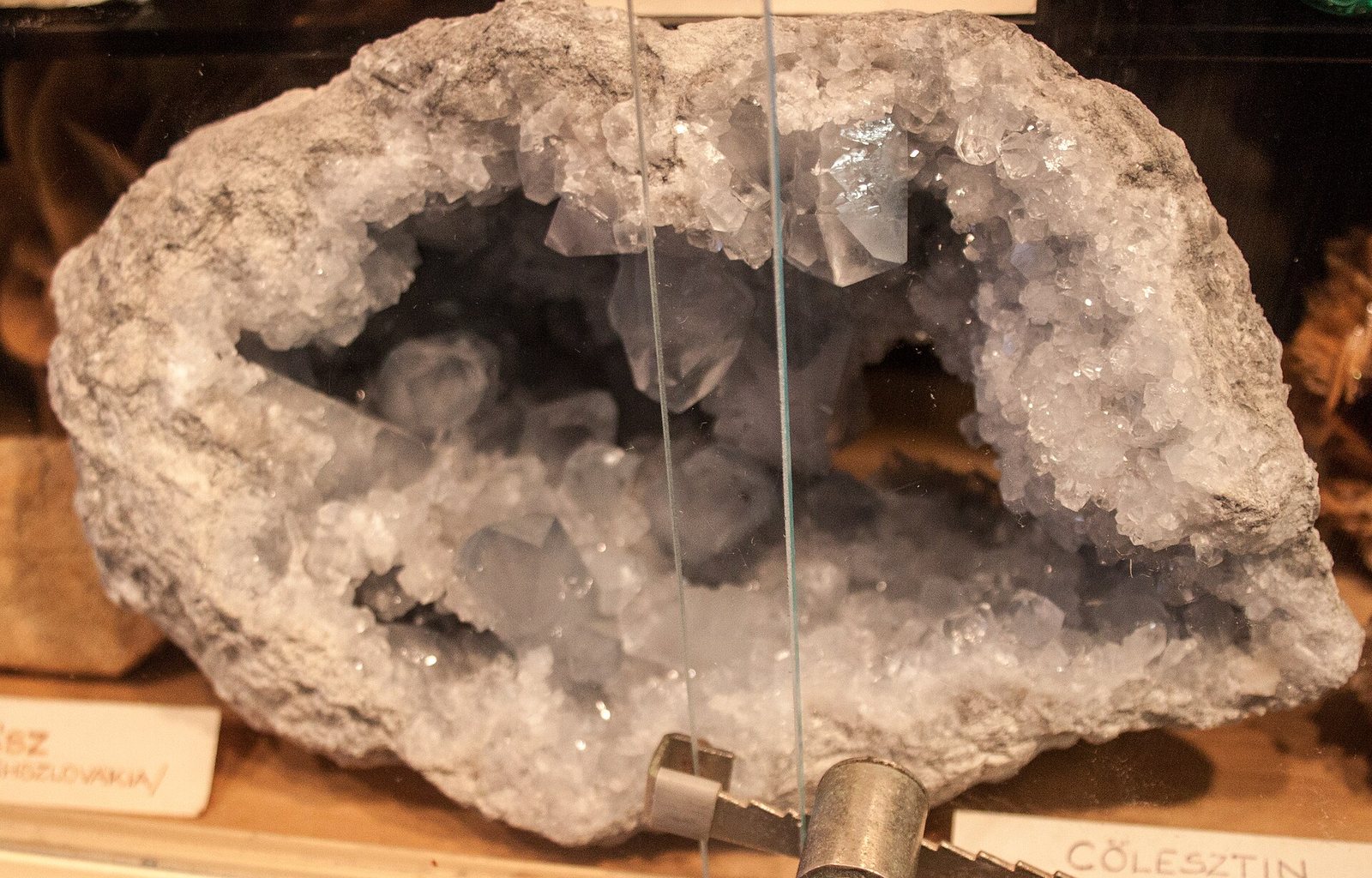
这是什么?
A soft metal whose salts burn bright red, which is why every red firework contains it.
为何重要?
Strontium ferrite is the cheap permanent magnet in most small motors — the one that does its job without any rare earth at all.
Where it is in the Earth
Strontium is not a rare element in absolute terms — it is moderately abundant in the Earth's crust — but it only reaches mineable concentrations where specific geological conditions have brought it together and kept it in place. The primary ore mineral is celestite, which is strontium sulfate. Celestite forms most commonly in sedimentary sequences: ancient shallow seas and coastal lagoons where strontium-bearing waters, often hydrothermal fluids rising through fractures in the crust, mixed with sulfate-rich brines or evaporating seawater. The strontium sulfate crystallised out because it is only very sparingly soluble, and it accumulated in beds and nodules within limestone, dolomite and marl — fine-grained carbonate sedimentary rocks. A secondary ore mineral, strontianite (strontium carbonate), forms in hydrothermal veins, but it is far less common commercially.
The geography of strontium deposits reflects this sedimentary origin. The great Iranian deposits sit within a belt of Tertiary-age sedimentary basins — geologically young by rock standards, formed roughly in the last sixty-five million years — where the structural conditions favoured repeated fluid movement and mineral precipitation. Spain's deposits, concentrated in Andalusia in the south, are similarly hosted in Triassic and younger sedimentary sequences. China's strontium province in Chongqing and surrounding areas occupies an ancient marine carbonate platform where celestite accumulated in thick, laterally extensive beds. Mexico's deposits in San Luis Potosí lie within evaporite-associated sequences. What all these settings share is the co-occurrence of a source of strontium (usually from weathering or hydrothermal alteration of Sr-bearing silicate or carbonate rocks), a sulfate source, and a depositional trap that concentrated the mineral before it could be diluted or dispersed.
The second important ore mineral context is the presence of strontium in barium deposits. Celestite and barite (barium sulfate) are chemically similar enough that they often occur together, and strontium can substitute for barium within the barite crystal structure, and vice versa. This means that some strontium is recovered as a by-product or co-product in operations primarily targeting barite. The distinction matters economically: a dedicated celestite mine can optimise for strontium purity, while a barite operation treating a mixed ore faces a processing challenge to separate the two.
Getting it out
Celestite deposits that are thick, near-surface and of sufficient grade are almost always mined by open-pit methods. The ore body is exposed by removing the overlying rock and soil — the overburden — with mechanical excavators and trucks. Because celestite beds in sedimentary sequences tend to be broadly horizontal and relatively continuous, open-pit mining suits them well: the geometry is predictable, and the stripping ratios (the volume of waste moved for each unit of ore recovered) are often manageable. Underground mining has been used at some Spanish and Mexican operations where the ore dips steeply or lies at depth, but it is the exception rather than the rule for strontium.
The ore grade — the proportion of celestite in the run-of-mine rock — matters because celestite is a bulk, relatively low-value mineral sold largely on gross weight. A higher-grade ore means less rock needs to be moved and processed per tonne of product, which directly reduces costs. Very high-grade zones can in principle be hand-sorted or selectively blasted to improve the average quality delivered to the plant. Lower-grade zones require more beneficiation — processing to separate the celestite from the surrounding rock — before the material meets the specifications buyers expect. In practice, the distinction between what counts as ore and what counts as waste shifts with the prevailing price and the cost of processing, which is one reason production figures can vary significantly from year to year without any change in the underlying deposit.
Strontium is not currently recovered from brines on a commercial scale in the way that lithium is extracted from South American salars, though strontium is present in some natural brines and oilfield waters. The dominant production route remains conventional hard-rock or soft-sediment open-pit mining of celestite beds, followed by crushing and processing at or near the mine site. The United States has no reported production — the source withholds domestic figures — and is entirely import-dependent, drawing celestite and processed strontium compounds mainly from Mexico, Germany and China.
What pulls on it
The largest single use of strontium by volume is in permanent ferrite magnets, specifically strontium hexaferrite. These magnets are made by sintering a mixture of strontium carbonate and iron oxide at high temperature, producing a hard ceramic material with useful magnetic properties. They are not as powerful as rare-earth magnets — neodymium-iron-boron magnets, for instance, produce far stronger fields in a given volume — but strontium ferrite magnets are inexpensive, chemically stable, and require no critical or geopolitically sensitive raw materials beyond iron and strontium. They are used in the small electric motors found in household appliances, in loudspeakers, in simple actuators, and in many automotive applications where the magnetic demands do not justify the cost of a rare-earth alternative. This is a large, relatively stable market; it grows broadly in line with the production of consumer electronics and motor vehicles rather than in response to any single dramatic shift in technology.
Pyrotechnics form the second well-known use: strontium salts, particularly the nitrate and carbonate, produce the characteristic crimson colour in flares, fireworks and signal devices. The colour arises because strontium atoms, when heated to incandescence, emit red light at specific wavelengths. This is a relatively small market in tonne terms, but it is inelastic — there is no convenient substitute for strontium if a red colour is required — and it is geographically dispersed. A third significant use, which has contracted substantially over recent decades, was in cathode-ray tube (CRT) glass: the glass envelope of a CRT television or monitor contained strontium and barium oxides to absorb X-ray emissions. As CRT displays were displaced by flat-panel technology, this demand effectively disappeared. The decline of CRT glass removed what had been a major consumption channel, and the strontium market adapted by growing in the ferrite and other segments rather than collapsing entirely. Other uses include the production of specialty glass, certain refinery catalysts, and some pharmaceutical and medical imaging applications, but none of these approach the scale of ferrite magnets.
A sharp change in demand would most plausibly follow from a major shift in motor design. If rare-earth magnet prices fell to the point where substituting strontium ferrite offered no cost saving, some motor designs might migrate upward; conversely, if concerns about rare-earth supply chains caused manufacturers to favour strontium ferrite in applications that currently use rare-earth magnets, demand for strontium would rise. Neither shift would happen quickly — motor designs are locked into product architectures with lead times of several years — but strontium's position as the affordable, non-critical alternative to rare-earth magnets means its fortunes are loosely coupled to conditions in the rare-earth market.
生产主体
在地图上查看 →Mine production
Mine productionmetric tons 2025 (估计值) 全球合计 450,000 metric tons
USGS Mineral Commodity Summaries 2026 · Reported as celestite (strontium sulfate) gross weight. · 来源 ↗
横向滚动表格以查看其余列。
| 国家/地区 | 产量 | 占全球份额 |
|---|---|---|
| Iran | 250,000 | 55.6% |
| Spain | 100,000 | 22.2% |
| China | 80,000 | 17.8% |
| Mexico | 20,000 | 4.4% |
| Argentina | 700.0 | 0.2% |
| United States | Zero | — |
| 全球合计 | 450,000 | 100% |
"未披露"表示美国地质调查局(USGS)为避免泄露单个企业数据而对该数字进行了保密处理——并不意味着数值为零。各国行数之和不一定等于世界合计,原因在于来源对每个数字单独进行四舍五入处理,且并不总是单独列出"其他国家/地区"一行。
储量持有方
Reserves
Reservesmetric tons 2025
USGS Mineral Commodity Summaries 2026 · 来源 ↗
| 国家/地区 | 储量 | 占全球份额 |
|---|---|---|
| China | 12,000,000 | — |
| Iran | 2,000,000 | — |
| Argentina | Not applicable | — |
| United States | Not applicable | — |
| Mexico | Not applicable | — |
| Spain | Not applicable | — |
| 全球合计 | Large | 100% |
价格
average unit value of celestite imports at port of exportation, dollars per ton
年度平均值dollars per ton
基准: average unit value of celestite imports at port of exportation, dollars per ton. 年度平均值,来源: USGS Mineral Commodity Summaries 2026 · 来源 ↗. 以下为参考年度均价,非实时市场报价。