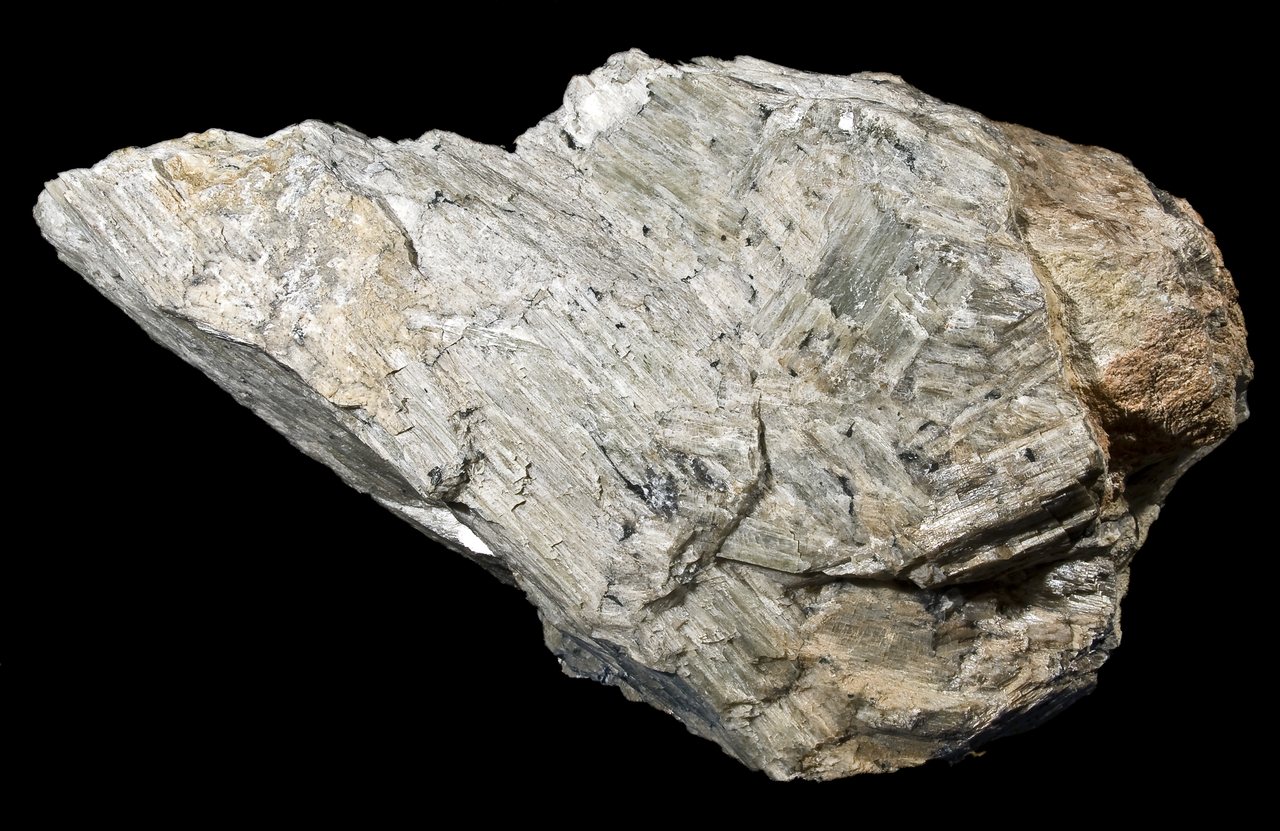
Qu'est-ce que c'est ?
A needle-shaped white mineral used as a safe replacement for asbestos fibre in brakes, boards and plastics.
Pourquoi est-ce important ?
Its acicular crystals reinforce a composite the way a fibre does, without the health consequences that ended asbestos.
Where it is in the Earth
Wollastonite is a calcium silicate mineral, meaning its structure is built from calcium, silicon and oxygen in a chain-like arrangement. It forms through a process called contact metamorphism, which happens when a body of hot magma intrudes into limestone or dolostone (carbonate rocks rich in calcium). The heat drives off carbon dioxide from the carbonate, and the calcium that remains reacts with silica — either from the intruding magma itself or from silica-bearing fluids moving through the rock — to crystallise as wollastonite. The key ingredient is therefore a geological coincidence: a calcium-rich sedimentary rock sitting close enough to an igneous intrusion that the two chemistries can meet at the right temperature.
The resulting deposits are found at what geologists call skarn zones — the altered contact between an igneous and a sedimentary rock. Skarns can carry many different minerals depending on what elements were available, but where the sedimentary rock was a relatively pure limestone and the fluids introduced little iron or aluminium, wollastonite can become the dominant mineral rather than a minor constituent. This explains why wollastonite deposits are geographically scattered but geologically specific: they require a particular combination of rock types and intrusive history that does not occur everywhere limestone exists.
The deposits that are large and pure enough to mine economically tend to sit in ancient orogenic belts — regions where continents have collided and buried rocks deeply enough for intense igneous activity. China's deposits, which account for the great majority of world output, lie in provinces where Mesozoic intrusions cut through Palaeozoic carbonate sequences. India's deposits occur in similar geological settings in Tamil Nadu and Rajasthan. North American production comes from skarn zones in the Adirondack region of New York and from Mexico, where comparable geological circumstances prevailed hundreds of millions of years ago.
Getting it out
Wollastonite is mined almost entirely from open pits. The geometry of a skarn deposit — a roughly tabular or lens-shaped body at or near the surface — suits open-pit methods well. Miners remove overburden, the rock that sits above the mineralised zone, by drilling and blasting it into fragments that can be loaded onto trucks and hauled away. The wollastonite-bearing rock is then blasted in turn and taken to a crusher at or near the pit. Where a deposit lies at depth or has an awkward shape, underground methods become possible, but they are the exception rather than the rule for this mineral.
Grade, in this context, means the proportion of useful wollastonite mineral in the rock as it comes out of the ground. Because wollastonite forms in a narrow contact zone, the ore body often grades outward into lower-quality or contaminated rock, and the boundary between ore and waste must be drawn carefully. A complicating factor is that the critical commercial property of wollastonite is not merely its chemical purity but its crystal shape. The mineral grows as elongated, needle-like crystals — described as acicular — and preserving that shape through mining and processing is as important as the chemical grade. Rock that is blasted too aggressively or crushed without care loses the high aspect ratio (the ratio of a crystal's length to its width) that gives the mineral its reinforcing character. This means that even at the mining stage, the method and the intensity of size reduction matter for end-product value.
Because the deposits are relatively small and geologically specific, waste-to-ore ratios vary considerably from site to site, and the data block does not supply a figure for a typical operation. What can be said qualitatively is that the stripping ratio — tonnes of overburden removed per tonne of ore — tends to be moderate at well-positioned open-pit operations, but rises as a pit deepens or as operators pursue lower-grade extensions of an orebody. The economics of wollastonite mining are therefore sensitive to deposit geometry in ways that large, disseminated deposits of other industrial minerals are not.
What pulls on it
Wollastonite is bought primarily by manufacturers who need to reinforce or fill a matrix — typically a polymer, a ceramic, a paint or a construction board — without adding biological hazard. The history of the market is inseparable from the history of asbestos regulation. For most of the twentieth century, asbestos fibre performed the same reinforcing function in friction materials, insulating boards and fibre-cement products, and it did so cheaply. As the link between asbestos exposure and lung disease became established and regulatory bans spread through industrialised countries from the 1970s onward, manufacturers needed alternative fibres that could survive high temperatures, resist chemicals and stiffen a composite. Wollastonite fitted a significant part of that need, and demand grew as the substitution worked its way through product lines and geographies.
Today the main end-use categories include plastics and polymers (where wollastonite stiffens components in automobiles and appliances), ceramics and tiles (where it reduces firing temperature and improves surface finish), paints and coatings (where it acts as a functional extender that also reduces the need for titanium dioxide), and construction products such as fibre-cement board and joint compounds. Each of these uses values slightly different properties: the plastics industry cares most about aspect ratio and surface treatment; the ceramics industry values the mineral's low thermal expansion and its contribution to glaze opacity; the paints industry values particle size and brightness.
Growth in wollastonite demand is broadly tied to construction activity in emerging markets, to the expansion of automotive plastics as manufacturers seek to reduce vehicle weight, and to the continuing phase-out of asbestos in countries that have not yet completed that transition. A sharp change in demand would require either a major shift in construction materials technology, a new regulatory requirement that specifically favoured or disfavoured wollastonite, or the emergence of a synthetic fibre that matched its properties at comparable cost — none of which appears imminent, though the data block contains no forecast figures on which to base a stronger statement.
Turning ore into product Niveau 3
Once the ore reaches the processing plant, the first task is comminution — reducing the rock to a size at which individual wollastonite crystals are liberated from the surrounding gangue minerals (the unwanted material that came along with the ore). This is where the acicular crystal habit creates a genuine engineering tension. Conventional ball-milling, which tumbles ore in a rotating cylinder with steel balls, is efficient at liberation but breaks needle-shaped crystals across their length, destroying the high aspect ratio that customers pay for. Producers therefore use impact mills, rod mills or carefully controlled grinding circuits that shear rock along grain boundaries rather than fracturing crystals. The choice of equipment and the residence time in each stage are calibrated to the specific liberation size of the deposit in question.
After grinding, concentration is achieved primarily by magnetic separation and froth flotation. Magnetic separation removes iron-bearing minerals — pyroxenes, amphiboles and iron oxides — that are common gangue constituents in skarn ore and that would contaminate the final product. Froth flotation, which exploits differences in the surface chemistry of minerals by attaching air bubbles selectively to certain particles, can further separate wollastonite from calcite or other calcium-bearing gangue. Acid leaching is used at some plants to dissolve residual carbonates. Each stage introduces a recovery loss: not all of the wollastonite that entered the mill exits as saleable product, and the proportion lost as tailings (the discarded fine-grained waste) depends on how tightly the gangue minerals are intergrown with the wollastonite crystals in the original ore.
The final product is graded and sold by aspect ratio. A product sold as high-aspect-ratio wollastonite — where crystals are much longer than they are wide — commands a premium because it provides greater reinforcement in a composite matrix. Lower-aspect-ratio material, sometimes called functional filler rather than reinforcing filler, competes on price with other calcium silicate minerals and carries a lower margin. The processing plant therefore has a sorting and classification function that is as commercially important as the chemical refining: material that has been broken during milling is downgraded, and the revenue yield of a tonne of ore depends heavily on how much of it survives as high-aspect-ratio product.
Substitution and recycling Niveau 3
The substitutes for wollastonite depend on which property is being replaced. In plastic reinforcement, short glass fibre is the most direct competitor: it offers comparable stiffening and is manufactured at scale, but it is denser than wollastonite, which raises the weight of a moulded part, and its processing can be more abrasive to equipment. Talc and mica are cheaper functional fillers that improve surface finish and dimensional stability but do not reinforce as effectively as a high-aspect-ratio mineral. Calcium carbonate is widely used as a low-cost extender but provides minimal reinforcement. In each case the substitution involves a trade-off: the alternative is either cheaper but weaker, or stronger but heavier or more expensive.
In ceramic glazes and tiles, nepheline syenite and feldspar can partially replace wollastonite, though they modify the melting behaviour and surface texture of the glaze differently and are not drop-in replacements. In paints, kaolin and precipitated calcium carbonate compete on cost, but wollastonite's distinctive platey-to-acicular particle shape gives it a specific role in anti-corrosion coatings that neither of those minerals replicates well. The functional specificity of wollastonite — the fact that its reinforcing behaviour comes from a physical shape rather than a chemical property — means that substitution is usually a compromise rather than a true equivalence.
Recycling of wollastonite-containing products is not practised in any meaningful way. Once the mineral is dispersed in a polymer matrix or fired into a ceramic body, recovery of the wollastonite as a discrete mineral is not technically or economically feasible with current methods. End-of-life plastic parts that contain wollastonite filler may be mechanically recycled, but the filler is retained in the recycled plastic as a contaminant of uncertain grade rather than recovered for reuse. This means the market is supplied entirely from primary mining, and any disruption to mine supply is not buffered by secondary material.
Where the chain is fragile Niveau 4
The production geography shown in the data block illustrates the central structural feature of wollastonite supply: China produces 600,000 of the 860,000 metric tons reported for 2025, a share large enough that policy changes, environmental enforcement actions or export restrictions originating in China would propagate directly and quickly into global availability. India and Mexico together add most of the remainder, with Canada a smaller contributor and United States production withheld by the source. The degree of concentration is therefore high by the standards of industrial minerals, even if it is less extreme than for some critical metals. Buyers outside China who seek security of supply have a limited pool of alternative producers to draw from, and expanding that pool requires time measured in years rather than months.
Unlike metals that emerge as by-products of base-metal smelting, wollastonite is a primary product at every known commercial operation, which means its production is not subsidised by co-product revenue in the way that, for example, tellurium production is cross-subsidised by copper refining. This cuts both ways: there is no hidden supply that could appear if a major co-product metal became more attractive, but equally there is no risk that wollastonite production will be curtailed because its host metal becomes uneconomic. Supply responds to wollastonite demand and wollastonite economics alone, which makes the market more transparent but also means capacity additions require dedicated capital and permitting.
Permitting and lead times represent a genuine constraint on supply response. Skarn deposits are geologically specific, and identifying a new deposit, completing environmental assessment, obtaining permits and constructing a concentrator plant takes a period that the available data do not allow to be stated with precision but that is typically long relative to the lead times of industrial customers. The processing constraint specific to wollastonite — the need to preserve crystal aspect ratio through milling — means that a new plant cannot simply adopt generic crushing and flotation equipment; the flowsheet must be tuned to the particular ore texture of the deposit, and this adds to commissioning time. Published production figures for wollastonite also carry some uncertainty because reporting conventions differ between countries: China's figures are compiled from provincial surveys that may not capture small or informal producers uniformly, while other countries report through national geological surveys with different methodologies, making direct comparison of reported totals an approximation rather than a precise accounting.
Qui le produit
Voir sur une carte →Mine production
Mine productionmetric tons 2025 (estimé) Total mondial 860,000 metric tons
USGS Mineral Commodity Summaries 2026 · Gross weight of concentrate. · source ↗
Faire défiler le tableau latéralement pour afficher les colonnes restantes.
| Pays | Production | Part mondiale |
|---|---|---|
| China | 600,000 | 69.8% |
| India | 120,000 | 14.0% |
| Mexico | 100,000 | 11.6% |
| Canada | 30,000 | 3.5% |
| Other countries | 11,000 | 1.3% |
| United States | Withheld | — |
| Total mondial | 860,000 | 100% |
« Withheld » signifie que l'USGS a supprimé le chiffre afin de ne pas divulguer les données d'une entreprise individuelle — cela ne signifie pas zéro. La somme des lignes par pays ne correspond pas toujours au total mondial, car la source arrondit chaque chiffre de manière indépendante et ne détaille pas toujours une ligne « autres pays ».