Che cos'è?
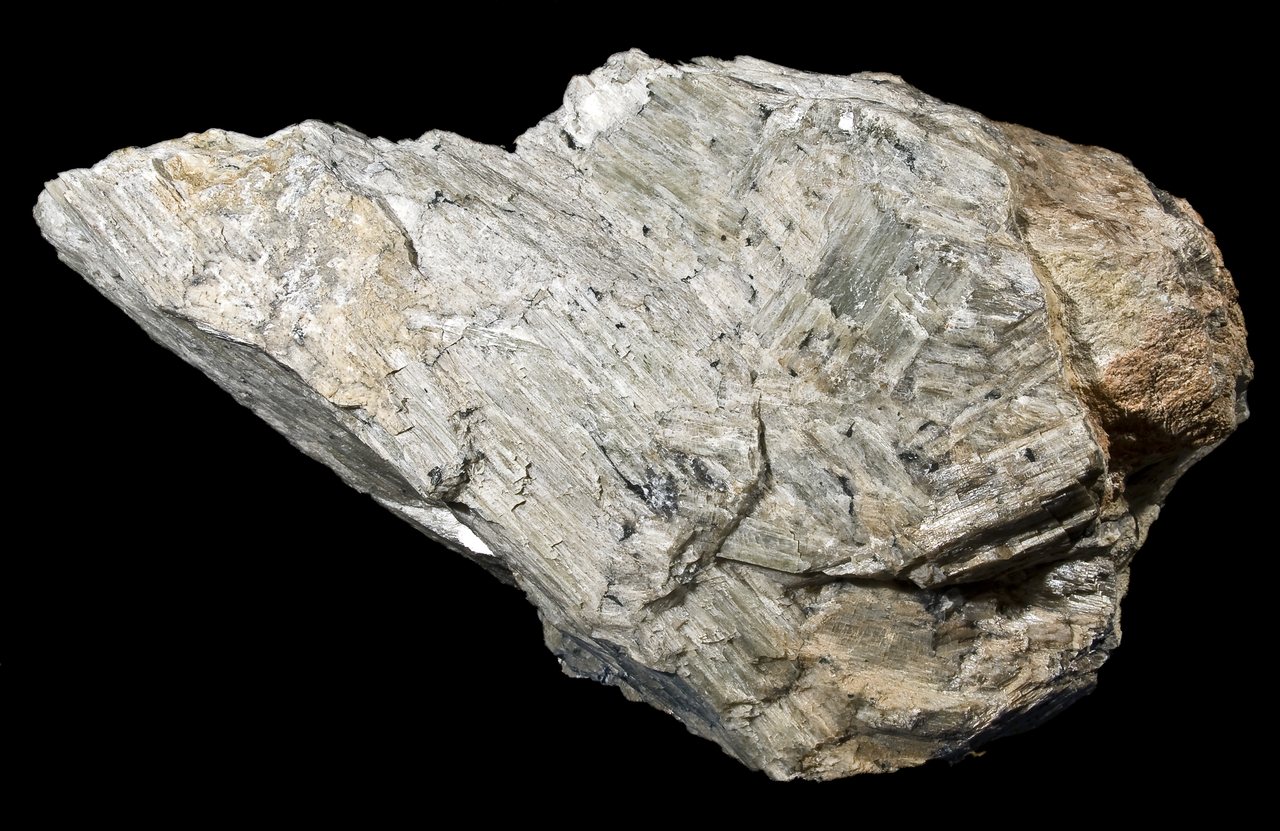
A needle-shaped white mineral used as a safe replacement for asbestos fibre in brakes, boards and plastics.
Perché è importante?
Its acicular crystals reinforce a composite the way a fibre does, without the health consequences that ended asbestos.
Where it is in the Earth
Wollastonite is a calcium silicate mineral, meaning its structure is built from calcium, silicon and oxygen in a chain-like arrangement. It forms through a process called contact metamorphism, which happens when a body of hot magma intrudes into limestone or dolostone (carbonate rocks rich in calcium). The heat drives off carbon dioxide from the carbonate, and the calcium that remains reacts with silica — either from the intruding magma itself or from silica-bearing fluids moving through the rock — to crystallise as wollastonite. The key ingredient is therefore a geological coincidence: a calcium-rich sedimentary rock sitting close enough to an igneous intrusion that the two chemistries can meet at the right temperature.
The resulting deposits are found at what geologists call skarn zones — the altered contact between an igneous and a sedimentary rock. Skarns can carry many different minerals depending on what elements were available, but where the sedimentary rock was a relatively pure limestone and the fluids introduced little iron or aluminium, wollastonite can become the dominant mineral rather than a minor constituent. This explains why wollastonite deposits are geographically scattered but geologically specific: they require a particular combination of rock types and intrusive history that does not occur everywhere limestone exists.
The deposits that are large and pure enough to mine economically tend to sit in ancient orogenic belts — regions where continents have collided and buried rocks deeply enough for intense igneous activity. China's deposits, which account for the great majority of world output, lie in provinces where Mesozoic intrusions cut through Palaeozoic carbonate sequences. India's deposits occur in similar geological settings in Tamil Nadu and Rajasthan. North American production comes from skarn zones in the Adirondack region of New York and from Mexico, where comparable geological circumstances prevailed hundreds of millions of years ago.
Getting it out
Wollastonite is mined almost entirely from open pits. The geometry of a skarn deposit — a roughly tabular or lens-shaped body at or near the surface — suits open-pit methods well. Miners remove overburden, the rock that sits above the mineralised zone, by drilling and blasting it into fragments that can be loaded onto trucks and hauled away. The wollastonite-bearing rock is then blasted in turn and taken to a crusher at or near the pit. Where a deposit lies at depth or has an awkward shape, underground methods become possible, but they are the exception rather than the rule for this mineral.
Grade, in this context, means the proportion of useful wollastonite mineral in the rock as it comes out of the ground. Because wollastonite forms in a narrow contact zone, the ore body often grades outward into lower-quality or contaminated rock, and the boundary between ore and waste must be drawn carefully. A complicating factor is that the critical commercial property of wollastonite is not merely its chemical purity but its crystal shape. The mineral grows as elongated, needle-like crystals — described as acicular — and preserving that shape through mining and processing is as important as the chemical grade. Rock that is blasted too aggressively or crushed without care loses the high aspect ratio (the ratio of a crystal's length to its width) that gives the mineral its reinforcing character. This means that even at the mining stage, the method and the intensity of size reduction matter for end-product value.
Because the deposits are relatively small and geologically specific, waste-to-ore ratios vary considerably from site to site, and the data block does not supply a figure for a typical operation. What can be said qualitatively is that the stripping ratio — tonnes of overburden removed per tonne of ore — tends to be moderate at well-positioned open-pit operations, but rises as a pit deepens or as operators pursue lower-grade extensions of an orebody. The economics of wollastonite mining are therefore sensitive to deposit geometry in ways that large, disseminated deposits of other industrial minerals are not.
What pulls on it
Wollastonite is bought primarily by manufacturers who need to reinforce or fill a matrix — typically a polymer, a ceramic, a paint or a construction board — without adding biological hazard. The history of the market is inseparable from the history of asbestos regulation. For most of the twentieth century, asbestos fibre performed the same reinforcing function in friction materials, insulating boards and fibre-cement products, and it did so cheaply. As the link between asbestos exposure and lung disease became established and regulatory bans spread through industrialised countries from the 1970s onward, manufacturers needed alternative fibres that could survive high temperatures, resist chemicals and stiffen a composite. Wollastonite fitted a significant part of that need, and demand grew as the substitution worked its way through product lines and geographies.
Today the main end-use categories include plastics and polymers (where wollastonite stiffens components in automobiles and appliances), ceramics and tiles (where it reduces firing temperature and improves surface finish), paints and coatings (where it acts as a functional extender that also reduces the need for titanium dioxide), and construction products such as fibre-cement board and joint compounds. Each of these uses values slightly different properties: the plastics industry cares most about aspect ratio and surface treatment; the ceramics industry values the mineral's low thermal expansion and its contribution to glaze opacity; the paints industry values particle size and brightness.
Growth in wollastonite demand is broadly tied to construction activity in emerging markets, to the expansion of automotive plastics as manufacturers seek to reduce vehicle weight, and to the continuing phase-out of asbestos in countries that have not yet completed that transition. A sharp change in demand would require either a major shift in construction materials technology, a new regulatory requirement that specifically favoured or disfavoured wollastonite, or the emergence of a synthetic fibre that matched its properties at comparable cost — none of which appears imminent, though the data block contains no forecast figures on which to base a stronger statement.
Chi lo produce
Visualizza sulla mappa →Mine production
Mine productionmetric tons 2025 (stimato) Totale mondiale 860,000 metric tons
USGS Mineral Commodity Summaries 2026 · Gross weight of concentrate. · fonte ↗
Scorrere la tabella lateralmente per visualizzare le colonne rimanenti.
| Paese | Produzione | Quota mondiale |
|---|---|---|
| China | 600,000 | 69.8% |
| India | 120,000 | 14.0% |
| Mexico | 100,000 | 11.6% |
| Canada | 30,000 | 3.5% |
| Other countries | 11,000 | 1.3% |
| United States | Withheld | — |
| Totale mondiale | 860,000 | 100% |
«Withheld» significa che l'USGS ha soppresso il dato per evitare di divulgare informazioni relative a una singola azienda — non equivale a zero. I valori per paese non sempre sommano al totale mondiale perché la fonte arrotonda ciascun dato in modo indipendente e non sempre disaggrega la voce «altri paesi».