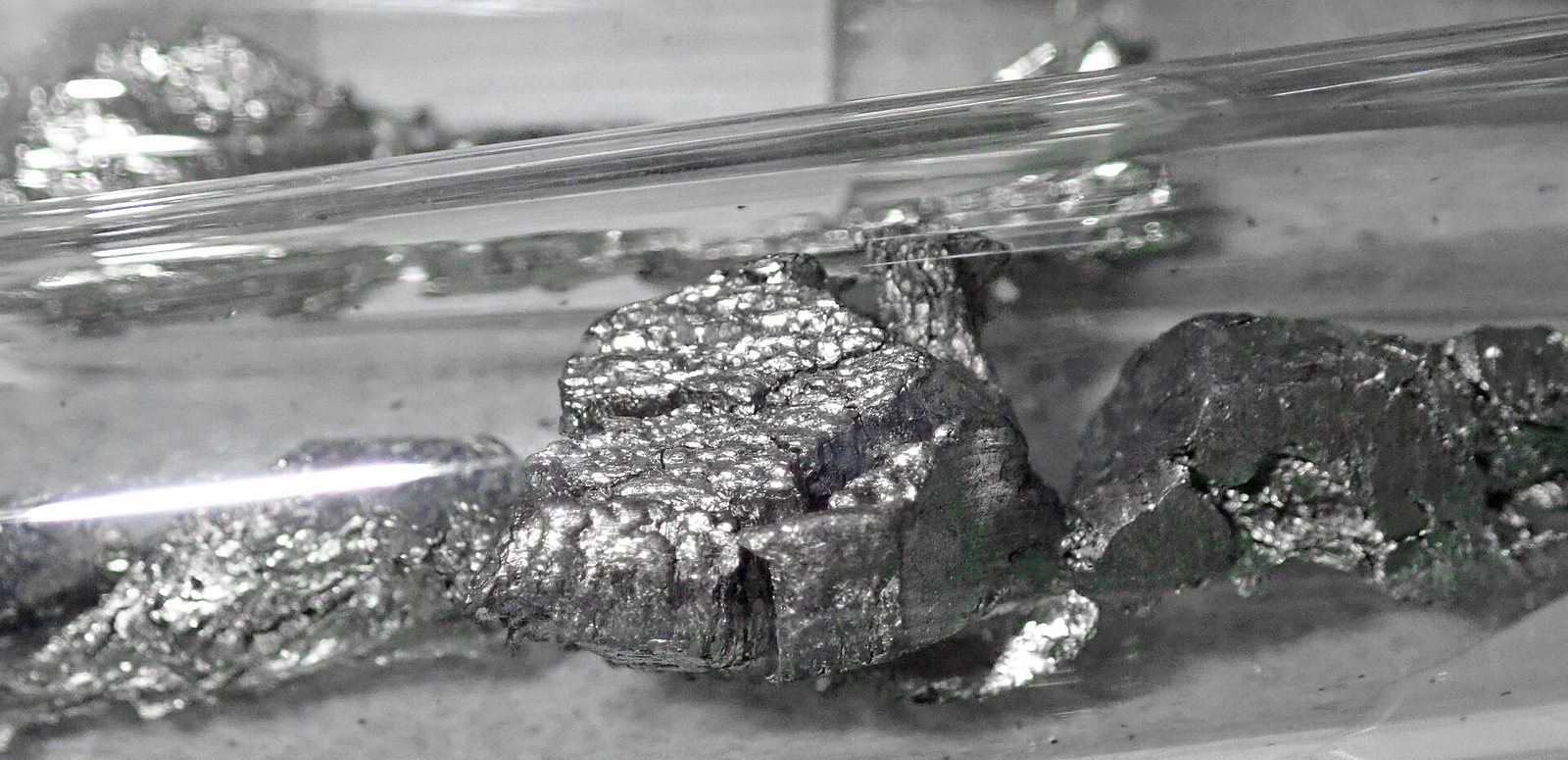
O que é?
A rare earth used in the fibre lasers that cut steel in factories, and in some of the most accurate atomic clocks ever built.
Por que razão é importante?
Ytterbium-doped fibre lasers displaced CO2 lasers across industrial cutting and welding in about a decade.
Where it is in the Earth
Ytterbium belongs to the group of elements collectively called the rare earth elements, or REEs. Despite the name, rare earths are not especially scarce in the Earth's crust — ytterbium is roughly as abundant as tin — but they rarely concentrate into deposits that can be mined economically. The reason lies in how the elements behave during the long, slow processes by which rocks form and are altered over millions of years. Ytterbium is one of the heavier rare earths, a grouping determined by the number of electrons in the atom rather than by physical weight, and the heavy REEs behave somewhat differently from their lighter cousins during geological processes.
The two main geological settings that produce workable ytterbium concentrations appear in the ore-mineral table above. The first is xenotime, a phosphate mineral that tends to crystallise inside certain granites and related igneous rocks, as well as in the ancient, wave-sorted beach and river sediments called placer deposits. Because xenotime is relatively resistant to weathering, it survives the erosion of the host rock and can accumulate in stream beds and coastal sands far from where the original granite formed. The second setting, and the one that has dominated production in recent decades, is the ion-adsorption clay deposit. Here, weathering in warm, humid conditions over millions of years has broken down granite, releasing REE ions that are then loosely held on the surface of clay minerals — principally kaolinite — rather than locked into a hard crystalline structure. These deposits are found predominantly in southern China, where the right combination of granitic bedrock, tropical weathering history, and sufficient geological time came together. The heavy REEs, including ytterbium, are proportionally more enriched in ion-adsorption clays than in most other deposit types, which is one reason these clays became so commercially significant.
Carbonatite rocks — igneous rocks unusually rich in carbonate minerals — host the world's largest REE deposits by total tonnage, but they tend to be enriched in the lighter rare earths and carry relatively little ytterbium. This means that ytterbium supply is more closely tied to the clay deposits and to placer xenotime sources than to the famous carbonatite mines that dominate discussions of cerium or lanthanum. Where the ore sits in the Earth thus has a direct bearing on where the supply chain begins and how it is structured.
Getting it out
The method used to mine ytterbium depends entirely on which type of deposit is being worked. Xenotime in hard-rock igneous or metamorphic settings is typically mined by conventional open-pit methods: the overlying rock and soil, collectively called overburden, is stripped away and the ore is blasted, loaded, and hauled to a processing facility. The same mineral in placer deposits is often won by dredging or by hydraulic mining of unconsolidated sands and gravels, techniques that are less energy-intensive because the material is already loose. In either case, xenotime is a minor constituent of the ore, and the ytterbium it contains is a fraction of the xenotime. A great deal of material therefore moves for each unit of ytterbium eventually recovered.
Ion-adsorption clay deposits are mined very differently. Because the clay is soft, loosely consolidated material, no blasting is required. Historically, surface scraping and open excavation sufficed. More recently, a method called in-situ leaching has been applied: a solution — typically a dilute ammonium sulfate or magnesium sulfate solution — is pumped into the clay through injection wells, the solution dissolves the REE ions away from the clay surfaces, and the resulting pregnant liquor is collected at drainage points lower on the hillside. This avoids moving large volumes of material physically. The trade-off is that the leaching solution must be carefully managed to prevent it from migrating into surrounding soils and waterways, and recovery of the injected solution is never complete. The grade of ion-adsorption deposits — that is, the concentration of REEs in the clay — is low by the standards of other metal ores, but the ease of processing the clay can offset this.
Because ytterbium is one of several rare earths present simultaneously in any of these deposits, it is always co-produced alongside other elements. It is not mined for its own sake; it appears as part of a mixed stream of REEs and must be separated from its companions at a later stage. This co-production relationship means that decisions about how much of any given deposit to mine are driven largely by demand for the more abundant or more valuable REEs in the same ore, and ytterbium production follows as a consequence rather than as a primary target.
What pulls on it
Ytterbium has a small number of distinct end uses, and they sit at opposite ends of the technology spectrum. The application that has driven most attention in recent years is the ytterbium-doped fibre laser. In these devices, ytterbium ions are incorporated into a glass fibre, where they absorb pump light of one wavelength and re-emit it at a longer wavelength suitable for cutting, welding, or marking metals and other materials. The proportion of ytterbium in the fibre is small, but it is essential: the specific electronic structure of ytterbium ions produces an emission wavelength and an efficiency that no other readily available dopant replicates at the same cost. Industrial manufacturing — automotive body panels, structural steel, consumer electronics casings — accounts for a large share of the fibre laser market. The USGS notes lasers alongside catalysts, metallurgy, and scintillators as primary applications.
The other application that draws considerable scientific interest is the ytterbium optical lattice clock. These are timekeeping instruments of extraordinary precision, in which ytterbium atoms are trapped in a grid formed by laser beams and their quantum energy transitions are used to define the tick of the clock. The quantities of ytterbium involved are minuscule — measured in micrograms rather than tonnes — but the application matters because it represents a potential future redefinition of the second itself, the base unit of time. Demand from this sector is essentially invisible in tonnage terms but significant in terms of the purity and form of material required.
Metallurgical uses — adding small amounts of ytterbium to certain stainless steels and other alloys to improve high-temperature oxidation resistance — represent a more diffuse demand that is difficult to track precisely. Scintillators, which are materials that emit light when struck by ionising radiation and are used in medical imaging and security screening equipment, represent another modest but persistent source of demand. What would have to change for demand to shift sharply? A significant decline in the adoption of fibre lasers in manufacturing, or the commercialisation of a functionally equivalent dopant, would reduce the largest demand segment. Conversely, broader rollout of precision timing infrastructure — for navigation, telecommunications synchronisation, or fundamental research — could increase demand for the highest-purity forms, though not in quantities that would register against the industrial laser market.
De onde vem na rocha
Todos os minerais de minério →Estes são os minerais que efetivamente transportam ytterbium. Um depósito só é um corpo de minério se um deles estiver concentrado o suficiente para justificar o custo de sua extração.
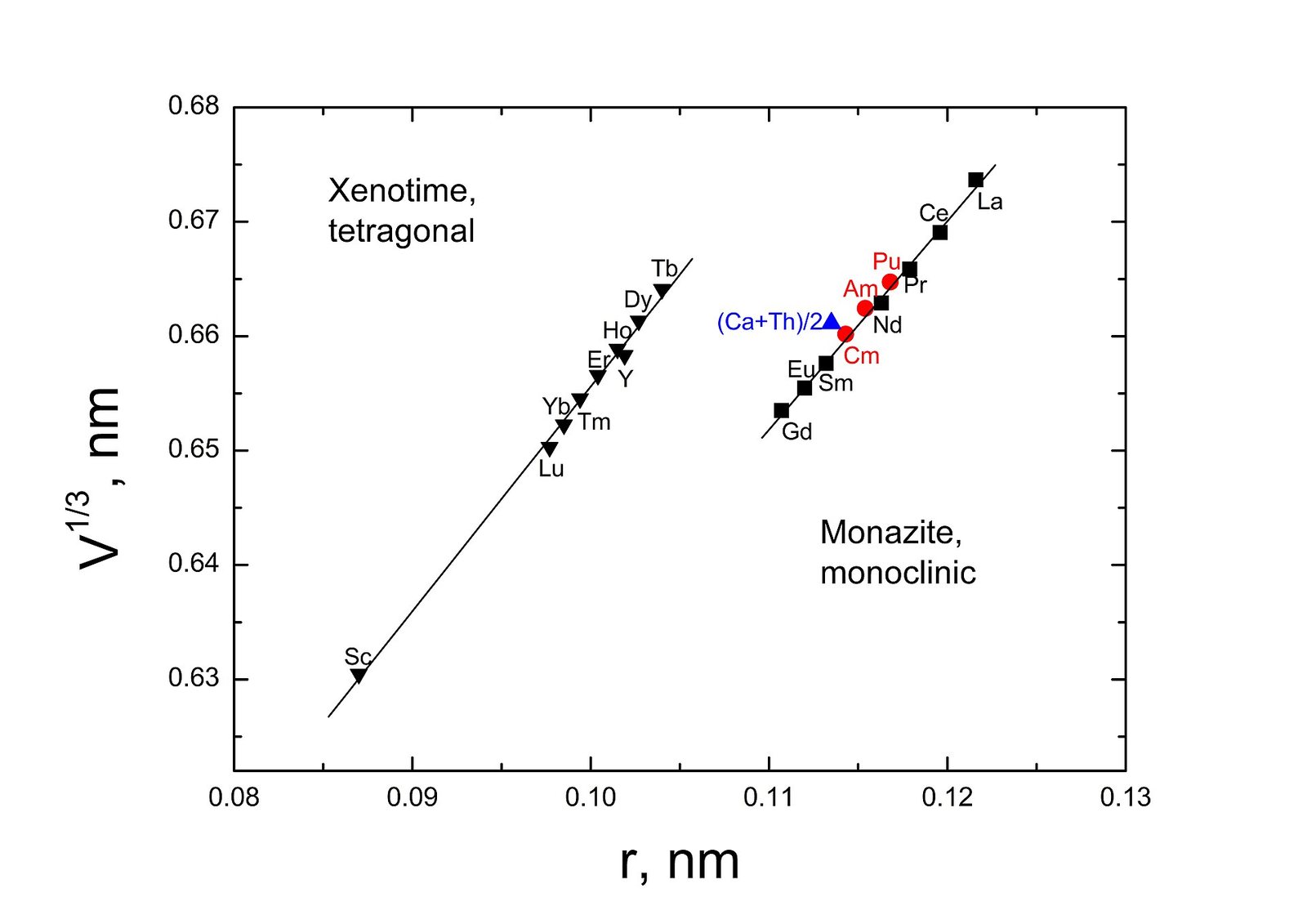
Xenotime
A yttrium phosphate that also carries the heavy rare earths — dysprosium, terbium, erbium — that magnets need.
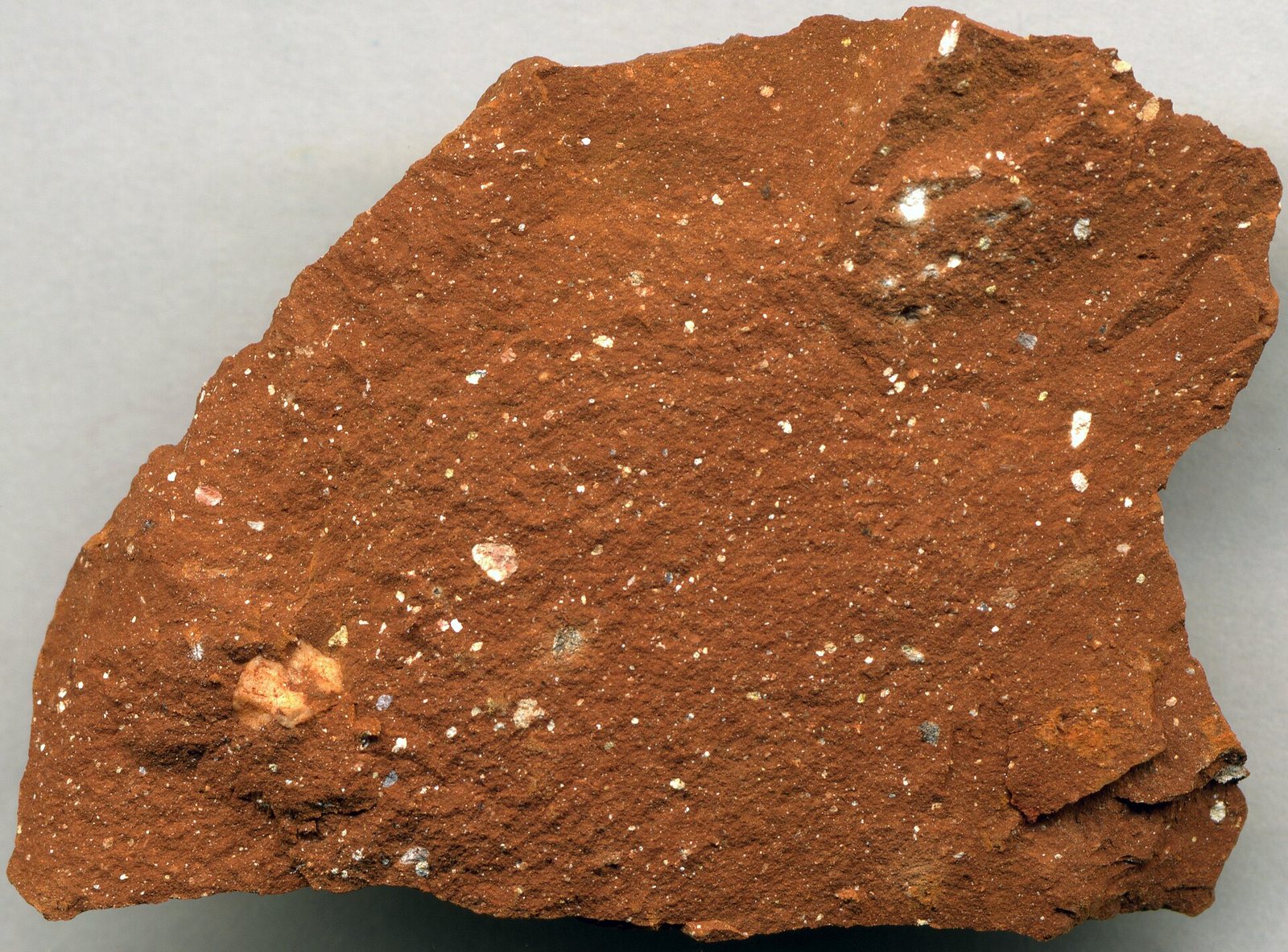
Ion-Adsorption Clay
Weathered granite where rare-earth ions cling loosely to clay surfaces. Grades are very low but the metal washes out…
Preço
average, dollars per kilogram: Ytterbium oxide, 99.99% minimum
Média anualdollars per kilogram
Base: average, dollars per kilogram: Ytterbium oxide, 99.99% minimum. Médias anuais conforme publicadas em USGS Mineral Commodity Summaries 2026 · fonte ↗. Estas são médias anuais de referência, não uma cotação de mercado em tempo real.