Module 3 · Smelting, refining and the narrow link
Electrorefining, and what falls to the bottom of the tank
Level 2 · Working knowledge 9 min read 4 questions
Two weeks in a tank takes copper from 98% to 99.99%. The impurities that drop out are a significant share of the world's supply of several other elements.
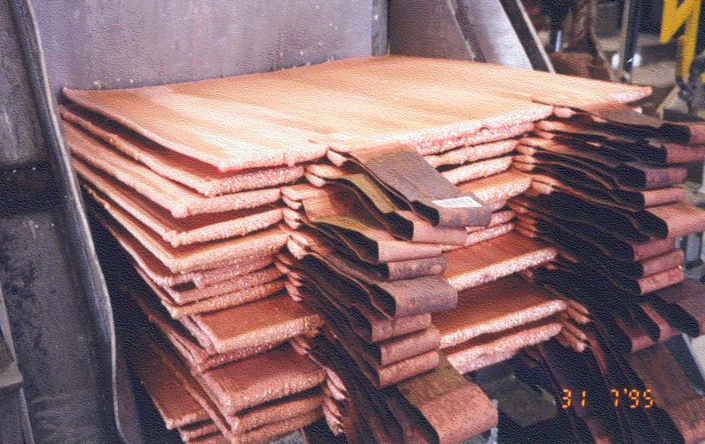
Blister copper is 98% copper, and the last 2% is what stops it being usable. Small quantities of the wrong elements - particularly oxygen, sulfur, bismuth and antimony - degrade conductivity and mechanical behaviour disproportionately. Removing them is done electrochemically.
How it works
Cast anodes of impure copper are hung in a tank of acidified copper sulfate solution, alternating with thin starter sheets or permanent blanks that will become the cathodes. A current is passed. Copper dissolves from the anode, travels through the solution as ions, and plates onto the cathode. The trick is selectivity: elements more reactive than copper dissolve but do not plate back, and elements less reactive than copper do not dissolve at all. They simply fall off the anode as it erodes and settle at the bottom of the tank.
Anode slimes
The sludge at the bottom of the tank is called anode slime, and it is one of the most valuable materials in the non-ferrous industry. It contains the elements too noble to dissolve: gold, silver, selenium, tellurium and the platinum-group metals. It is collected periodically and processed in a dedicated precious metals plant.
| Fate | Elements | Where they end up |
|---|---|---|
| Plates onto the cathode | Copper | 99.99% cathode |
| Dissolves but does not plate | Iron, nickel, cobalt, zinc, arsenic | Bled from the electrolyte and treated |
| Does not dissolve | Gold, silver, selenium, tellurium, platinum-group metals | Anode slimes, sold to a precious metals refinery |
Process chemistry; not time-varying · commodityeducation.com, Copper to the Grid
Why the cathode has to be this pure
Copper's selling point is conductivity, and conductivity is extraordinarily sensitive to dissolved impurities. Elements that stay in solid solution in the copper lattice scatter electrons; a fraction of a per cent of the wrong element costs a measurable percentage of conductivity. Oxygen is a special case: it is deliberately controlled rather than eliminated, and for applications where hydrogen embrittlement matters an oxygen-free grade is produced instead. The difference between 99.9% and 99.99% copper is not fastidiousness; it is the difference between a conductor that meets specification and one that does not.
Finished cathode is then registered against an exchange specification - LME Grade A is the usual reference - which is what allows a plate produced in Chile to settle a contract written in London and be delivered in Rotterdam. Standardisation at this step is what makes copper a traded commodity rather than a negotiated product.
- Electrorefining is selective dissolution: copper plates, noble metals fall, reactive metals stay in solution.
- Anode slimes are where much of the world's tellurium and selenium supply comes from.
- 99.99% purity is a functional requirement of conductivity, not a mark of quality for its own sake.
- Anode / cathode
- The dissolving impure plate / the pure plate that grows.
- Anode slimes
- The precious-metal-bearing sludge at the bottom of an electrorefining tank.
- Grade A
- The LME cathode specification that most copper contracts reference.
- By-productson this site
- Telluriumon this site
- Seleniumon this site
- Purity gradeson this site
Check yourself
1. Gold and platinum-group metals end up in anode slimes because they:
The separation is electrochemical: elements nobler than copper never enter solution and simply drop as the anode around them dissolves.
2. Why is the supply of tellurium hard to increase in response to demand for it?
By-product supply responds to the economics of the main metal. That is the structural problem this site's by-products lesson describes.
3. Cathode is refined to 99.99% because:
Impurities in solid solution scatter electrons. The purity requirement comes from the physics of the application.
4. Elements such as nickel and arsenic that dissolve but do not plate are dealt with by:
They build up in solution, so a portion of the electrolyte is continuously withdrawn and purified.