Module 1 · The molecule and the rock
Source, reservoir, trap: why oil is where it is
Level 1 · Foundation 9 min read 3 questions
An oil field needs four things to have happened in the right order over tens of millions of years. Getting three of them is a dry hole. This is why oil is clustered rather than spread.
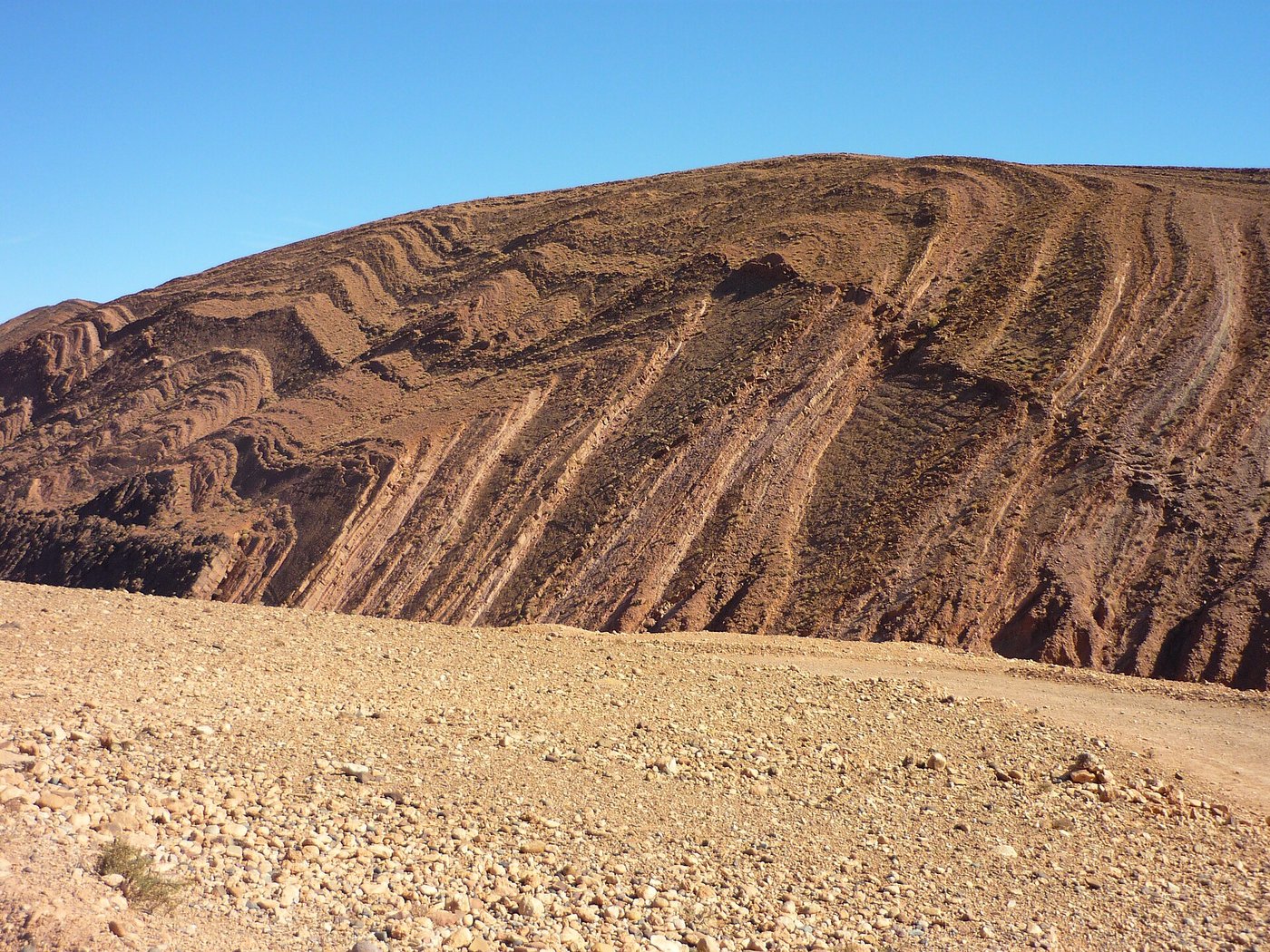
Oil is not distributed the way rainfall is. It is clustered into a relatively small number of sedimentary basins, and the reason is that a commercial accumulation requires a sequence of unlikely things to have happened in the right order. Geologists call the set of them a petroleum system.
What each element does to the economics
These are not just geological curiosities. Each element leaves a fingerprint on cost and on the character of the barrel:
- Source richness and type
- Marine algal source rocks tend to yield waxy, low-sulfur oil; source rocks deposited in restricted, oxygen-poor marine settings tend to give sulfur-rich oil. Sulfur content is set in the source rock, tens of millions of years before anyone drills.
- Depth and temperature
- Too shallow and the kerogen never cracked. Too deep and the oil cracked further into gas. The same basin often produces oil at one depth and gas at another.
- Reservoir quality
- Porosity is how much fluid the rock holds; permeability is how easily it flows. High permeability means fewer wells for the same output, which is the difference between a few dollars a barrel and tens of dollars a barrel in lifting cost.
- Trap size
- Sets how much is in one place, which decides whether a field can carry the fixed cost of a platform, a pipeline or an export terminal.
Why the Middle East
The material page for crude oil puts the geological case plainly: the ancient Tethys Sea laid down prodigious volumes of marine organic matter, the region then received thick carbonate reservoir rocks with excellent flow properties, and broad gentle structural traps formed at the right time. The result is a small number of very large fields in permeable carbonate, which is why a barrel there can be lifted for a fraction of what it costs almost anywhere else. The Saudi Arab Light journey follows one such barrel from reservoir to petrol and makes the point concretely: the same commodity, a fraction of the effort, because of what the molecule is and what rock it sits in.
When the system is incomplete
Sometimes the source rock cooked properly but there was no route out, or no trap to fill. The oil is then still sitting inside the source rock, dispersed through shale that has almost no permeability. That is tight oil, often called shale oil, and it is not a different substance - it is the same oil that never migrated. Sometimes migration reached the surface, the light fractions evaporated and bacteria degraded the rest, leaving heavy bitumen mixed into sand: the Alberta oil sands. Both are covered in lesson 6, and both require different extraction precisely because nature did not do the concentrating step.
- A field needs source, cooking, migration, reservoir and trap, in the right order and at the right time.
- Sulfur content and oil quality are inherited from the source rock, not created at the well.
- Tight oil and oil sands are the same petroleum system with a step missing, which is why they cost more to produce.
- Petroleum system
- Source, cooking, migration, reservoir, trap and seal, in the right order and timing.
- Oil window
- The depth and temperature range in which kerogen cracks to liquid oil rather than to gas.
- Porosity / permeability
- How much fluid a rock holds, and how easily that fluid flows through it. They are not the same property and a rock can have one without the other.
- Crude oil - where it is in the Earthon this site
- Oil sands and bitumenon this site
- Saudi Arab Light, tracedon this site
- Ore deposit types, for the mining comparisonon this site
Check yourself
1. A well is drilled into a good sandstone reservoir with an excellent seal, in a basin with a proven rich source rock, and comes up dry. What is the most likely explanation?
Timing is part of the petroleum system. A trap that formed too late catches nothing, however good it looks today.
2. Why does the same sedimentary basin often produce oil at one depth and natural gas at another?
The oil window is a temperature range. Past it, further cracking drives the mixture towards shorter chains and ultimately gas.
3. Tight (shale) oil differs from conventional oil mainly because:
It is the same oil. What is missing is the migration step that would have concentrated it somewhere permeable, so the permeability has to be created by fracturing.