Module 1 · What wood is, and how it is measured
Log rules: three answers to the same question
Level 2 · Working knowledge 10 min read 4 questions
How many board feet are in a log is not a measurement. It is an estimate produced by one of three rules that disagree with each other, most of all on small logs.
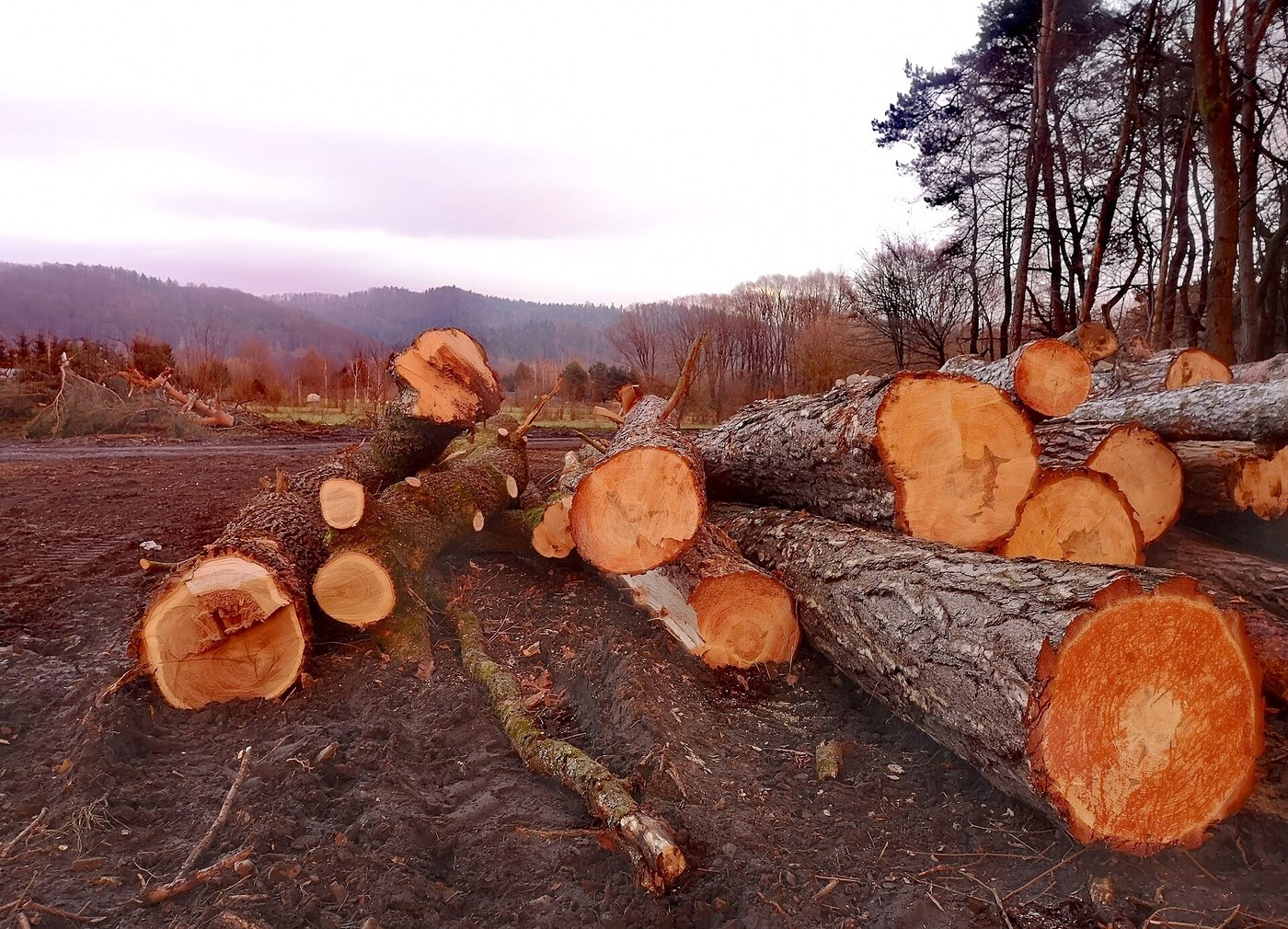
A standing tree and a log on the landing both contain some amount of usable lumber, and nobody knows what it is until the log is sawn. A log rule is a formula or table that estimates board-foot yield from the log's small-end diameter inside bark and its length. Three are in common use in North America, they give materially different answers, and the difference is money.
- Doyle
- The oldest and mathematically crudest. It subtracts four inches from the diameter before computing, as an allowance for slab and saw kerf. That allowance is far too large for small logs and too small for very large ones, so Doyle badly under-scales small timber. It remains the standard in much of the US South and parts of the Midwest, by custom.
- Scribner
- A diagram rule: someone drew boards inside circles of each diameter and counted. More accurate than Doyle for small logs, less generous than International. Widely used in the West and in US Forest Service timber sales, often as Scribner Decimal C, which rounds to the nearest ten board feet.
- International 1/4-inch
- A formula rule built from the actual geometry of sawing, assuming a quarter-inch saw kerf and a small taper allowance. It is generally considered the best estimate of what can actually be sawn from a log, and it is what state agencies and the US Forest Service use for inventory.
How far apart they are
The gap is largest on small logs and narrows as diameter increases. Compare the two rules on the same standing trees, from Ohio State University Extension's tables:
| DBH, inches | Doyle | International 1/4-inch | International as a multiple of Doyle |
|---|---|---|---|
| 12 | 50 | 100 | 2.00 |
| 14 | 80 | 140 | 1.75 |
| 16 | 120 | 180 | 1.50 |
| 18 | 160 | 240 | 1.50 |
| 20 | 220 | 300 | 1.36 |
| 24 | 360 | 430 | 1.19 |
| 28 | 520 | 600 | 1.15 |
| 32 | 730 | 790 | 1.08 |
| 36 | 970 | 1,010 | 1.04 |
| 40 | 1,230 | 1,250 | 1.02 |
Standard published volume tables · Ohio State University Extension, Measuring Standing Trees
Final column computed from the two published columns. The convergence at large diameters is the point: Doyle's fixed four-inch deduction is crippling on a 12-inch log and almost irrelevant on a 40-inch one.
A twelve-inch tree scales at half as much under Doyle as under International. For a landowner selling a stand of small timber, that is not a technicality - it is the difference between two offers that look similar per thousand and are not similar at all in total.
Overrun and underrun
Overrun is the amount by which a mill's actual lumber tally exceeds the scaled volume of the logs it sawed; underrun is the shortfall. Because Doyle under-scales, mills buying on Doyle typically report large overrun, and that overrun is real margin. Because International is close to actual recoverable volume, overrun against it is small and depends mostly on how well the mill is run - thinner kerf, better sawing decisions and better log positioning all show up here.
Scaling in practice
The last two steps carry most of the disagreement in a real transaction. Volume is a table lookup; defect deduction and grade are judgement, and they are where a scaler earns their keep on both sides of the sale.
- Doyle, Scribner and International give different board-foot answers for the same log.
- A price per MBF is meaningless without knowing the rule it is quoted on - Doyle can scale a small log at half of International.
- Volume is a lookup; defect deduction and grade are judgement, and grade usually moves price more.
- Log rule
- A formula or table estimating board-foot yield from a log's diameter and length.
- Scaling diameter
- Diameter inside bark at the small end of the log.
- Overrun / underrun
- Actual lumber tally above / below the scaled log volume.
- Net scale
- Gross scale after deductions for rot, sweep and other defect.
Check yourself
1. Under the Doyle rule, a 12-inch DBH tree with two 16-foot logs scales at 50 board feet. Under International 1/4-inch the same tree scales at:
100 board feet - twice the Doyle figure. Doyle's fixed four-inch deduction is crippling on small logs.
2. Why does the gap between Doyle and International narrow as log diameter increases?
Subtracting four inches from a 40-inch log matters far less than subtracting it from a 12-inch one.
3. A mill reports substantial overrun. The most likely explanation is that it:
Overrun is actual tally minus scaled volume. A conservative rule produces structural overrun that is priced into log prices.
4. Two buyers offer for the same stand: one at $600/MBF Doyle, one at $450/MBF International. Without more information you should:
Price per thousand on different rules cannot be compared. On small timber the Doyle scale can be half the International scale, so the total is what matters.