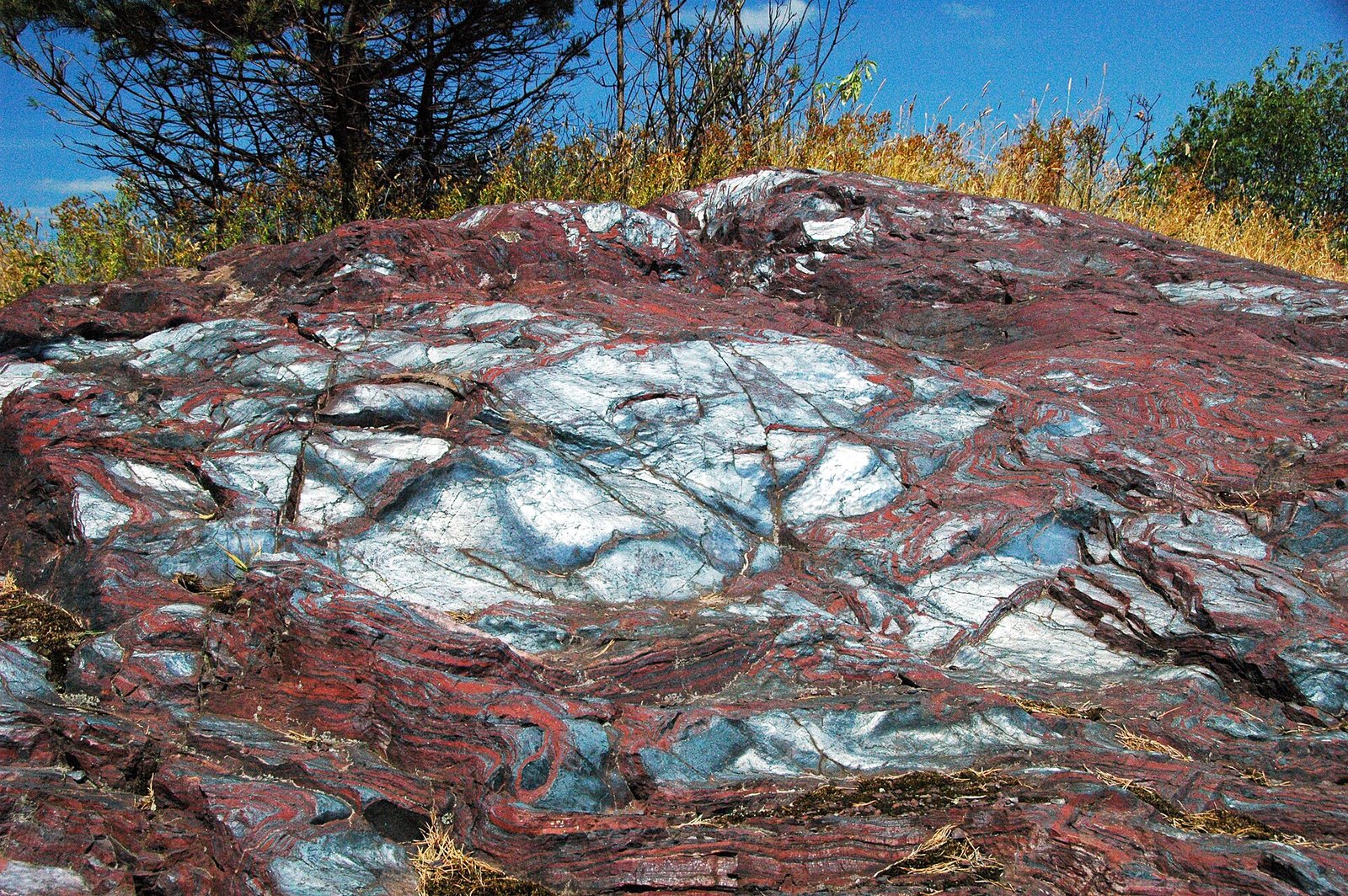
Imagine slicing through a rock and finding it striped like a layer cake — centimetre-wide bands of deep red chert alternating with silvery grey iron minerals, repeated hundreds of times over. That is a banded iron formation, and the stripes are not decorative accident. Each couplet is a chemical record laid down on an ancient seafloor, capturing a moment when dissolved iron and dissolved silica were precipitating out of seawater in rhythmic pulses. The largest accumulations formed between roughly 2.5 and 1.8 billion years ago, during an interval geologists call the Palaeoproterozoic, and they are now mined on every inhabited continent to feed steelmaking furnaces.
Why the oceans rusted
Early Earth had almost no free oxygen in its atmosphere or oceans. Iron leached from the seafloor by hydrothermal vents dissolved readily in that oxygen-free water, building up to concentrations that would be toxic to most modern organisms. Then, around 2.4 billion years ago, photosynthetic bacteria — cyanobacteria — began releasing oxygen as a waste product in sufficient quantities to change ocean chemistry. Oxygen reacts with dissolved iron to form iron oxides, which are insoluble and sink. The result was a vast, slow precipitation event: the oceans, in effect, rusted from the inside out, and the rust settled in layers on the seafloor.
The banding itself is still debated. Seasonal or longer-term cycles in biological productivity, fluctuations in hydrothermal input, and periodic mixing of deep and shallow water have all been proposed as pacemakers. Whatever the mechanism, the regularity of the lamination suggests that something was cycling with enough consistency to leave a repeated chemical signal across what are now entire mountain ranges of rock.
What the rock is made of
The iron-rich bands consist mainly of magnetite (an iron oxide, Fe₃O₄), haematite (Fe₂O₃), or iron-rich carbonates and silicates, depending on how oxidising the original conditions were and how the rock has been altered since. The silica-rich bands are mostly chert — microcrystalline quartz — which was once amorphous silica gel settling alongside the iron minerals. Together, the two phases give the formation its name: banded, for the layering; iron, for the dominant metal; formation, because geologists use that word for a mappable body of rock with consistent character.
Not all banded iron formations are equal in terms of iron content. The original sediment typically carried iron grades that, if expressed as a percentage of total rock, were relatively modest. What makes many deposits economically significant is secondary enrichment: groundwater moving through the rock over hundreds of millions of years has dissolved and carried away much of the silica, leaving a residual material much richer in iron oxides. These enriched zones — sometimes called direct shipping ore — can be mined and sent to a blast furnace with relatively little preparation.
An illustrative example of grade and enrichment
To see why enrichment matters, consider an illustrative calculation. Suppose an unenriched banded iron formation contains equal masses of iron oxide and chert by volume, giving a bulk iron grade of around 30%. If groundwater leaching removes roughly half the silica over geological time, the remaining material concentrates the iron oxides into a smaller volume. The iron grade in that residual material might rise to something closer to 60% — roughly double the original. That difference is not trivial: a steel plant designed around 60% feed ore would need to process far less rock per tonne of metal than one working with 30% feed, with corresponding differences in haulage, crushing and sintering costs. This is an illustrative scenario; actual grades vary by deposit and are measured by sampling programmes, not back-of-envelope calculation.
Where the major deposits are
The Pilbara region of Western Australia holds some of the most extensive banded iron formation sequences on Earth, and Australian exports of iron ore dominate global seaborne trade. The Quadrilátero Ferrífero — the Iron Quadrangle — in the state of Minas Gerais, Brazil, is another major province, its name reflecting how iron-saturated the landscape is. The Hamersley Basin in Australia and the formations around Carajás in Brazil are frequently cited in the same breath as the largest known iron ore accumulations. Significant deposits also occur in South Africa, India, Ukraine, Russia, Canada and the United States, most of them following the same Palaeoproterozoic age range, because that is when the chemical conditions for their formation were most widespread.
From ancient seafloor to steel
Mining a banded iron formation typically begins with drilling and blasting the hard, siliceous rock, followed by crushing and screening to separate ore from waste. Enriched ore may go directly to port; lower-grade material usually passes through a beneficiation circuit where magnetic separation exploits the magnetic properties of magnetite to concentrate the iron minerals. The product — either lump ore, fines or pellets — is then shipped to steel mills, where it enters a blast furnace alongside coke and limestone to produce pig iron, the precursor to steel.
The sheer scale of this trade is worth appreciating in qualitative terms. Iron ore is one of the largest commodity flows by mass of any material traded internationally, and banded iron formations are the source of the overwhelming majority of it. The connection between a two-billion-year-old chemical event in an ancient sea and the steel in a modern bridge or car body is direct and unbroken by any geological transformation since.
For the reader who wants to go further
The questions that remain genuinely open at research level include the precise biological and chemical mechanisms driving the banding periodicity, the role of anoxygenic photosynthetic bacteria (which can oxidise iron without producing oxygen), and the relationship between different depositional facies — oxide, carbonate, silicate and sulphide — within a single formation. Understanding those facies transitions matters both for reconstructing Precambrian ocean chemistry and for predicting where within a formation the highest-grade ore is likely to sit. The literature on the Great Oxidation Event and its relationship to banded iron formation deposition is a natural starting point for anyone prepared to read primary geochemistry.