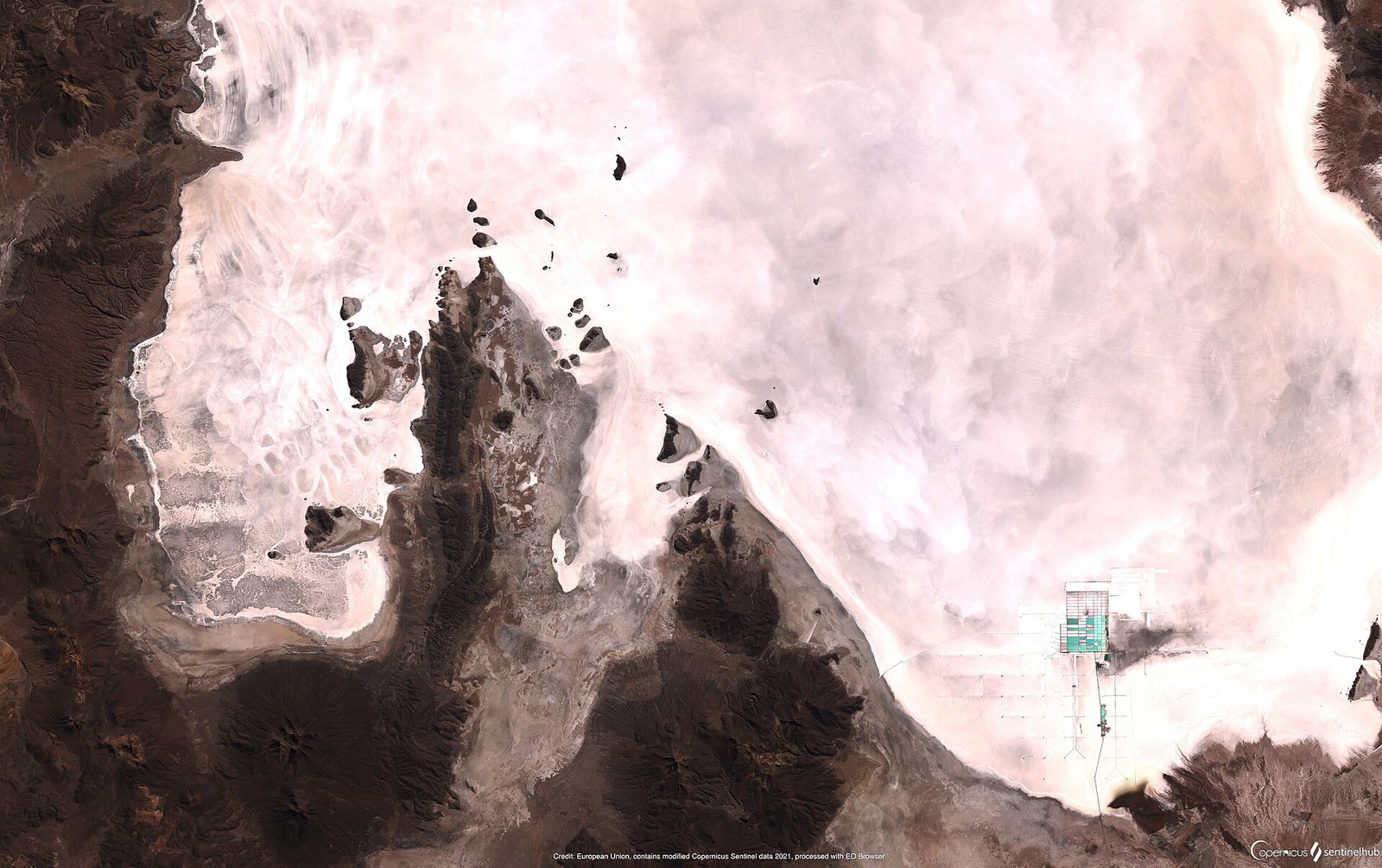
On the Atacama plateau, at roughly four thousand metres above sea level, sits a flat white crust the size of a small country. It looks barren. Beneath and within it, however, lies a saturated brine — water so loaded with dissolved salts that little else can stay in solution. This is the Salar de Atacama, and it is one of the places where the modern world goes to find lithium. Understanding why it exists, and why similar places yield potash, boron and iodine, requires thinking about what happens when water has nowhere to go.
How evaporite basins form
When a body of water sits in a closed basin — one with no outlet to the sea — evaporation eventually removes more water than rainfall and river inflow can replace. The dissolved minerals stay behind. Over geological time, if conditions remain arid, the concentration climbs until salts begin to crystallise out of solution in a predictable sequence: the least soluble compounds precipitate first, the most soluble last. The resulting layered deposits are called evaporites. Common salt (halite) typically appears early in the sequence; highly soluble potassium and magnesium salts come later. Lithium, being extremely soluble, tends to remain in the residual brine rather than forming its own early mineral, which is why the liquid itself is often the ore, not a solid rock.
The geological settings vary. Some evaporite deposits are ancient marine sequences, formed when arms of a sea were cut off and dried out over millions of years — the potash beds of Saskatchewan and the Permian Basin in Europe formed this way. Others are continental, fed by rivers draining volcanic highlands rich in the right elements. The Andean salars sit above some of the world's most lithium-rich volcanic geology, and the rivers that drain into these closed basins have been leaching that lithium for millions of years.
Why the sun does most of the work
Solar evaporation is not a metaphor for cheap energy; it is literally the processing step. At a brine operation, the raw brine is pumped from below the salar surface into a sequence of large shallow ponds. As water evaporates under the intense high-altitude sun, salt concentrations rise and different compounds drop out of solution at each stage. Operators move the progressively enriched brine from pond to pond, allowing each unwanted salt — sodium chloride, magnesium sulfate and others — to crystallise and be separated before the lithium-enriched liquor moves on. The sun provides the thermal energy for this separation at no direct fuel cost, which is a significant reason why salar brine operations have historically had low operating costs compared with hard-rock lithium mining.
To see the arithmetic, consider an illustrative example. Suppose a brine contains lithium at a concentration of 0.15% by weight. Evaporating away roughly two thirds of the water would, in principle, triple that concentration to around 0.45%. Evaporate further and the figure rises again. Of course real brines also contain magnesium, sodium, potassium and sulfate, all of which complicate the chemistry, but the underlying logic — concentrate by removing water — is straightforward. The engineering challenge is managing the impurities and the time required, since large evaporation ponds may take many months to cycle through.
Lithium
Lithium in brines originates mainly from the weathering of lithium-bearing volcanic rocks and from hydrothermal fluids. Rivers carry dissolved lithium into closed basins, where it accumulates over geological timescales. Because lithium chloride is so soluble, it stays in solution long after most other salts have crystallised, meaning the most lithium-rich brines are those that have been concentrating the longest in the most arid conditions. Not all brines are equal: the ratio of magnesium to lithium matters considerably, because magnesium is chemically similar to lithium and makes downstream processing more difficult. Brines with a low magnesium-to-lithium ratio are generally more amenable to processing.
Potash
Potash is a loosely used term for potassium-bearing salts, principally sylvite (potassium chloride) and carnallite (potassium magnesium chloride). Most of the world's potash comes from ancient marine evaporite sequences rather than continental salars. When shallow inland seas evaporated hundreds of millions of years ago, they left behind thick layered sequences that now lie buried under younger rock. Mining these deposits involves reaching the potassium-rich layers, which sit above the more abundant halite but below the surface. Because potash is a primary ingredient of agricultural fertiliser, the geography of these ancient seabeds has a direct bearing on global food production.
Boron
Boron concentrates in evaporite basins that are fed by hydrothermal or volcanic springs rich in boron compounds. Turkey and the United States hold a large share of known deposits. The principal minerals are borax and colemanite, which form in continental lake evaporites rather than marine ones. Boron's chemistry makes it relatively easy to identify and separate once it has been concentrated by evaporation, and surface or near-surface deposits have historically been worked by open-pit methods. Industrial uses range from glass and ceramics to agriculture and specialist materials.
Iodine
Iodine has a less obvious connection to evaporites but belongs to the same family of elements concentrated by natural water chemistry. In Chile's Atacama region, iodine occurs in nitrate-bearing evaporite deposits — the same caliche deposits that were once the world's main source of agricultural nitrogen. The iodine is thought to derive partly from ancient marine organic matter, concentrated and preserved under extreme aridity. Japan is the other major source, where iodine comes not from surface evaporites but from ancient brine trapped in deep sedimentary formations, pumped to surface and processed. In both cases, the underlying story is the same: prolonged natural concentration of a trace element that would be unworkable at its original dilution in seawater or rock.
What shapes the supply geography
The distribution of these commodities is not random. It reflects a specific set of geological coincidences: closed drainage basins, arid climates, the right source rocks or hydrothermal systems, and enough time. The Andes, the Middle East's ancient seabeds, the arid interior of Asia and the old continental margins of North America and Europe account for a large share of known resources precisely because those regions satisfy one or more of those conditions. When a commodity appears scarce in a country or region, the reason is usually geological rather than a matter of effort.
Going further
A reader moving into more technical territory will find that the chemistry of brine processing — particularly the phase diagrams governing which salts crystallise at which concentrations and temperatures — becomes the central subject. The behaviour of mixed electrolyte solutions, selective precipitation, membrane separation and solvent extraction methods each build on the same foundational chemistry described here. Isotope geochemistry offers another route: the ratios of lithium, boron and sulfur isotopes are used both to trace the origin of brines and to distinguish different geological sources, which matters for resource characterisation and environmental monitoring alike.