A bottle of water and a very expensive metal
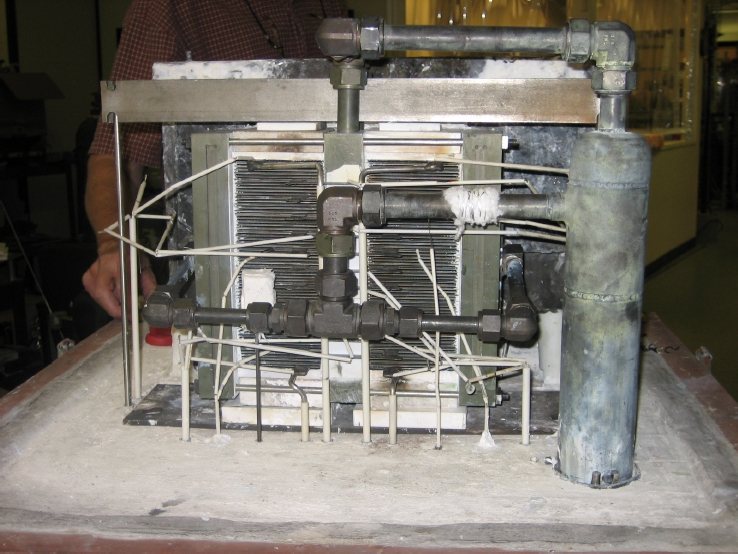
Somewhere in a research facility in Germany or South Korea, a stack of cells about the size of a suitcase is quietly splitting water into hydrogen and oxygen using nothing but electricity. The principle is simple enough that a schoolchild can demonstrate it with a battery and two pencils. The engineering challenge, however, comes down to what sits between the electrodes — and whether the world can mine enough of it.
That question is not abstract. Green hydrogen, produced by electrolysis powered by renewable electricity, is widely expected to play a role in decarbonising industries that cannot easily run on batteries alone: steelmaking, shipping, certain chemical processes. How fast that can happen depends in part on two competing electrolyser designs whose material needs are almost entirely different. One of them has an iridium problem.
Two routes to the same reaction
Both designs do the same thing: pass an electric current through water and collect the gases that appear at each electrode. Hydrogen forms at the cathode, oxygen at the anode. The difference is in what kind of electrolyte — the medium that carries ions between the electrodes — each design uses.
Alkaline electrolysers, the older technology, use a liquid solution of potassium hydroxide in water as the electrolyte. The electrodes on each side are separated by a porous membrane called a diaphragm, and the electrodes themselves are typically made from nickel or nickel alloys, sometimes with cobalt added to improve performance. These are reasonably abundant metals. Alkaline systems have been manufactured at scale for decades, particularly for industrial applications, and their supply chains are mature.
Proton exchange membrane electrolysers — PEM for short — take a different approach. Instead of a liquid electrolyte, they use a solid polymer membrane, typically based on a material called Nafion, which conducts protons. Because the membrane is highly acidic in operation, most common metals corrode rapidly against it. The only materials that survive reliably at the anode, where conditions are harshest, are platinum-group metals: specifically iridium as a catalyst and titanium as the structural material beneath it. The cathode is less demanding and typically uses platinum.
Why iridium is the constraint
Iridium is one of the rarest elements in the Earth's crust. It occurs primarily as a byproduct of platinum mining in South Africa and, to a lesser extent, in Russia and Zimbabwe. Because it is a byproduct, its supply cannot simply be scaled up by opening a new iridium mine; production is tied to the rate at which platinum is mined, and platinum demand is driven largely by catalytic converters in vehicles — a market that is itself shifting as electric vehicles displace combustion engines.
The amounts of iridium involved in each electrolyser cell are small, but they accumulate. To illustrate the arithmetic, suppose — as an illustrative example — that a PEM stack requires 0.4 grams of iridium per kilowatt of capacity. A modest hydrogen facility with 100 megawatts of electrolyser capacity would then need around 40 kilograms of iridium. Scale that thinking to the gigawatt-scale deployments that hydrogen roadmaps envision, and the numbers begin to press against realistic annual production figures. The constraint is not that iridium is impossible to obtain; it is that demand from a rapidly growing PEM industry could outpace what mining and refining can supply in a given year.
Platinum is less scarce than iridium, though it still qualifies as a precious metal. Its use in PEM cathodes is a secondary concern relative to iridium, and catalyst loading on that side of the cell has already been reduced substantially by ongoing research.
The alkaline bill of materials
Alkaline electrolysers avoid platinum-group metals almost entirely. Nickel is the primary electrode material, and while nickel has its own supply considerations — demand from lithium-ion battery cathodes has grown sharply — it is produced in far larger quantities than any platinum-group metal and from a more geographically distributed set of mines. Cobalt appears in some electrode formulations, and cobalt supply carries its own well-documented concerns, but it is not structurally required in the way iridium is for PEM.
The diaphragm or membrane in an alkaline system is typically made from polymers or asbestos-free composite materials. Alkaline stacks also tend to use more steel in their structural components than PEM, which relies more on titanium — a metal that is geologically abundant but expensive to refine and fabricate because of the energy intensity of the Kroll process that extracts it from ore.
Trade-offs in performance and application
If alkaline electrolysers are cheaper in materials and have more straightforward supply chains, why does PEM exist at all? The answer is operating characteristics. PEM systems respond quickly to fluctuating power inputs, which makes them well-suited to pairing with variable renewable electricity sources like wind or solar. They also operate at higher pressures and produce hydrogen with less downstream processing required. Alkaline systems are better adapted to steady, continuous operation and have historically been the choice for large industrial facilities running on grid power around the clock.
Neither design is categorically superior. The choice depends on the application, the available power source, and the cost constraints of a given project. What is clear is that a world building out both types simultaneously faces different material bottlenecks depending on which route it favours, and those bottlenecks exist in entirely different parts of the mining and refining industries.
What is being done about the iridium loading
Research into reducing the iridium content per unit of capacity is active and has already produced meaningful reductions compared to earlier generations of PEM technology. The direction of travel involves thinner catalyst layers, better dispersion of iridium across the electrode surface, and the search for mixed-oxide materials that might perform acceptably with less iridium, or in some formulations with none at all. Recycling iridium from end-of-life stacks is another route that becomes more significant as the installed base grows, though the industry is young enough that the volume of material available for recovery remains small at present.
A reader wanting to go further might look into the electrochemistry of oxygen evolution reaction catalysts, the specific stability mechanisms that make iridium oxide perform where other oxides fail, and the emerging literature on anion exchange membrane electrolysers — a third design that attempts to combine PEM's performance characteristics with an alkaline-compatible, platinum-group-metal-free material bill.