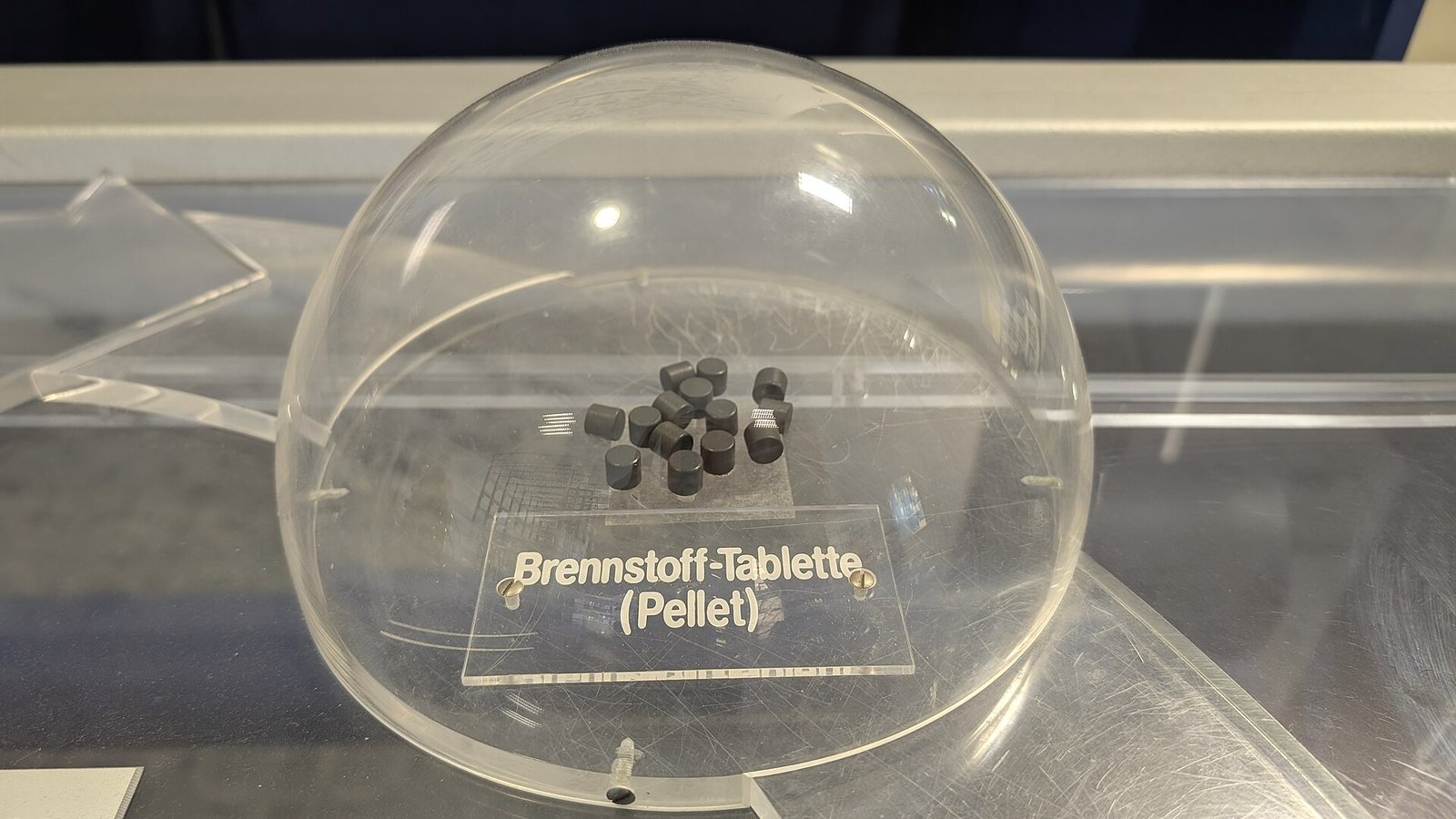
Picture a small ceramic cylinder, roughly the size of a wine-gum sweet. It sits in the palm of a hand, weighs about as much as a coin, and contains enough energy — when fissioned in a reactor — to match several tonnes of coal. That pellet did not arrive at the reactor door simply by mining uranium. Before it could generate heat, the uranium it contains passed through at least five distinct industrial stages, each governed by international safeguards and national licensing regimes. Understanding those stages is what the nuclear fuel cycle is about.
Where it begins: uranium concentrate
Uranium ore is mined by conventional open-pit or underground methods, or extracted through in-situ leaching, where a weak acid or alkaline solution is pumped through a porous ore body to dissolve uranium in place. The dissolved uranium is then recovered at surface. Regardless of the mining method, the product leaving the mine site is a dried, partially refined powder known commercially as uranium concentrate — more commonly called yellowcake, for the colour of earlier batches (modern material is often closer to brown or grey). Yellowcake is predominantly uranium oxide, though the precise chemical composition varies by processing route. It is not yet suitable for a reactor; further chemistry is required.
Conversion: from oxide to gas
Most commercial power reactors — the light-water designs that dominate the global fleet — require uranium in enriched form, meaning a higher proportion of the fissile isotope uranium-235 than nature provides. Achieving that enrichment demands a process that can physically separate isotopes, and the most widely used approach works on a gas. The yellowcake must therefore be converted into uranium hexafluoride, written as UF₆ and pronounced "hex" in the industry. Conversion plants react the oxide with fluorine compounds through a series of steps, producing a material that is solid at room temperature but becomes a gas when modestly heated. UF₆ is chemically aggressive and requires specialist handling; this stage is carried out at a small number of dedicated commercial facilities worldwide.
Enrichment: sorting isotopes
Natural uranium contains a very low proportion of uranium-235, with the remainder being almost entirely uranium-238, which does not fission readily under the conditions in a light-water reactor. Enrichment raises the share of uranium-235 to the level a reactor specification requires — typically a few percent for power reactors, well below the concentrations associated with weapons material. Gas centrifuge technology is now the dominant commercial method. Banks of rapidly spinning centrifuges exploit the tiny mass difference between molecules of UF₆ containing uranium-235 and those containing uranium-238; the slightly heavier molecules migrate outward, allowing the lighter, fissile-enriched fraction to be drawn off. Many thousands of centrifuges are cascaded together to reach useful enrichment levels. The process produces two streams: enriched uranium hexafluoride, destined for fuel fabrication, and depleted uranium hexafluoride, in which the uranium-235 fraction is lower than natural. Depleted uranium is stored at enrichment sites in large quantities and has some industrial uses, though much remains in long-term storage.
A worked illustrative example
To give a sense of the material flows, suppose — illustratively — that a fabrication plant needs to produce a batch of fuel enriched to a uranium-235 content three times that found in natural uranium. Because enrichment concentrates the fissile isotope into a smaller mass of product and pushes the rest into the depleted stream, the plant must feed in a considerably larger mass of natural uranium than it will recover as enriched product. The exact ratio depends on the target enrichment and how thoroughly the plant depletes the tails, but the general principle is that the enriched output is always a fraction of the feed — meaning a reactor's annual fuel requirement traces back to a substantially larger initial quantity of mined and converted uranium. Small improvements in centrifuge efficiency reduce the feed required for a given output, which is why enrichment technology is continuously refined.
Conversion back to oxide and pellet fabrication
Enriched UF₆ is not loaded directly into a reactor. At a fuel fabrication plant, it is converted back into a solid ceramic material — uranium dioxide, UO₂ — and the fluorine is recovered or treated as a byproduct. The UO₂ powder is pressed into the familiar cylindrical pellets and then sintered in high-temperature furnaces. Sintering drives off moisture, closes internal pores and densifies the ceramic to a consistent, controlled specification. The resulting pellets are hard, chemically stable and highly resistant to the temperatures they will encounter in a reactor core. Dimensional tolerances are tight: pellets that vary in diameter by even a small fraction of a millimetre can affect how they sit within their cladding tube.
Fuel assembly
Finished pellets are loaded into tubes of zirconium alloy — a metal chosen because it absorbs very few of the neutrons that sustain a chain reaction and because it resists corrosion in hot water. These tubes, called fuel rods or fuel pins, are sealed at each end and assembled into a precise geometric array with spacers, guide tubes and end-fittings to form a fuel assembly. A single assembly for a large power reactor contains a large number of individual rods, each holding a column of pellets. Assemblies are manufactured to exacting specifications because they must slot into a reactor core and remain dimensionally stable for years under neutron bombardment, heat and coolant flow.
Regulation along the entire chain
Every step described above is subject to safeguards administered by the International Atomic Energy Agency and by national regulatory bodies. The intent is to account for all nuclear material through the cycle — tracking mass and isotopic composition at each transfer point — to detect any diversion. Operators maintain detailed material balances, submit to inspections and operate under licences that specify exactly what quantities they may hold and process. The fuel cycle is probably the most intensively regulated industrial supply chain in existence.
For the reader going further
The steps covered here represent the front end of the nuclear fuel cycle. A fuller understanding requires engaging with the back end as well: what happens to spent fuel assemblies after they leave the reactor, covering storage, reprocessing options, the behaviour of transuranic actinides and fission products, and the long-term management of high-level waste. Readers with technical backgrounds will also find that each stage described above contains significant engineering and materials science depth — centrifuge rotor dynamics, sintering kinetics, zirconium alloy metallurgy — each of which is treated in specialist literature and in the Level 3 and 4 articles linked elsewhere in this site.