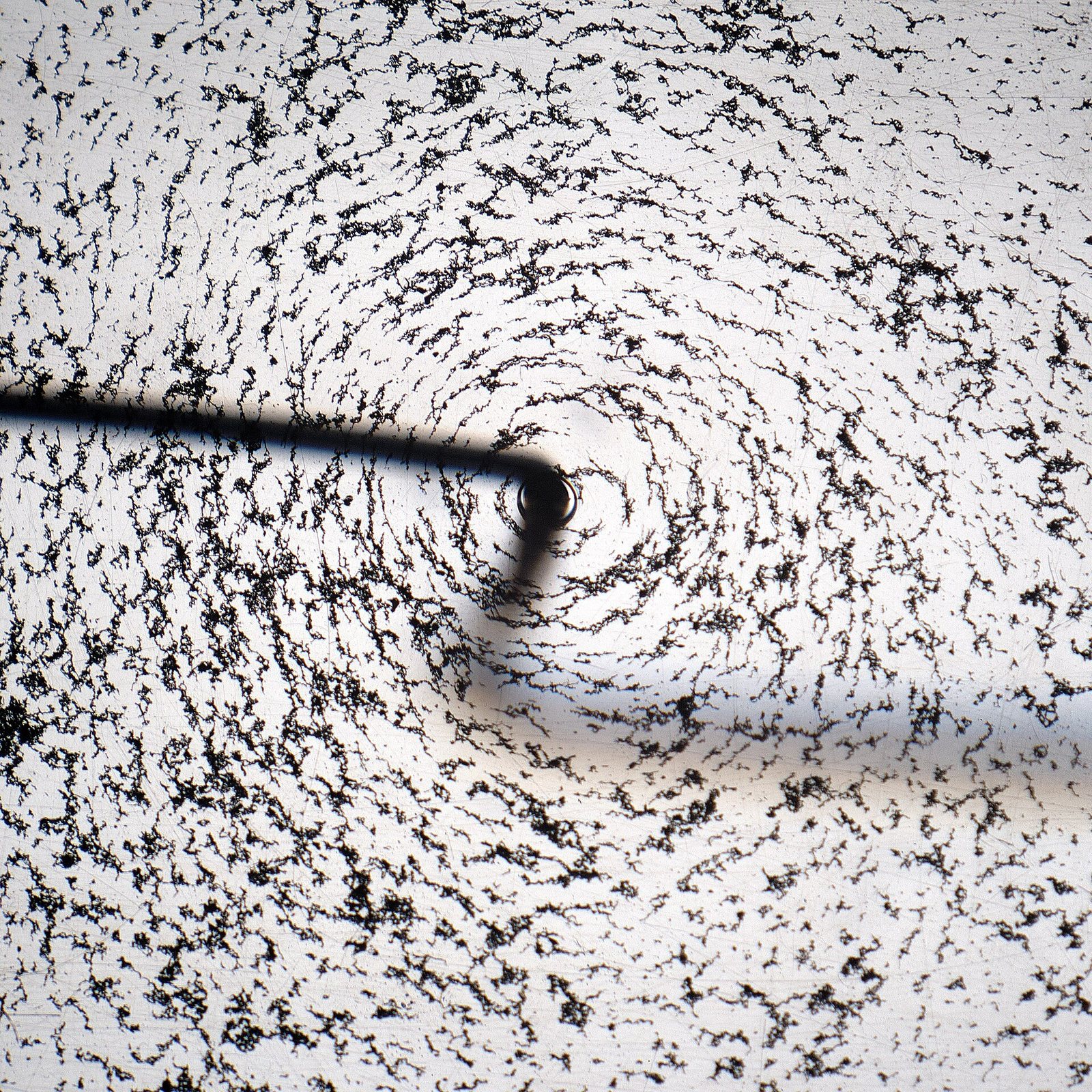
A magnet you cannot pull off
Stick a fridge magnet to a steel door and it holds a shopping list without complaint. Now try to pull it off with your fingers: a gentle tug is all it takes. The magnet in the motor of an electric car is a different matter entirely. Engineers have to apply a substantial opposing field just to begin disturbing it, and at room temperature that field must be enormous by everyday standards. Both objects are called permanent magnets, but they belong to different worlds. Understanding why requires a short journey into what magnetism actually is at the scale of atoms.
Where magnetism lives
Every electron behaves like a tiny bar magnet, a property that arises from quantum mechanics rather than from anything spinning in a mechanical sense. In most materials, electrons pair up so that their magnetic moments point in opposite directions and cancel out. In a handful of elements — iron, cobalt, nickel and a few others — some electrons remain unpaired, giving each atom a net magnetic moment. The real question is whether those atomic moments line up with their neighbours or point in random directions.
Inside any magnetic material, small regions called domains form spontaneously. Within a single domain every atomic moment points the same way, so the domain as a whole acts like a tiny magnet. In an unmagnetised piece of iron, millions of domains exist but point in random directions, so they cancel each other and the piece looks magnetically inert. When you bring a strong external magnet close, domains whose direction is near-parallel to the external field grow at the expense of their neighbours, and the iron temporarily becomes magnetic. Remove the field and most domains shuffle back toward disorder. That shuffling is precisely what makes soft iron useful for transformer cores — it follows an applied field easily — and useless for a permanent magnet.
A permanent magnet resists that reshuffling. It needs what physicists call high coercivity: a strong resistance to having its domains re-randomised by an opposing field or by heat.
The fridge magnet and its limits
The material in a typical fridge magnet is a flexible composite containing ferrite — iron oxide combined with barium or strontium. Ferrite is cheap, corrosion-resistant, and perfectly adequate for holding paper against steel. Its coercivity, however, is modest. The energy it takes to flip its domains is low, which is why a competing field — even the modest one produced by a second fridge magnet held nearby — can disturb it. The energy stored per unit volume, a quantity called the energy product, is comparatively small.
Why neodymium changes everything
Neodymium–iron–boron magnets, usually written NdFeB, achieve a far higher energy product than ferrite. The neodymium atoms in the crystal lattice create a strong internal electric field that locks the magnetic moments of the iron atoms into a preferred direction with unusual tenacity. This is called magnetocrystalline anisotropy: the crystal structure itself acts as a sort of ratchet, making it energetically costly to rotate the moments away from that preferred axis.
The consequence is a coercivity and energy product that are in a different class from ferrite. The energy product of NdFeB is roughly a thousand times greater than that of a typical ceramic fridge magnet — which is why the data sheets for electric-motor magnets use units that would have seemed absurd to engineers who grew up with ferrite. A motor that would have required a large, heavy ferrite magnet assembly can instead use a much smaller, lighter NdFeB component and still produce the same force.
To make NdFeB magnets, the alloy is melted, cast, crushed to a fine powder, aligned in a magnetic field, pressed, and sintered into a dense solid. The alignment step is critical: the powder particles are all oriented so that their easy magnetisation axes point the same way before sintering locks them in place. The resulting block is then magnetised by a brief, intense external field, and from that point it resists demagnetisation strongly.
A simple illustrative example
This is illustrative only and does not represent any real motor. Suppose a motor designer needs a magnetic flux of a given value in a compact gap. With ferrite, achieving that flux might require a magnet volume of, say, one hundred arbitrary units. Because NdFeB stores roughly a thousand times more magnetic energy per unit volume, the same flux could in principle be delivered by a magnet of roughly one-tenth of a unit — a reduction of about a thousandfold in volume. In practice, losses and geometry mean the real gain is smaller, but the direction of the arithmetic explains immediately why NdFeB transformed the design of loudspeakers, hard-drive actuators, wind-turbine generators, and traction motors.
Heat: the principal enemy
Every magnetic material has a Curie temperature, the point above which thermal agitation overwhelms the alignment of atomic moments and magnetism collapses entirely. For NdFeB this temperature is considerably lower than for some competing materials, which is one of the reasons engineers pay close attention to operating temperature.
Even well below the Curie temperature, heat causes trouble. As temperature rises, the coercivity of NdFeB falls. Domains that were locked in place at room temperature become easier to flip as the magnet warms up. If a motor runs hot and the magnet's coercivity drops far enough, a strong opposing field — the kind the motor itself generates under certain fault conditions — can partially demagnetise the magnet. That demagnetisation may be irreversible: when the motor cools, the magnet does not recover its original strength because some domains have been permanently redirected.
The industry response has been to substitute some of the neodymium with heavier rare earth elements, principally dysprosium or terbium, which restore coercivity at elevated temperatures. This approach works, but dysprosium and terbium are scarcer and more geographically concentrated than neodymium, which is why the supply chain for high-temperature NdFeB magnets draws as much attention from materials analysts as the magnets' performance does from engineers.
Where to go next
Readers with a closer interest in the field may want to look into the physics of magnetic anisotropy fields and how the Stoner–Wohlfarth model describes single-domain particle behaviour, or at the grain-boundary diffusion techniques now used to deposit dysprosium selectively at domain walls rather than throughout the bulk — a refinement that reduces the quantity of heavy rare earth needed without sacrificing high-temperature coercivity.