A blast furnace is essentially a very tall chimney running in reverse. Instead of drawing smoke upward, it forces hot air and burning coke downward through a column of iron ore, stripping away the oxygen that makes ore useless as a structural material. The carbon in the coke does the stripping, and the carbon leaves as carbon dioxide. That exchange — carbon for iron — is why steelmaking has historically been one of the largest single sources of industrial greenhouse gas emissions. The question engineers have been working on for decades is whether the carbon can be replaced with something else.
Why coal is there in the first place
Iron ore is mostly iron oxide. To make iron, you need to remove the oxygen atoms bonded to the iron — a chemical step called reduction. Carbon, supplied by coke made from coking coal, is very good at this job. It grabs the oxygen atoms and leaves as carbon monoxide or carbon dioxide. The iron that remains collects at the bottom of the furnace as liquid pig iron, which is then converted into steel by removing most of its carbon content. The coal therefore plays two roles at once: it is a fuel that generates the heat, and it is a chemical reagent that performs the reduction. Any alternative route has to handle both jobs.
Direct reduction: swapping carbon for gas
The first major alternative is called direct reduction. Instead of melting the ore in a blast furnace, direct reduction passes a reducing gas — traditionally a mixture of carbon monoxide and hydrogen derived from natural gas — over iron ore pellets at high temperature but below the melting point. The oxygen leaves with the gas, and what remains is a porous, sponge-like solid called direct reduced iron, or DRI. Because the iron never becomes liquid inside the reduction vessel, the process uses substantially less energy than a blast furnace route, and it can be built at smaller scale.
DRI made with natural gas still produces carbon dioxide, but considerably less per tonne of steel than the blast furnace route. The more significant change comes when the reducing gas is switched to hydrogen. Hydrogen reacts with the oxygen in the ore and the only by-product is water vapour. If the hydrogen is produced by electrolysis powered by low-carbon electricity, the reduction step can be made nearly free of direct emissions. Several steelmakers in Europe have built or are constructing pilot and demonstration plants on this principle, though commercial-scale operation remains at an early stage.
The electric arc furnace
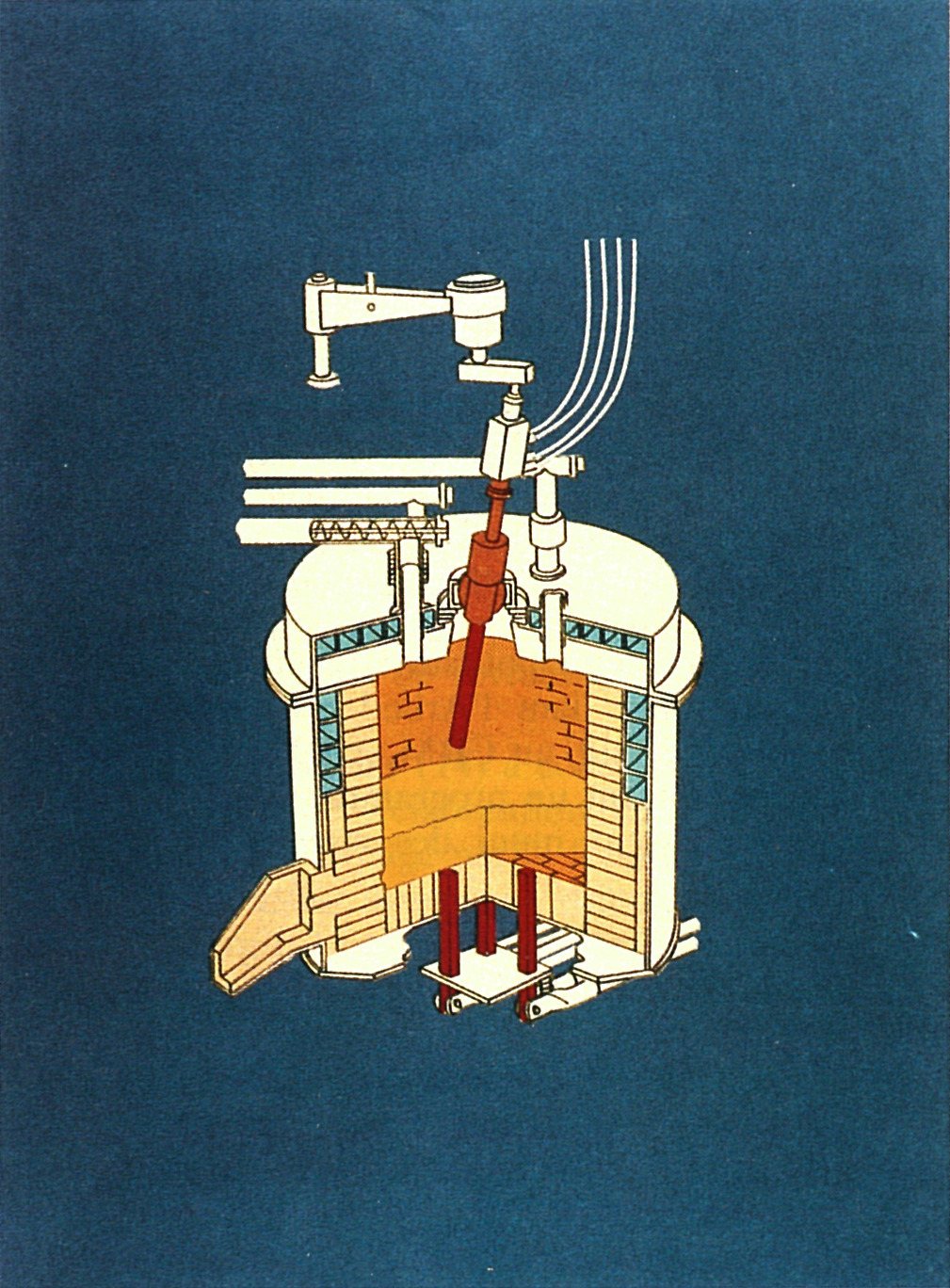
DRI does not arrive at a finished steel product on its own. Once reduced, the iron still needs to be melted and refined. For the newer routes, that refining step usually happens in an electric arc furnace, or EAF. An EAF melts its charge — DRI, scrap steel, or a mixture of both — using electrical arcs struck between large graphite electrodes. The process is fast compared with the integrated blast furnace route, and an EAF mill can in principle run on renewable electricity. EAFs have been widely used for decades to recycle scrap steel, and they already account for a substantial share of global steel production.
When an EAF is charged with DRI rather than scrap, it can produce the flat-rolled, high-specification steel that automotive and appliance manufacturers require — grades that scrap-fed furnaces have historically struggled to meet consistently, because scrap carries impurities from previous uses.
A worked example (illustrative)
Suppose a steelworks is designing a hydrogen-DRI route and wants to understand the rough hydrogen requirement. Reducing one tonne of iron from iron oxide requires removing a fixed quantity of oxygen. The chemistry dictates that, in round terms, you need in the region of fifty-four kilograms of hydrogen to reduce enough ore for one tonne of iron. Producing that hydrogen by electrolysis requires a substantial quantity of electricity — the exact figure depends on electrolyser efficiency, but the energy demand is not trivial. If electricity costs money, and electrolysers have capital costs, then every tonne of green steel carries an energy cost that coking coal, when cheap, does not. This is an illustrative calculation to show the structure of the cost; real plant figures vary with equipment choice, ore grade and operating conditions.
The point the example illustrates is that hydrogen steelmaking is not just a matter of swapping one pipe for another. It requires either cheap, abundant low-carbon electricity or a willingness to pay a premium — or both. The competitiveness of the route relative to conventional steelmaking therefore depends heavily on where a plant is built and what the local electricity system looks like.
The scrap ceiling
Scrap steel is, in a sense, already reduced iron. Melting it in an EAF uses far less energy than making iron from ore, and it sidesteps the reduction problem entirely. The catch is that the global supply of scrap is finite and tied directly to how much steel society has already used and is ready to discard. Steel that goes into a building stays there for decades; steel in a car becomes available as scrap after the vehicle's working life. The total pool of scrap available in any given year is therefore set by decisions made years or decades earlier, not by current demand.
This creates what analysts call the scrap ceiling: there is a maximum fraction of world steel production that could theoretically be made from scrap alone, and that fraction is determined by how much end-of-life steel flows back into the market. As long as global steel demand is growing and as long as steel embedded in infrastructure has not yet reached end of life, the scrap available falls short of what a fully scrap-based industry would need. Some new primary iron production — from ore — will remain necessary for the foreseeable future, which is precisely why the hydrogen-DRI route matters: it offers a path to primary iron without the coking coal.
Where this sits in the larger picture
The three elements described here — direct reduction, hydrogen as the reductant, and electric arc melting — are increasingly discussed together as the basis of a lower-emission integrated steelmaking route. None of the individual technologies is brand new; what is changing is the attempt to combine them at industrial scale and to supply them with genuinely low-carbon hydrogen and electricity. Readers who want to go further should look at the metallurgical constraints on DRI quality, particularly the effects of gangue minerals in the ore on EAF operation, and at the question of how different hydrogen production pathways — electrolysis, autothermal reforming with carbon capture — compare in lifecycle emissions terms. Those details sit closer to level three of this series.