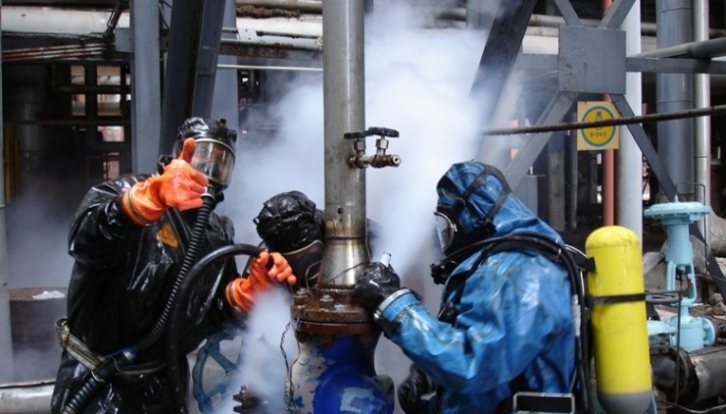
Đây là gì?
Nitrogen pulled out of the air and joined to hydrogen under pressure — the invention that roughly doubled how many people the planet can feed.
Tại sao điều này quan trọng?
Ammonia synthesis consumes on the order of one to two percent of world energy and is the reason synthetic fertiliser exists at all.
Where it is in the Earth
Nitrogen is not mined from a deposit in any conventional sense. It does not accumulate in a vein, a seam, or a sedimentary bed the way iron or potash do. Instead, the raw material is the air itself, which is approximately four-fifths nitrogen by volume. The challenge has never been scarcity of the element — nitrogen is the most abundant gas in the atmosphere — but rather the extraordinary stability of the nitrogen molecule. Two nitrogen atoms are held together by a triple bond, one of the strongest in common chemistry, which makes atmospheric nitrogen almost entirely inert. Plants and most other organisms cannot use it in that form.
The geological story of nitrogen as a resource is therefore really the story of a fixation problem. In nature, lightning and certain soil bacteria break that triple bond and convert atmospheric nitrogen into compounds — nitrates, ammonium — that living things can absorb. Before the twentieth century, agriculture depended on these natural pathways plus deposits of sodium nitrate, called caliche, found in the Atacama Desert of Chile, where extraordinarily dry conditions preserved ancient accumulations of oxidised nitrogen compounds in surface rocks. Those Chilean deposits were the world's principal source of fixed nitrogen for fertiliser and explosives until a synthetic alternative arrived.
The synthetic alternative is the Haber-Bosch process, developed in the early twentieth century, which uses high pressure and temperature together with an iron catalyst to force atmospheric nitrogen to react with hydrogen and form ammonia (NH₃). From that point on, the limiting factor on nitrogen supply shifted from geology to energy and hydrogen supply. Modern ammonia plants are built near natural gas pipelines, not near ore deposits, because the hydrogen comes almost entirely from natural gas through a process called steam methane reforming. The nitrogen still comes from air, separated at the plant. There is no ore grade to speak of and no overburden to move.
Getting it out
Because ammonia synthesis draws its nitrogen from the atmosphere, there is no mine in the usual sense. Air separation units — large industrial installations that cool air until it liquefies and then fractionate it by the different boiling points of its components — deliver essentially pure nitrogen gas to the synthesis section of the plant. This is an industrial rather than an extractive operation, and the concept of ore grade or strip ratio does not apply to it.
The meaningful extraction step is on the hydrogen side. Most hydrogen used in ammonia production today comes from natural gas, and that gas is produced through conventional well drilling and gathering. Where coal is used as the hydrogen feedstock, as is common in China, it arrives via coal mining. The energy intensity of getting hydrogen to the plant — and the carbon footprint that comes with it — is where the economics and the environmental discussion actually live. A smaller share of global ammonia is made using hydrogen from coal gasification, naphtha reforming, or, in a growing number of announced projects, electrolysis powered by renewable electricity, though the last of these remains a small fraction of current output.
The only remnant of conventional mining in the nitrogen supply chain is the Chilean caliche, which still produces some natural nitrates used in speciality applications. That material is mined by open-pit methods from surface and near-surface horizons in the Atacama, but it plays no material role in global nitrogen supply compared with synthetic ammonia. The practical result is that the nitrogen supply chain carries almost none of the geological concentration risk that surrounds metals or even phosphate, but it carries very large energy and feedstock risks instead.
What pulls on it
The overwhelming share of ammonia production goes into fertiliser, and the reason is straightforward: nitrogen is the element most commonly limiting to plant growth in agricultural soils. Crops remove nitrogen from the soil every harvest, and without replenishment yields fall. The three principal fertiliser products — urea, ammonium nitrate, and ammonium sulfate — deliver that nitrogen in forms crops can absorb. The global population and the dietary shift in growing economies toward more meat, which requires more grain per calorie, have together kept fertiliser nitrogen demand on a long upward trend.
Outside agriculture, ammonia feeds into industrial applications including the production of plastics, fibres such as nylon, explosives for mining and construction, and cleaning products. These non-agricultural uses are substantial in absolute terms but small relative to the fertiliser fraction. A newer and actively discussed demand category is ammonia as a carrier for hydrogen in low-carbon shipping and power generation: because ammonia can be liquefied at moderate pressure and has a reasonable energy density, it is being evaluated as a way to ship hydrogen produced in one region to consumers in another, without the extreme refrigeration that liquid hydrogen itself requires. This pathway is not yet a material contributor to demand, but engineering and infrastructure choices being made now will determine whether it becomes one over the coming decades.
Demand would shift sharply if agricultural practice changed at scale — for instance, if biological nitrogen fixation by engineered crops or soil microbes became capable of replacing synthetic inputs, or if food systems contracted. Neither appears imminent. On the energy-carrier side, demand growth depends on policy commitments, the cost trajectory of green hydrogen, and port infrastructure investment that has not yet been made in most regions. The fertiliser demand base, by contrast, is tied to the number of people eating and to the productivity of farmland, both of which change slowly.
Turning ore into product Cấp độ 3
The Haber-Bosch synthesis loop begins with feedstock preparation. Where the hydrogen source is natural gas, the gas first passes through a desulfurisation step to protect the catalysts, then through steam methane reforming (SMR), in which steam reacts with methane at high temperature over a nickel catalyst to yield a mixture of hydrogen, carbon monoxide, and carbon dioxide, called synthesis gas or syngas. A subsequent water-gas shift reaction converts most of the carbon monoxide to additional hydrogen and carbon dioxide. The carbon dioxide is then removed — typically by an amine scrubbing system — leaving a relatively pure hydrogen stream. This front end of the plant is the principal site of energy consumption and of carbon emissions when no capture is applied.
Nitrogen from the air separation unit is blended with hydrogen in a three-to-one molar ratio and fed into the synthesis loop at elevated pressure. The feed gas passes over an iron-based catalyst where a fraction of it converts to ammonia. Because conversion per pass is limited by equilibrium — the reaction is reversible — unreacted gas is recycled and ammonia is continuously condensed and drawn off. Synthesis loop pressure and temperature are tightly managed because higher pressure favours conversion but raises capital and operating cost; the optimum varies by plant design. The ammonia that exits the loop is anhydrous (water-free) liquid, which is either stored in refrigerated tanks, compressed and piped, or immediately processed downstream.
Downstream processing depends on the intended product. Urea, the dominant solid fertiliser form, is made by reacting ammonia with the carbon dioxide that was separated earlier in the plant, making good use of what would otherwise be a waste stream. Ammonium nitrate requires a separate nitric acid plant, in which ammonia is oxidised over a platinum-rhodium catalyst to produce nitric acid, which then reacts with more ammonia. Each conversion step has its own yield losses and energy demands. Figures are reported as contained nitrogen throughout the chain — meaning a tonne of urea and a tonne of ammonium nitrate contain different masses of elemental nitrogen — and this unit-basis choice is the reason the data block specifies contained nitrogen rather than gross product weight.
Substitution and recycling Cấp độ 3
Within fertiliser, nitrogen has no chemical substitute: plants require it and no other element performs the same biochemical functions. What can vary is the form in which nitrogen is delivered. Urea, ammonium nitrate, ammonium sulfate, and solutions such as urea-ammonium nitrate (UAN) are all interchangeable from a crop-nutrition standpoint, subject to agronomic and handling considerations. Switching between them is therefore a supply-chain question rather than a substitution question. Organic nitrogen sources — manure, compost, legume cover crops — genuinely substitute for synthetic fertiliser in some farming systems, but they cannot supply nitrogen at the concentration or at the application reliability that high-yield arable farming requires at current scale. Biological nitrogen fixation by legumes does displace some synthetic nitrogen, and research into extending this capability to non-legume crops has continued for decades without producing a commercially deployable result.
Recycling of nitrogen in any meaningful sense does not operate the way metals recycling does. Nitrogen applied to soil is either taken up by crops, lost to the atmosphere as nitrogen gases through microbial denitrification, or leached into water as nitrate. Recovered and reused nitrogen exists mainly as treated municipal and industrial wastewater applied to land, and as the nitrogen content of manure and sewage sludge applied in managed systems. These flows are significant regionally but are not tracked or traded as a supply stream in the way that scrap steel is. The core reason more nitrogen is not recovered is that it is dilute by the time it has passed through a biological system and the energy cost of reconcentrating it is high relative to the cost of making fresh ammonia — though that calculus changes somewhat as energy prices rise, as the price data in the table illustrates across recent years.
Ai sản xuất nó
Xem trên bản đồ →Plant production
Plant productionthousand metric tons 2025 (ước tính) Tổng toàn cầu 160,000 thousand metric tons
USGS Mineral Commodity Summaries 2026 · Reported as contained nitrogen, not as ammonia gross weight. · nguồn ↗
Cuộn bảng sang ngang để xem các cột còn lại.
| Quốc gia | Sản lượng | Tỷ phần thế giới |
|---|---|---|
| China | 49,000 | 30.6% |
| India | 15,000 | 9.4% |
| Russia | 15,000 | 9.4% |
| United States | 14,000 | 8.8% |
| Other countries | 12,000 | 7.5% |
| Indonesia | 6,000 | 3.8% |
| Saudi Arabia | 5,200 | 3.2% |
| Iran | 4,800 | 3.0% |
| Egypt | 4,000 | 2.5% |
| Canada | 3,800 | 2.4% |
| Pakistan | 3,800 | 2.4% |
| Trinidad and Tobago | 3,300 | 2.1% |
| Qatar | 3,000 | 1.9% |
| Netherlands | 2,000 | 1.2% |
| Algeria | 2,000 | 1.2% |
| Germany | 2,000 | 1.2% |
| Nigeria | 2,000 | 1.2% |
| Oman | 2,000 | 1.2% |
| Poland | 1,700 | 1.1% |
| Malaysia | 1,500 | 0.9% |
| Australia | 1,500 | 0.9% |
| Vietnam | 1,400 | 0.9% |
| Uzbekistan | 1,300 | 0.8% |
| Tổng toàn cầu | 160,000 | 100% |
"Withheld" có nghĩa là USGS đã ẩn số liệu để tránh tiết lộ dữ liệu của một công ty riêng lẻ — không có nghĩa là bằng không. Tổng các hàng theo quốc gia không phải lúc nào cũng bằng tổng toàn cầu vì nguồn làm tròn từng số liệu một cách độc lập và không phải lúc nào cũng tách riêng dòng "các quốc gia khác".
Giá
average, free on board Gulf Coast, dollars per short ton
Trung bình nămdollars per short ton
Cơ sở: average, free on board Gulf Coast, dollars per short ton. Trung bình năm theo công bố trong USGS Mineral Commodity Summaries 2026 · nguồn ↗. Đây là mức trung bình hàng năm tham khảo, không phải báo giá thị trường trực tiếp.
Công dụng của nó
Tất cả thị trường đầu ra →| Thị trường đầu ra | Chức năng của nó ở đó | Tầm quan trọng |
|---|---|---|
| Agriculture & Food | The N in NPK | Định nghĩa |