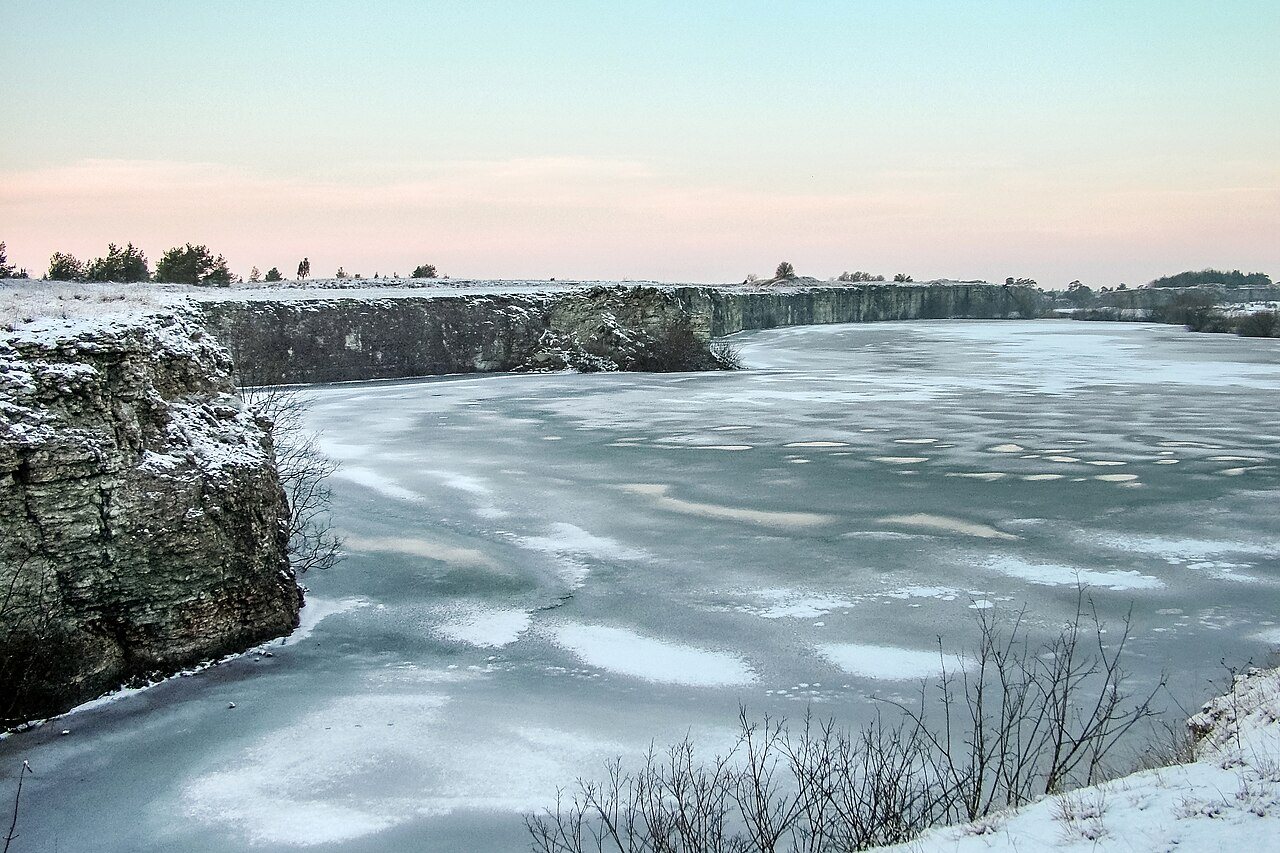
Đây là gì?
Rock blasted and broken to size — limestone, granite, trap rock — and, with sand, the largest tonnage humans move.
Tại sao điều này quan trọng?
Every road base, railway ballast and concrete mix is mostly this. It is low-value per tonne, so it is quarried close to where it is used and its economics are entirely about haulage distance.
Where it is in the Earth
Crushed stone is not a single mineral but a catch-all term for any hard rock that can be blasted, broken, and sized for construction use. The three dominant rock types are limestone, granite, and trap rock — a term that covers dense, fine-grained volcanic and intrusive rocks such as basalt and diabase. Each forms by a different geological process, but what they share is the mechanical strength and durability that aggregate applications demand.
Limestone is sedimentary, meaning it accumulated in layers on ancient sea floors from the shells and skeletons of marine organisms, later cemented and sometimes recrystallised by heat and pressure into dolomite or marble. Because shallow tropical seas covered large parts of every continent at various points in geological history, limestone is broadly distributed and often found close to the surface, which is one reason it makes up the largest share of crushed stone production. Granite and similar intrusive igneous rocks formed when magma cooled slowly deep underground; they are exposed at the surface where overlying rock has been removed by erosion over millions of years, most commonly in ancient shield areas and mountain belts. Trap rocks are the volcanic counterpart — lava flows and intrusions that cooled quickly, producing a dense, hard material often preferred for railway ballast and high-traffic road surfaces because of their resistance to crushing and polishing.
The geography of crushed stone production therefore follows geology fairly directly. Limestone quarries are widespread across the eastern United States, the Midwest, and much of Europe because those regions sit on ancient sedimentary basins. Granite and trap rock operations concentrate where shields and old mountain roots are close to the surface. Because the material is low in value relative to its weight, producers do not ship it long distances — the quarry must be near the market, so what gets mined in any given region is largely whatever hard rock happens to be accessible there.
Getting it out
Crushed stone is extracted by open-pit quarrying, which is the obvious method when you are after bulk quantities of rock at low cost. A quarry is simply an open excavation — benches of rock are drilled and charged with explosives, blasted loose, and then loaded by large shovels or front-end loaders onto haul trucks. The geometry of a quarry, with its descending terraces, reflects both safety requirements and the need to maintain stable rock faces as the excavation deepens over decades of operation.
Because crushed stone is the rock itself rather than a metallic element locked inside it, there is no grade in the conventional mining sense — no percentage of a target element to measure and optimise. Quality is assessed instead by the physical properties of the rock: compressive strength, resistance to abrasion, resistance to freeze-thaw cycling, and for road surfaces, resistance to polishing under traffic. A deposit is workable if the rock meets these specifications and if it is thick and unweathered enough that the ratio of stripped overburden (the soil and degraded rock removed to reach the fresh stone) to saleable product is acceptable. In many older quarries, the freshest and most competent rock lies deeper, so over the life of a quarry the proportion of overburden to product tends to grow.
Waste in crushed stone mining looks different from metallic mining. There is no tailings pond of chemically processed residue. What cannot be sold — fines produced during blasting and crushing that are too small for aggregate specifications — is stockpiled on site. Some of these fines find markets as agricultural lime or as fill, but significant volumes are simply managed as quarry waste. Dust control and blasting vibration are the main environmental management concerns for neighbouring communities, rather than the geochemical hazards associated with sulfide-bearing metallic ores.
What pulls on it
The primary pull on crushed stone is construction activity, in the broadest sense. Road building and maintenance consume the largest share: a road is largely aggregate, from the granular sub-base through the road base to the bituminous surface layers, all of which depend on crushed stone. Concrete — the other major use — is a composite of cement paste and aggregate, and aggregate by volume makes up the great majority of the mix. Railway ballast, the crushed rock bed on which sleepers are laid, is a smaller but consistent market that demands particularly hard and angular stone.
Because crushed stone is cheap per tonne and expensive to move, demand is almost entirely local and follows the level of construction spending in the immediate region. When construction booms — driven by population growth, urbanisation, infrastructure programmes, or housing — quarry output rises. When construction contracts, the quarry faces idle capacity it cannot easily export away. This tight coupling to local construction cycles makes crushed stone one of the more direct indicators of physical economic activity in a region, though it is a lagging one: aggregate demand peaks during the construction phase of projects, not during their planning.
For demand to change sharply in a sustained way, the composition of construction itself would have to shift. If building methods moved strongly toward timber-framed or prefabricated structures that use less concrete, or if transport investment shifted away from roads toward modes requiring less aggregate, demand growth would slow. In the other direction, large infrastructure programmes — highway rehabilitation, new rail corridors, flood defence works — require aggregate in quantities that are difficult to source quickly if local quarry capacity has not been maintained.
Ai sản xuất nó
Xem trên bản đồ →Mine production
Mine productionmillion metric tons 2025 (ước tính)
USGS Mineral Commodity Summaries 2026 · US figures only in the MCS; a world total is not compiled. · nguồn ↗
Cuộn bảng sang ngang để xem các cột còn lại.
| Quốc gia | Sản lượng | Tỷ phần thế giới |
|---|---|---|
| United States | 1,500 | — |
| Other countries | Not applicable | — |
| Tổng toàn cầu | Not applicable | 100% |
"Withheld" có nghĩa là USGS đã ẩn số liệu để tránh tiết lộ dữ liệu của một công ty riêng lẻ — không có nghĩa là bằng không. Tổng các hàng theo quốc gia không phải lúc nào cũng bằng tổng toàn cầu vì nguồn làm tròn từng số liệu một cách độc lập và không phải lúc nào cũng tách riêng dòng "các quốc gia khác".
Giá
average unit value, dollars per metric ton
Trung bình nămdollars per metric ton
Cơ sở: average unit value, dollars per metric ton. Trung bình năm theo công bố trong USGS Mineral Commodity Summaries 2026 · nguồn ↗. Đây là mức trung bình hàng năm tham khảo, không phải báo giá thị trường trực tiếp.