이것은 무엇인가?
Rock blasted and broken to size — limestone, granite, trap rock — and, with sand, the largest tonnage humans move.
왜 중요한가?
Every road base, railway ballast and concrete mix is mostly this. It is low-value per tonne, so it is quarried close to where it is used and its economics are entirely about haulage distance.
Where it is in the Earth
Crushed stone is not a single mineral but a catch-all term for any hard rock that can be blasted, broken, and sized for construction use. The three dominant rock types are limestone, granite, and trap rock — a term that covers dense, fine-grained volcanic and intrusive rocks such as basalt and diabase. Each forms by a different geological process, but what they share is the mechanical strength and durability that aggregate applications demand.
Limestone is sedimentary, meaning it accumulated in layers on ancient sea floors from the shells and skeletons of marine organisms, later cemented and sometimes recrystallised by heat and pressure into dolomite or marble. Because shallow tropical seas covered large parts of every continent at various points in geological history, limestone is broadly distributed and often found close to the surface, which is one reason it makes up the largest share of crushed stone production. Granite and similar intrusive igneous rocks formed when magma cooled slowly deep underground; they are exposed at the surface where overlying rock has been removed by erosion over millions of years, most commonly in ancient shield areas and mountain belts. Trap rocks are the volcanic counterpart — lava flows and intrusions that cooled quickly, producing a dense, hard material often preferred for railway ballast and high-traffic road surfaces because of their resistance to crushing and polishing.
The geography of crushed stone production therefore follows geology fairly directly. Limestone quarries are widespread across the eastern United States, the Midwest, and much of Europe because those regions sit on ancient sedimentary basins. Granite and trap rock operations concentrate where shields and old mountain roots are close to the surface. Because the material is low in value relative to its weight, producers do not ship it long distances — the quarry must be near the market, so what gets mined in any given region is largely whatever hard rock happens to be accessible there.
Getting it out
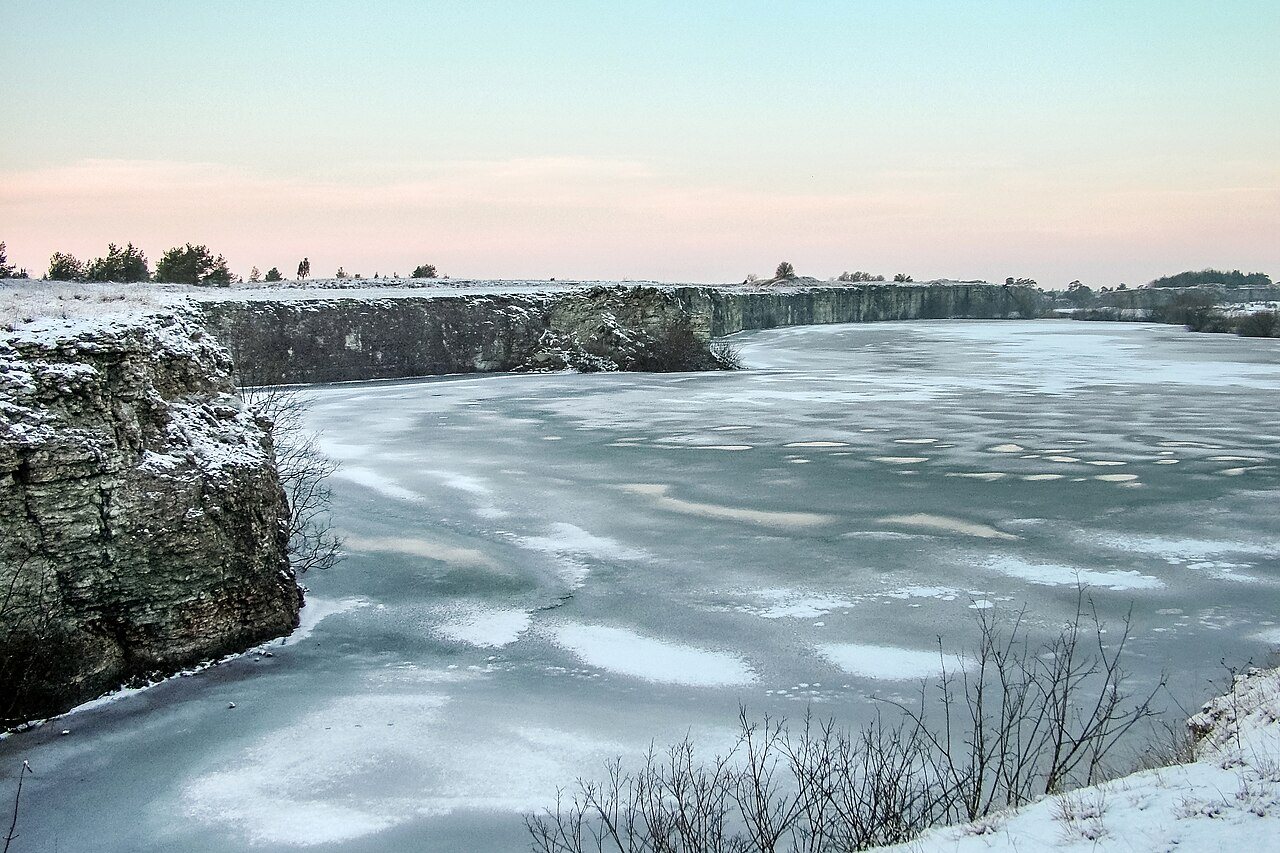
Crushed stone is extracted by open-pit quarrying, which is the obvious method when you are after bulk quantities of rock at low cost. A quarry is simply an open excavation — benches of rock are drilled and charged with explosives, blasted loose, and then loaded by large shovels or front-end loaders onto haul trucks. The geometry of a quarry, with its descending terraces, reflects both safety requirements and the need to maintain stable rock faces as the excavation deepens over decades of operation.
Because crushed stone is the rock itself rather than a metallic element locked inside it, there is no grade in the conventional mining sense — no percentage of a target element to measure and optimise. Quality is assessed instead by the physical properties of the rock: compressive strength, resistance to abrasion, resistance to freeze-thaw cycling, and for road surfaces, resistance to polishing under traffic. A deposit is workable if the rock meets these specifications and if it is thick and unweathered enough that the ratio of stripped overburden (the soil and degraded rock removed to reach the fresh stone) to saleable product is acceptable. In many older quarries, the freshest and most competent rock lies deeper, so over the life of a quarry the proportion of overburden to product tends to grow.
Waste in crushed stone mining looks different from metallic mining. There is no tailings pond of chemically processed residue. What cannot be sold — fines produced during blasting and crushing that are too small for aggregate specifications — is stockpiled on site. Some of these fines find markets as agricultural lime or as fill, but significant volumes are simply managed as quarry waste. Dust control and blasting vibration are the main environmental management concerns for neighbouring communities, rather than the geochemical hazards associated with sulfide-bearing metallic ores.
What pulls on it
The primary pull on crushed stone is construction activity, in the broadest sense. Road building and maintenance consume the largest share: a road is largely aggregate, from the granular sub-base through the road base to the bituminous surface layers, all of which depend on crushed stone. Concrete — the other major use — is a composite of cement paste and aggregate, and aggregate by volume makes up the great majority of the mix. Railway ballast, the crushed rock bed on which sleepers are laid, is a smaller but consistent market that demands particularly hard and angular stone.
Because crushed stone is cheap per tonne and expensive to move, demand is almost entirely local and follows the level of construction spending in the immediate region. When construction booms — driven by population growth, urbanisation, infrastructure programmes, or housing — quarry output rises. When construction contracts, the quarry faces idle capacity it cannot easily export away. This tight coupling to local construction cycles makes crushed stone one of the more direct indicators of physical economic activity in a region, though it is a lagging one: aggregate demand peaks during the construction phase of projects, not during their planning.
For demand to change sharply in a sustained way, the composition of construction itself would have to shift. If building methods moved strongly toward timber-framed or prefabricated structures that use less concrete, or if transport investment shifted away from roads toward modes requiring less aggregate, demand growth would slow. In the other direction, large infrastructure programmes — highway rehabilitation, new rail corridors, flood defence works — require aggregate in quantities that are difficult to source quickly if local quarry capacity has not been maintained.
Substitution and recycling 수준 3
Within aggregate applications, the main alternatives to primary crushed stone are recycled concrete aggregate, reclaimed asphalt pavement, and slag — the glassy or crystalline residue from iron and steel smelting. Recycled concrete aggregate is produced by crushing demolished structures; it is widely used in road base and non-structural fill. Its performance in concrete mixes is more limited because the residual cement paste attached to the particles increases water demand and reduces strength compared with fresh aggregate. Reclaimed asphalt pavement is routinely incorporated back into road surfaces and base layers and represents a well-established recycling loop in road maintenance. Blast furnace and steel slag, where chemistry and particle shape are suitable, can substitute directly in road base and sometimes in concrete, and their use avoids a disposal problem for the producing industry.
None of these materials eliminate the demand for primary crushed stone at the aggregate volumes modern construction requires; they moderate it at the margin. The constraint on higher recycling rates is partly logistical — demolition waste must be collected, processed, and quality-certified before it can re-enter the supply chain — and partly technical, since recycled aggregate is not always permitted in high-specification applications by the standards bodies that govern construction. Slag availability is geographically concentrated around iron and steel centres and cannot be transported economically to distant markets. In regions far from steel industry or with low demolition rates, these alternatives contribute little.
There is no material substitution at the level of the end use itself — concrete and road base have no practical replacements in large-scale civil construction with present technology. Demand reduction through design efficiency (thinner pavements, optimised concrete mixes) has some scope but faces limits set by structural requirements and existing standards.
Turning ore into product 수준 3
The transformation from blasted rock to saleable aggregate is almost entirely mechanical. Primary crushers — typically jaw crushers or gyratory crushers — receive the run-of-mine rock and reduce it to a manageable size. Secondary and tertiary crushers, often cone crushers or impact crushers, reduce it further. At each stage the material passes over vibrating screens that sort it by particle size, routing oversize back for another pass and directing product streams into separate stockpiles by nominal size fraction. The sequence of crushing and screening is called the flowsheet, and its design determines both the product mix and the proportion of fines generated.
Recovery in aggregate processing is defined by the product size distribution the market will accept. A quarry producing road base, railway ballast, and concrete aggregate simultaneously wants to maximise the yield of each specification grade. The difficulty is that every crusher also generates fines — particles too small for any of those markets. Minimising fines generation, or finding outlets for them, is a persistent economic problem. Some operations run wet-processing circuits where fine material is washed and sized into manufactured sand, capturing value that would otherwise be lost. The water required and the management of the resulting slurry are non-trivial concerns, particularly in water-scarce regions.
There is no chemical processing in the metallurgical sense — no leaching, no smelting, no refining. The value added between the quarry face and the customer is almost entirely the cost of energy (crushing is energy-intensive relative to the value of the product), the capital cost of the crushing and screening plant, and the haulage to the point of use. This cost structure means that processing efficiency is measured in tonnes per hour of plant throughput and in the energy consumed per tonne of product, rather than in recovery of a target element.
Where the chain is fragile 수준 4
The supply picture for crushed stone is unusual among industrial minerals because geographic concentration at the national level is less relevant than concentration at the local level. A world total production figure is not compiled in the standard reporting sources — the USGS Mineral Commodity Summaries covers United States figures and notes that other country data are not aggregated — because the material is so immobile that global supply and demand balance is not a meaningful concept. The risk is not that one country dominates export supply, as with many metallic minerals, but that a specific region lacks accessible quarry capacity close to where it is needed.
Permitting is the most commonly cited structural constraint in established markets. Opening a new quarry in a densely populated region requires planning approvals that can take many years, and opposition from neighbouring communities on grounds of noise, dust, traffic, and landscape alteration is common. This means that when demand in a metropolitan area grows faster than existing quarry capacity, the response time is long. Existing operators therefore hold significant market power not because of any global monopoly but because of the difficulty of establishing competing supply at a useful distance. The practical lead time between a decision to develop a new quarry and first production is measured in years, not months.
Reported price data carry modest uncertainty by the standards of commodity statistics because crushed stone is sold directly to end users with limited spot trading, and average unit values are computed from producer surveys. The figures in the database reflect average unit values reported to the USGS rather than a traded market price, so they smooth over the considerable variation between rock types, product sizes, and regional markets. Researchers using these figures should note that a quarry producing high-specification trap rock ballast near a major rail corridor will realise a substantially different price from one selling road base limestone in a competitive rural market, and the average obscures both ends of that range.
생산 주체
지도에서 보기 →Mine production
Mine productionmillion metric tons 2025 (추정치)
USGS Mineral Commodity Summaries 2026 · US figures only in the MCS; a world total is not compiled. · 출처 ↗
나머지 열을 보려면 표를 옆으로 스크롤하십시오.
| 국가 | 생산 | 세계 비중 |
|---|---|---|
| United States | 1,500 | — |
| Other countries | Not applicable | — |
| 세계 합계 | Not applicable | 100% |
'비공개'는 USGS가 개별 기업의 데이터 노출을 막기 위해 수치를 억제한 것으로, 0을 의미하지 않습니다. 출처가 각 수치를 독립적으로 반올림하고 '기타 국가' 항목을 항상 별도로 구분하지는 않기 때문에, 국가별 합계가 세계 합계와 일치하지 않을 수 있습니다.
가격
average unit value, dollars per metric ton
연간 평균dollars per metric ton
기준: average unit value, dollars per metric ton. 다음 자료에 게재된 연간 평균 USGS Mineral Commodity Summaries 2026 · 출처 ↗. 이 수치는 기준 연간 평균값이며, 실시간 시장 가격이 아니다.