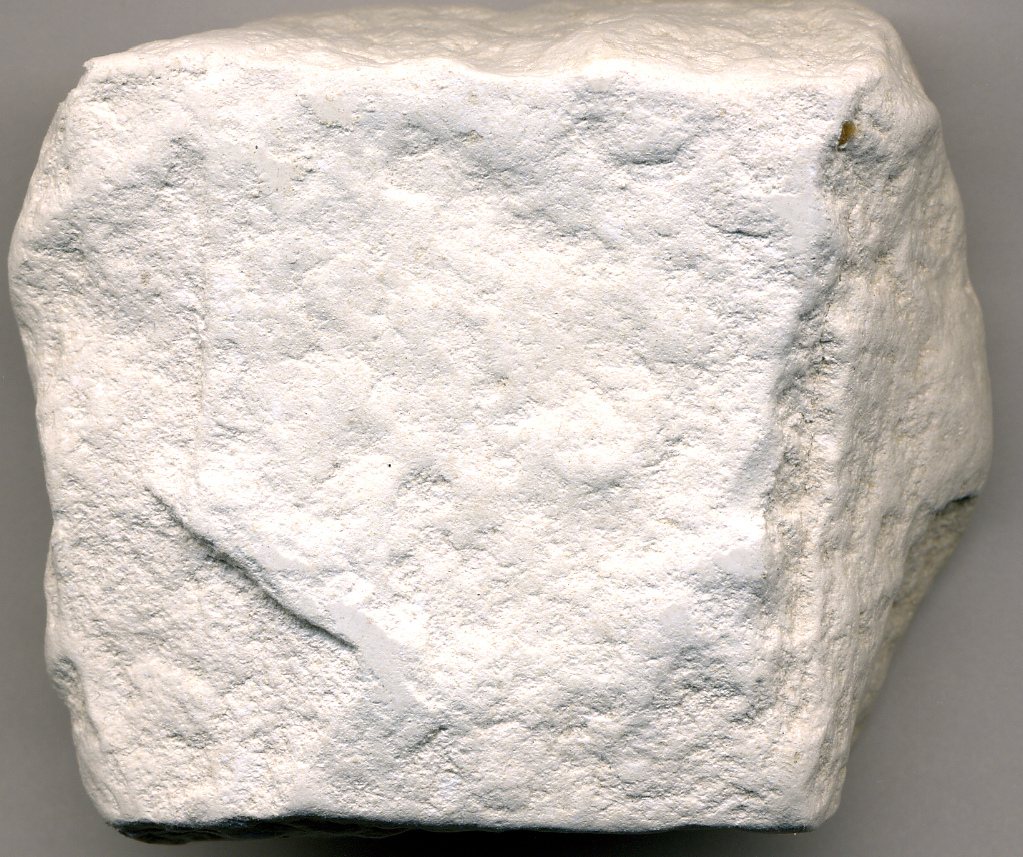
Apa ini?
Rock made from the glass skeletons of microscopic algae, so porous that a lump of it floats on water.
Mengapa ini penting?
It is the standard filter medium for beer, wine, sugar and swimming pools, and a mild abrasive and absorbent.
Where it is in the Earth
Diatomite begins with living organisms. Diatoms are single-celled algae that build their cell walls from dissolved silica drawn out of water. When a diatom dies its soft organic parts decompose, but the silica skeleton — called a frustule — sinks to the lake or sea floor and is preserved. Given the right conditions over millions of years, these skeletons accumulate layer upon layer into a sedimentary deposit thick enough to mine. The resulting rock is composed almost entirely of amorphous, or non-crystalline, silica, and it is extraordinarily light and porous because each tiny frustule is itself riddled with microscopic holes.
The conditions that favour thick accumulations are fairly specific. A body of water needs to be nutrient-rich enough to sustain dense diatom blooms but calm enough that the fragile frustules are not broken up before they settle. Many of the world's better deposits formed in enclosed or semi-enclosed Miocene-age lakes and shallow coastal seas, periods when the silica supply was plentiful and the water chemistry stable. Volcanic regions are often productive settings: volcanic glass weathering in the catchment area releases silica into the water column, feeding the diatoms. This is why productive deposits in the western United States, parts of Turkey, and parts of South America are frequently associated with ancient volcanic lake beds.
Because the deposit is essentially a settled sediment, diatomite beds tend to be broadly flat and relatively shallow, which has an important bearing on how they are mined. The thickness and purity of the deposit varies with proximity to the ancient shoreline, the pattern of sediment input, and subsequent geological disturbance. Clay layers interbedded with the diatomite, and volcanic ash falls that punctuated the accumulation period, are the main sources of contamination that determine whether a given section of a deposit is usable without heavy processing.
Getting it out
Because diatomite deposits are sedimentary and relatively shallow, open-pit mining is almost universal. Overburden — the soil and rock sitting above the diatomite — is stripped away with bulldozers and scrapers, exposing the pale, chalky deposit beneath. The diatomite itself is often soft enough that it can be dug directly with a front-end loader or scraped loose without blasting. This softness is one of the material's defining characteristics: the frustules that create its useful porosity also make it mechanically weak, so the ore comes out of the ground as a crumbly, low-density material rather than as hard rock.
What matters most to the miner is not grade in the conventional sense of metal content, but purity. The proportion of the deposit that is actual diatom silica versus contaminating clay, sand, volcanic ash, or calcium carbonate determines whether the product will meet the strict specifications that filter applications demand. High-clay zones may be left in place or stockpiled separately for lower-value uses such as absorbents or fillers. Waste-to-product ratios are therefore highly site-specific: a deposit with thin clay partings and consistent purity generates relatively little reject material, while a more variable orebody requires selective extraction and generates considerably more.
Water content is a practical concern from the moment the ore is dug. Fresh diatomite can carry a great deal of moisture — it is highly absorbent by nature — and wet ore is heavy and difficult to process. Drying begins at the mine face in dry climates, but in wetter regions the first stage of processing is simply removing water. Transportation costs are sensitive to moisture content, which is why large diatomite operations typically process the ore close to the mine rather than shipping it in its raw state.
What pulls on it
The largest single pull on diatomite is filtration. Brewers, winemakers, sugar refiners, and operators of swimming pools and water treatment systems all use diatomite as a filter aid — a material that builds up on a filter septum and traps fine particles that would otherwise pass through. The mechanism depends on the frustule structure: the labyrinth of tiny pores in each skeleton traps solids while allowing liquid to flow. No other naturally occurring mineral combines the right pore size range, flow-through characteristics, and chemical inertness quite as conveniently, which is why the food and beverage industries adopted it widely and have not abandoned it.
Beyond filtration, diatomite is used as a mild abrasive in polishes — its hardness is just sufficient to scratch tarnish from metal but not to damage the surface — and as an absorbent in industrial applications ranging from spill cleanup to pesticide carriers. It also acts as a functional filler and anti-caking agent in paints, rubber, and animal feed. These non-filtration uses tend to consume lower grades of material and are generally less sensitive to purity specifications, which is why they absorb the fines and reject fractions from the processing plant.
The filtration market is the one most worth watching for structural change. Membrane filtration technology has been gradually displacing diatomite in some industrial processes, particularly in the dairy and pharmaceutical sectors, where the desire to eliminate the handling and disposal of spent filter cake is an operating concern. Crossflow and hollow-fibre membrane systems do not require a filter aid at all. However, membranes involve higher capital cost and are slower to displace established practice in cost-sensitive industries such as brewing. For diatomite demand to fall sharply, membrane adoption would need to accelerate across several large end-use sectors simultaneously, which has not occurred at any rapid pace to date.
Siapa yang memproduksinya
Lihat di peta →Mine production
Mine productionthousand metric tons 2025 (estimasi) Total dunia 2,500 thousand metric tons
USGS Mineral Commodity Summaries 2026 · Gross weight of processed diatomite. · sumber ↗
Gulir tabel ke samping untuk melihat kolom-kolom yang tersisa.
| Negara | Produksi | Pangsa dunia |
|---|---|---|
| United States | 720.0 | 28.8% |
| France | 250.0 | 10.0% |
| Argentina | 190.0 | 7.6% |
| Other countries | 160.0 | 6.4% |
| Turkey | 150.0 | 6.0% |
| China | 140.0 | 5.6% |
| Korea, Republic of | 120.0 | 4.8% |
| Mexico | 100.0 | 4.0% |
| Peru | 99.00 | 4.0% |
| Germany | 50.00 | 2.0% |
| Spain | 50.00 | 2.0% |
| Russia | 50.00 | 2.0% |
| Japan | 40.00 | 1.6% |
| New Zealand | 40.00 | 1.6% |
| Total dunia | 2,500 | 100% |
Mine production: processed
Mine production: processedthousand metric tons 2025 (estimasi)
USGS Mineral Commodity Summaries 2026 · Gross weight of processed diatomite. · sumber ↗
Gulir tabel ke samping untuk melihat kolom-kolom yang tersisa.
| Negara | Produksi | Pangsa dunia |
|---|---|---|
| Denmark | 380.0 | — |
"Ditahan" berarti USGS menyembunyikan angka tersebut untuk menghindari pengungkapan data perusahaan tertentu — bukan berarti nol. Baris per negara tidak selalu berjumlah sama dengan total dunia karena sumber membulatkan setiap angka secara independen dan tidak selalu merinci baris "negara lain".
Siapa yang memegang cadangan
Reserves
Reservesthousand metric tons 2025
USGS Mineral Commodity Summaries 2026 · sumber ↗
| Negara | Cadangan | Pangsa dunia |
|---|---|---|
| United States | 250,000 | — |
| China | 120,000 | — |
| Spain | 57,000 | — |
| Turkey | 44,000 | — |
| Korea, Republic of | 2,200 | — |
| New Zealand | Not applicable | — |
| Peru | Not applicable | — |
| Russia | Not applicable | — |
| Mexico | Not applicable | — |
| Argentina | Not applicable | — |
| France | Not applicable | — |
| Germany | Not applicable | — |
| Japan | Not applicable | — |
| Other countries | Not applicable | — |
| Total dunia | Large | 100% |
Reserves: processed
Reserves: processedthousand metric tons 2025
USGS Mineral Commodity Summaries 2026 · sumber ↗
| Negara | Cadangan | Pangsa dunia |
|---|---|---|
| Denmark | Not applicable | — |
Harga
average value, f.o.b. plant, dollars per metric ton
Rata-rata tahunandollars per metric ton
Dasar: average value, f.o.b. plant, dollars per metric ton. Rata-rata tahunan sebagaimana diterbitkan dalam USGS Mineral Commodity Summaries 2026 · sumber ↗. Ini adalah rata-rata tahunan referensi, bukan kuotasi pasar secara langsung.