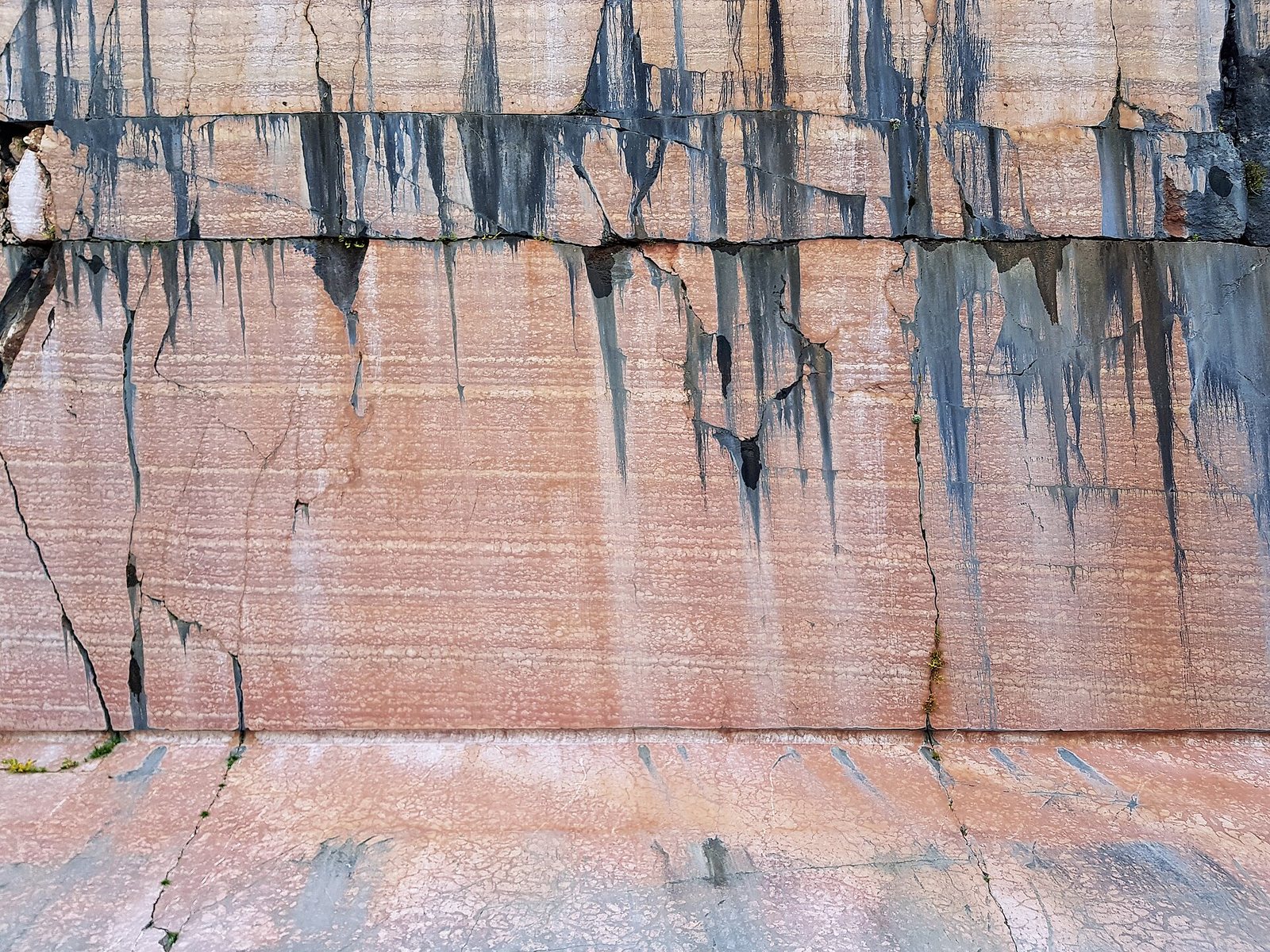
Was ist das?
Rock cut into blocks and slabs rather than crushed — granite, marble, limestone, slate — sold for what it looks like.
Warum ist das wichtig?
It is the only mineral commodity where appearance sets the price, and the only one whose product may still be in service a thousand years later.
Where it is in the Earth
Dimension stone is not a mineral in the strict sense but a collective term for any rock that can be quarried in large, coherent pieces and worked into a usable shape. What matters geologically is not the chemistry of the rock but its internal structure: the absence of fractures, fissures, and weak planes that would cause a block to split or crumble during cutting. That structural integrity is what separates a dimension-stone deposit from an ordinary outcrop of the same rock type.
The principal rock types — granite, marble, limestone, slate, sandstone, and travertine — each arise from distinct geological processes. Granite and related igneous rocks form when molten material cools slowly deep within the crust, giving crystals time to grow into an interlocking fabric that is both hard and coherent. Marble is limestone or dolostone that has been recrystallised by heat and pressure during mountain-building episodes; the process destroys the original sedimentary layering and produces the even, fine-grained texture that makes it workable. Slate forms when fine-grained sedimentary rocks, typically muds, are subjected to low-grade metamorphism, creating a strong planar cleavage along which the rock splits cleanly into thin sheets. Limestone and sandstone used as dimension stone are sedimentary rocks deposited in shallow seas or river systems and are chosen specifically because their original bedding is uniform enough, and their pore structure fine enough, that they hold together under the saw.
Deposits sit where they sit for two main reasons: first, the original geological event that created the right rock type had to occur there; second, subsequent erosion must have brought workable rock close enough to the surface to be economical to reach. Mountain belts and their eroded roots are disproportionately productive because they expose large volumes of once-deep igneous and metamorphic rock. Flat sedimentary basins yield limestone and sandstone where ancient seas laid down thick, laterally continuous beds. The global spread of production reflects this geology directly: different continents and regions have been shaped by different tectonic histories, and that history determines which rock types are available in any given place.
Getting it out
Dimension stone quarrying is unlike almost every other form of mining because the objective is to extract the rock without breaking it. In most mining, fragmentation is the goal; here it is the enemy. The value of a block lies in its size, freedom from cracks, and surface quality, so the quarry operator must separate rock from the mass using methods that cut rather than shatter. Wire saws — continuous loops of steel wire or diamond-impregnated cable drawn under tension — are the primary tool in most modern granite and marble quarries. Jet-piercing burners, hydraulic splitters, and line drilling are used depending on the rock type and the required block dimensions. Explosives, when used at all, are used only in controlled, light charges to relieve stress along pre-cut planes, never to fragment the rock.
The concept of grade, as used in metallic mining, does not apply here in the conventional sense. There is no ore mineral to concentrate. Instead, the quarry is evaluated on the yield of saleable block relative to the total rock moved, and that yield is strongly influenced by the natural joint spacing — the frequency of pre-existing fractures in the rock mass. A deposit with widely spaced joints produces large, clean blocks. One with closely spaced or irregular jointing produces a high proportion of waste, which is either crushed for aggregate or simply stockpiled. The ratio of waste to product can vary enormously between deposits and even between different parts of the same quarry. Overburden, the soil and weathered rock above the sound stone, must also be stripped and moved before extraction can begin, adding to the total material handled per tonne of saleable product.
Quarrying is almost always open to the surface — open-pit or open-bench working — because underground methods are rarely economic for a commodity that depends on the ability to manoeuvre large cranes and saws and to remove blocks on heavy transport. The depth of workable stone is therefore limited by the economics of stripping, and most active quarries are relatively shallow compared with metallic mines. Water management within the quarry is a constant operational concern, as many dimension stone quarries in wetter climates require continuous pumping.
What pulls on it
Dimension stone is bought almost entirely for appearance. The end markets are construction — external cladding, flooring, paving, roofing slate, monumental and funerary work — and interior fitment, primarily kitchen and bathroom surfaces. In each case the buyer is paying for how the material looks and feels and, to a lesser extent, for its durability and the cultural associations it carries. This is unusual among mineral commodities, where buyers generally seek a specific chemical or physical property rather than an aesthetic one.
Construction activity is the dominant driver of demand, but the relationship is not simple. Dimension stone is a discretionary upgrade within construction: a building can be clad in brick, glass, or composite panels instead of granite, and a kitchen can have laminate worktops instead of marble. Demand therefore tracks not just the volume of construction but the spending mix within it — the share going to higher-specification finishes. In periods of strong residential and commercial construction, particularly in markets where natural stone is culturally preferred, demand rises. When construction slows or budgets are squeezed, stone is often among the first specifications to be value-engineered out.
The geography of demand has shifted considerably over recent decades. Established markets in Europe and North America remain large consumers, but rapid urbanisation in Asia, the Middle East, and parts of Latin America has created substantial new demand. At the same time, fashion within the stone market shifts: particular colours and types move in and out of favour with architects and interior designers, and a quarry producing an unfashionable variety can find its market much reduced even if the rock itself is perfectly sound. Demand for roofing slate is more stable and less fashion-driven, being tied to maintenance and replacement of existing slate roofs as much as to new construction.
Wer es produziert
Auf einer Karte anzeigen →Mine production
Mine productionthousand metric tons 2025 (geschätzt)
USGS Mineral Commodity Summaries 2026 · Gross weight; sold by area or piece rather than by tonne in practice. · Quelle ↗
Tabelle seitwärts scrollen, um die restlichen Spalten zu sehen.
| Land | Produktion | Anteil an der Weltproduktion |
|---|---|---|
| United States | 2,300 | — |
| Other countries | Not applicable | — |
| Weltgesamt | Not applicable | 100% |
„Withheld" bedeutet, dass der USGS den Wert zurückgehalten hat, um keine Rückschlüsse auf Daten einzelner Unternehmen zuzulassen – er bedeutet nicht null. Die Länderwerte addieren sich nicht immer zum Weltgesamt, weil die Quelle jeden Einzelwert unabhängig rundet und eine Zeile „sonstige Länder" nicht immer ausweist.