これは何か
Rock cut into blocks and slabs rather than crushed — granite, marble, limestone, slate — sold for what it looks like.
なぜ重要なのか
It is the only mineral commodity where appearance sets the price, and the only one whose product may still be in service a thousand years later.
Where it is in the Earth
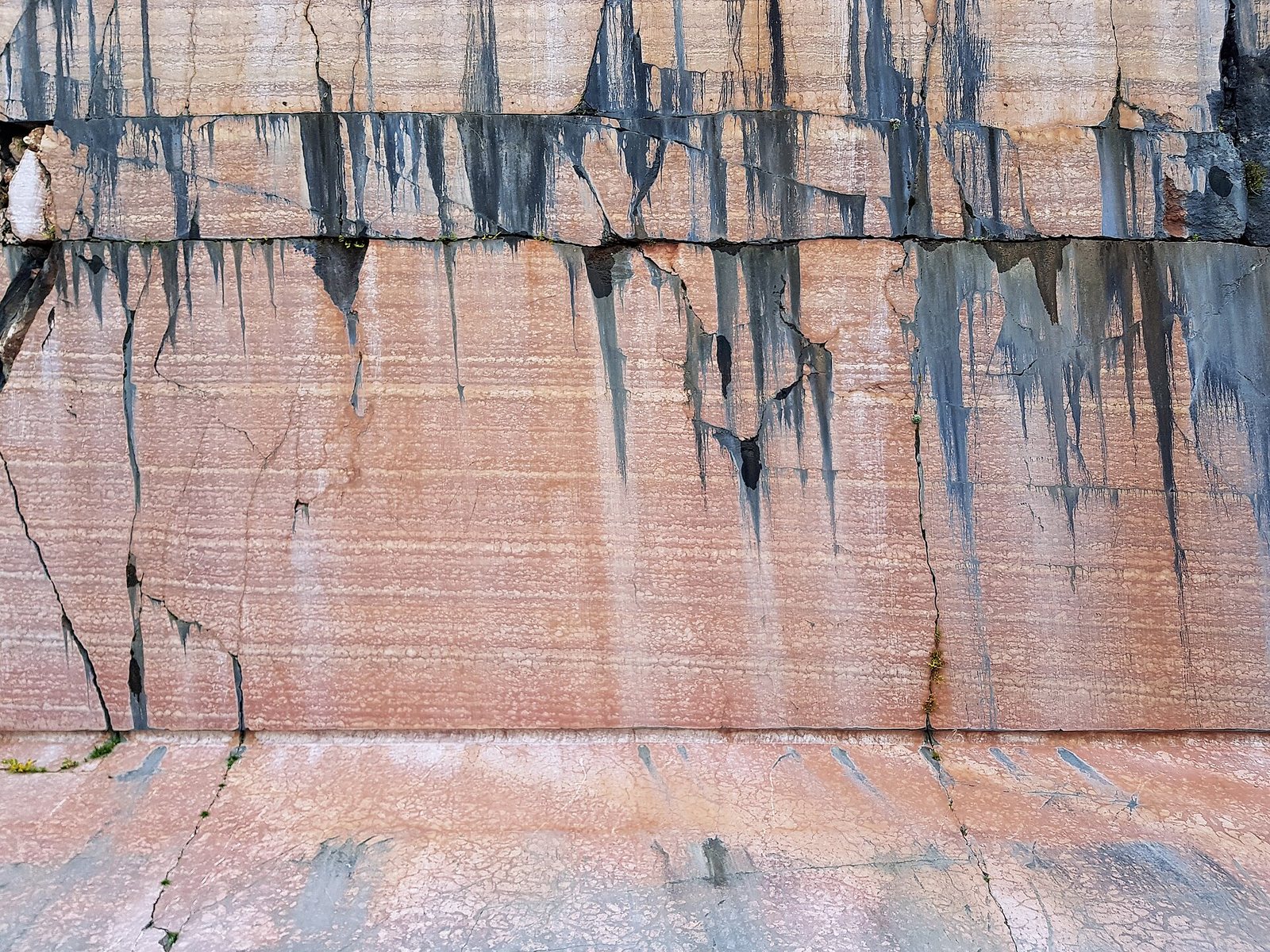
Dimension stone is not a mineral in the strict sense but a collective term for any rock that can be quarried in large, coherent pieces and worked into a usable shape. What matters geologically is not the chemistry of the rock but its internal structure: the absence of fractures, fissures, and weak planes that would cause a block to split or crumble during cutting. That structural integrity is what separates a dimension-stone deposit from an ordinary outcrop of the same rock type.
The principal rock types — granite, marble, limestone, slate, sandstone, and travertine — each arise from distinct geological processes. Granite and related igneous rocks form when molten material cools slowly deep within the crust, giving crystals time to grow into an interlocking fabric that is both hard and coherent. Marble is limestone or dolostone that has been recrystallised by heat and pressure during mountain-building episodes; the process destroys the original sedimentary layering and produces the even, fine-grained texture that makes it workable. Slate forms when fine-grained sedimentary rocks, typically muds, are subjected to low-grade metamorphism, creating a strong planar cleavage along which the rock splits cleanly into thin sheets. Limestone and sandstone used as dimension stone are sedimentary rocks deposited in shallow seas or river systems and are chosen specifically because their original bedding is uniform enough, and their pore structure fine enough, that they hold together under the saw.
Deposits sit where they sit for two main reasons: first, the original geological event that created the right rock type had to occur there; second, subsequent erosion must have brought workable rock close enough to the surface to be economical to reach. Mountain belts and their eroded roots are disproportionately productive because they expose large volumes of once-deep igneous and metamorphic rock. Flat sedimentary basins yield limestone and sandstone where ancient seas laid down thick, laterally continuous beds. The global spread of production reflects this geology directly: different continents and regions have been shaped by different tectonic histories, and that history determines which rock types are available in any given place.
Getting it out
Dimension stone quarrying is unlike almost every other form of mining because the objective is to extract the rock without breaking it. In most mining, fragmentation is the goal; here it is the enemy. The value of a block lies in its size, freedom from cracks, and surface quality, so the quarry operator must separate rock from the mass using methods that cut rather than shatter. Wire saws — continuous loops of steel wire or diamond-impregnated cable drawn under tension — are the primary tool in most modern granite and marble quarries. Jet-piercing burners, hydraulic splitters, and line drilling are used depending on the rock type and the required block dimensions. Explosives, when used at all, are used only in controlled, light charges to relieve stress along pre-cut planes, never to fragment the rock.
The concept of grade, as used in metallic mining, does not apply here in the conventional sense. There is no ore mineral to concentrate. Instead, the quarry is evaluated on the yield of saleable block relative to the total rock moved, and that yield is strongly influenced by the natural joint spacing — the frequency of pre-existing fractures in the rock mass. A deposit with widely spaced joints produces large, clean blocks. One with closely spaced or irregular jointing produces a high proportion of waste, which is either crushed for aggregate or simply stockpiled. The ratio of waste to product can vary enormously between deposits and even between different parts of the same quarry. Overburden, the soil and weathered rock above the sound stone, must also be stripped and moved before extraction can begin, adding to the total material handled per tonne of saleable product.
Quarrying is almost always open to the surface — open-pit or open-bench working — because underground methods are rarely economic for a commodity that depends on the ability to manoeuvre large cranes and saws and to remove blocks on heavy transport. The depth of workable stone is therefore limited by the economics of stripping, and most active quarries are relatively shallow compared with metallic mines. Water management within the quarry is a constant operational concern, as many dimension stone quarries in wetter climates require continuous pumping.
What pulls on it
Dimension stone is bought almost entirely for appearance. The end markets are construction — external cladding, flooring, paving, roofing slate, monumental and funerary work — and interior fitment, primarily kitchen and bathroom surfaces. In each case the buyer is paying for how the material looks and feels and, to a lesser extent, for its durability and the cultural associations it carries. This is unusual among mineral commodities, where buyers generally seek a specific chemical or physical property rather than an aesthetic one.
Construction activity is the dominant driver of demand, but the relationship is not simple. Dimension stone is a discretionary upgrade within construction: a building can be clad in brick, glass, or composite panels instead of granite, and a kitchen can have laminate worktops instead of marble. Demand therefore tracks not just the volume of construction but the spending mix within it — the share going to higher-specification finishes. In periods of strong residential and commercial construction, particularly in markets where natural stone is culturally preferred, demand rises. When construction slows or budgets are squeezed, stone is often among the first specifications to be value-engineered out.
The geography of demand has shifted considerably over recent decades. Established markets in Europe and North America remain large consumers, but rapid urbanisation in Asia, the Middle East, and parts of Latin America has created substantial new demand. At the same time, fashion within the stone market shifts: particular colours and types move in and out of favour with architects and interior designers, and a quarry producing an unfashionable variety can find its market much reduced even if the rock itself is perfectly sound. Demand for roofing slate is more stable and less fashion-driven, being tied to maintenance and replacement of existing slate roofs as much as to new construction.
Turning ore into product レベル 3
The transformation of a quarry block into a finished product passes through several distinct stages, each of which can add or destroy value. At the quarry, primary sawing reduces blocks to slabs of a standard thickness using gang saws or, increasingly, multi-wire diamond saws. This stage sets the surface texture and the dimensional tolerances that downstream processors work to. Losses here are principally kerf — the material consumed by the saw blade itself — plus any slabs that crack during cutting. In hard rocks like granite, kerf losses are not trivial; the fine stone slurry produced is a processing residue that must be managed.
Secondary processing — calibrating slabs to a precise thickness, surface finishing, and cutting to size — takes place either at the quarry site or at fabrication facilities closer to the market. Surface finishing ranges from rough splitting or thermal flaming, which opens the crystal structure and produces a non-slip texture, through honing to a matte finish and on to full polishing, which closes the surface and brings out colour and pattern. Each finishing step uses progressively finer abrasives and adds labour cost. The polishing stage is where much of the cosmetic value of marble and granite is created, but it also exposes defects — veins, pits, and colour variation — that were hidden in the rough slab, so polished yield is always lower than rough-sawn yield. Tiles are cut from calibrated slabs using bridge saws or waterjet cutters, with the cutting pattern optimised to minimise waste from a given slab.
Because blocks and slabs are sold by area or by piece rather than by weight, the economics of processing are dominated by yield per block rather than recovery per tonne in the metallurgical sense. A fabricator's profitability turns on how much saleable area can be extracted from each slab, which in turn depends on the natural variation in the stone. Highly figured or veined material may command a higher unit price but produce a lower area yield because defects must be cut around. This creates a trade-off between price per square metre and efficiency of use that is specific to each stone variety and each end-use specification.
Substitution and recycling レベル 3
The substitutes for dimension stone depend entirely on the application. In external cladding, ceramic and porcelain tile, glass fibre-reinforced concrete, high-pressure laminate panels, and brick all serve similar functional roles and can be specified instead of stone. In worktop applications, engineered quartz — a composite of crushed quartz bound in resin — has taken a significant share of the market previously held by granite and marble. Engineered quartz offers more consistent appearance, lower maintenance requirements, and, in many cases, a lower installed cost than natural stone. Porcelain slabs, produced in large formats to mimic the appearance of marble or granite, are a more recent competitor that replicates the look of stone with greater dimensional consistency and resistance to staining.
The performance trade-offs of substitutes are real but vary by application. No manufactured product yet matches the specific thermal mass, the acoustic character, or the long-term weather resistance of well-chosen natural stone in external construction. In interior applications, the functional differences are smaller, and the decision often comes down to cost and fashion. Recycling of dimension stone is limited and structurally constrained. Reclaimed stone from demolished buildings — particularly limestone and slate — does re-enter the market, and reclaimed stone from historic buildings sometimes commands a premium for restoration work. However, the volumes involved are small relative to primary production, and the stone recovered is often in irregular pieces that cannot meet the dimensional requirements of modern specifications without substantial recutting, which itself produces waste and adds cost.
The more significant form of material recovery in this sector is the crushing of off-cuts and waste from quarrying and fabrication for use as aggregate or filler. This diverts material from landfill but does not constitute recycling in the sense of returning the product to its original form. The fundamental constraint on higher recovery rates is that stone is a durable, site-fixed material: it comes out of buildings slowly, in irregular forms, and often damaged, and the logistics of collection rarely favour reuse over disposal.
Where the chain is fragile レベル 4
The supply picture for dimension stone differs structurally from that of metallic minerals in ways that standard concentration metrics tend to obscure. Production is geographically dispersed at the country level — many nations quarry some dimension stone — but commercially significant production of any specific variety is often highly concentrated. A particular colour or texture of granite may come from a single region of a single country, and if that region faces a regulatory, political, or infrastructure disruption, the supply of that specific product is interrupted with no direct substitute available. The U.S. data illustrate the broader import dependence plainly: the net import reliance figure reported for 2025 stands at 85 percent, with Brazil, Italy, China, and India identified as the leading sources across the 2021–2024 period. This means U.S. consumption rests heavily on supply chains that cross multiple jurisdictions and ocean freight lanes.
Processing bottlenecks in this commodity are less about metallurgical complexity than about capital investment in primary saw capacity and the availability of skilled stone workers. The finishing and fabrication stages have migrated substantially to producing countries — particularly India and China — which have invested in large-scale slab-processing infrastructure. This means that disruptions affecting those processing hubs affect not just raw block supply but the availability of finished slabs and tiles in importing markets. Rebuilding equivalent processing capacity in consuming countries would require both capital and time, and the economics of doing so are not straightforward given labour cost differentials.
Permitting and lead times present a chronic constraint on the supply side. Opening a new dimension stone quarry requires identifying a deposit with the right combination of rock quality, joint spacing, accessible depth, and appearance; securing land rights; completing environmental assessments; and installing infrastructure. Because the quarry is producing for an appearance market, even a technically sound deposit is commercially worthless if the stone it yields is not accepted by specifiers and designers. This means that new quarries face both the usual regulatory timelines and an additional market-acceptance risk that metallic mines do not. The practical consequence is that supply of established, well-regarded stone varieties responds slowly to changes in demand, and shortages of specific types can persist for years without being resolved by new entrants.
生産者
地図で見る →Mine production
Mine productionthousand metric tons 2025 (推定値)
USGS Mineral Commodity Summaries 2026 · Gross weight; sold by area or piece rather than by tonne in practice. · 出典 ↗
テーブルを横にスクロールすると残りの列が表示されます。
| 国 | 生産 | 世界に占める割合 |
|---|---|---|
| United States | 2,300 | — |
| Other countries | Not applicable | — |
| 世界合計 | Not applicable | 100% |
「非開示」とは、個別企業のデータが特定されないようUSGSが数値を公表しなかったことを意味し、ゼロを意味するものではありません。出典が各数値を独立して丸め処理しており、「その他の国」の内訳を常に示しているわけではないため、各国の数値の合計が世界合計と一致しないことがあります。