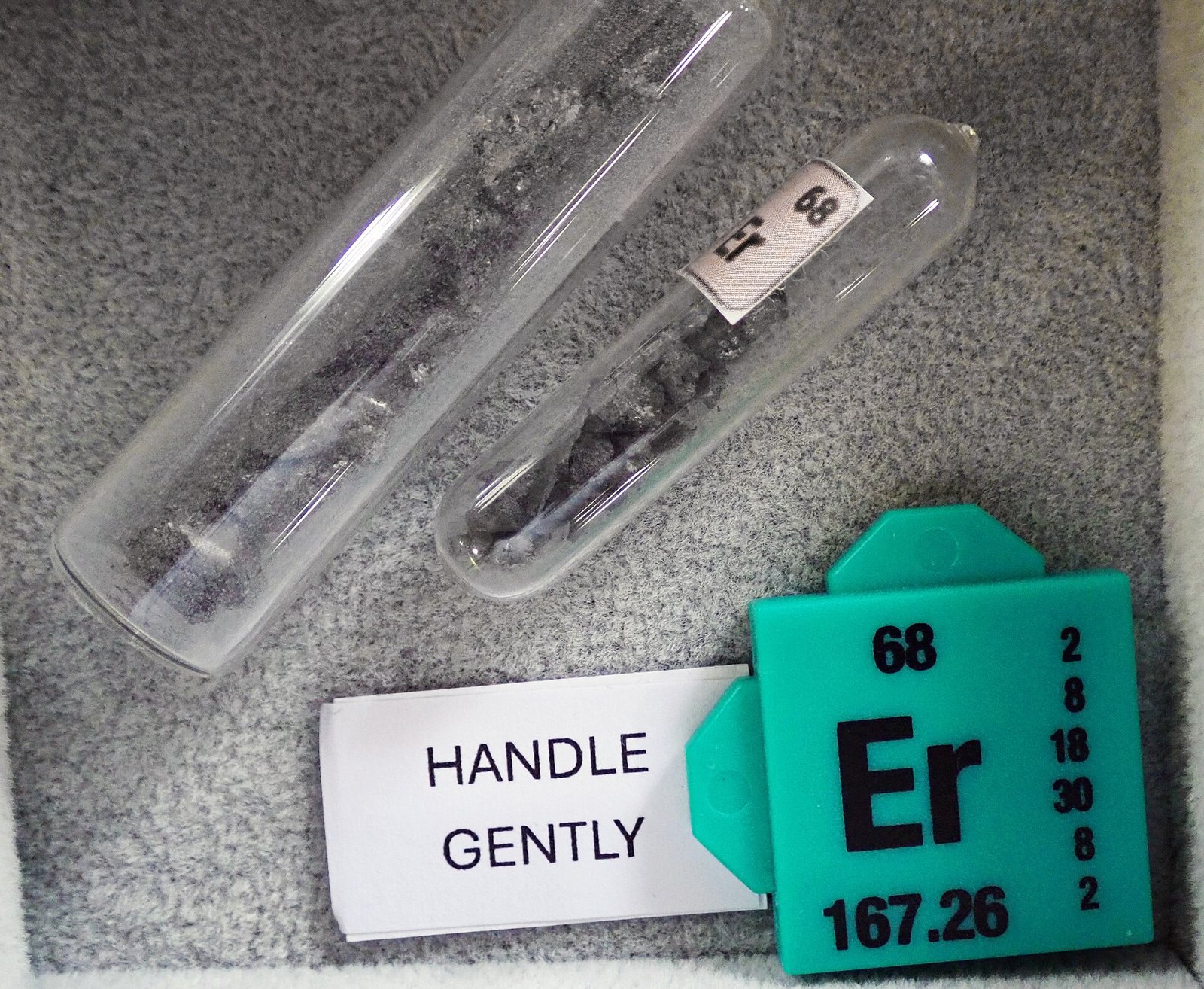
这是什么?
The rare earth that amplifies light inside a fibre-optic cable without ever turning it back into electricity.
为何重要?
Erbium-doped fibre amplifiers are why an undersea cable can carry a signal for thousands of kilometres. The modern internet is built on them.
Where it is in the Earth
Erbium belongs to the heavy rare earth elements (HREEs), a group that sits at the upper end of the lanthanide series. The lanthanides share very similar chemistry, which means they almost never form deposits where a single element dominates; they travel together through geological processes and arrive together in the ore. To understand where erbium sits in the Earth, it helps to understand why rare earths concentrate at all. Although they are not particularly scarce in the crust as a whole, they are so uniformly dispersed in common rocks that most occurrences are simply too dilute to recover. Economic deposits require a geological process that partitions the rare earths away from ordinary silicate minerals and gathers them into a smaller volume of rock.
The two ore types listed in the mineral table represent very different geological settings. Xenotime is a yttrium-bearing phosphate mineral that crystallises directly from magma or from hydrothermal fluids — hot, mineral-laden water moving through fractures in the crust. Because erbium and yttrium have almost identical ionic radii, erbium substitutes readily for yttrium in the xenotime crystal lattice, making xenotime one of the richer hosts for heavy rare earths. Xenotime-bearing deposits are associated with granitic rocks and with certain metamorphic sequences; they also appear as a minor constituent in heavy-mineral sands, where waves and currents have sorted grains by density over geological time.
Ion-adsorption clays represent a geologically younger and chemically gentler process. In subtropical and tropical settings — southern China being the type locality — intense weathering over millions of years breaks down granitic and volcanic rocks. The rare earth ions released by that weathering do not wash away entirely; instead, they adsorb onto the surfaces of clay minerals such as kaolinite, held by electrostatic attraction rather than locked into a crystal structure. Heavy rare earths, including erbium, tend to partition preferentially into these clay profiles relative to light rare earths, which is why ion-adsorption deposits are disproportionately important for erbium supply despite their typically low rare earth content per tonne of material.
Getting it out
The method used to extract erbium depends entirely on which ore type hosts it. Xenotime-bearing hard-rock deposits and heavy-mineral sands are mined by conventional open-pit or dredging methods. In open-pit mining, overlying rock and soil — called overburden — is stripped away by excavators and trucks to expose the ore body beneath. The ore is then blasted or dug out and transported to a processing facility. Heavy-mineral sand deposits, which often lie close to the surface along ancient or current coastlines, are sometimes worked by floating dredges that scoop up sand, separate the heavy minerals on board, and return the light waste sand to the excavated pond behind the dredge. In both cases, the volumes of material moved are large relative to the amount of erbium eventually recovered, because the grade — that is, the concentration of the target mineral in the ore — is low.
Ion-adsorption clay deposits are mined quite differently, and the contrast matters. Because the rare earth ions are attached to clay particles rather than locked inside hard crystals, they can be dislodged by washing the clay with a dilute salt or ammonium sulfate solution. Historically this was done by spraying the solution directly onto hillsides and collecting the pregnant leach solution — solution carrying dissolved rare earth ions — from drainage points below. This in-situ or heap-leach approach disturbs the landscape extensively and has caused serious erosion and water contamination in some producing regions. More recently, attempts have been made to pipe solution underground to reduce surface damage, though the technique is difficult to control. The distinction between in-situ leaching and conventional open-pit mining is significant not just for environmental reasons but because it affects what processing steps are needed downstream.
Erbium is never the primary target of any mine. It is recovered as one element among many in a mixed rare earth stream, and its share of that stream is small. The practical implication is that the economics of erbium supply are determined largely by the demand for the more abundant rare earths in the same ore — principally the light rare earths such as cerium and lanthanum — rather than by erbium demand itself. If the market for those dominant elements is healthy, mining continues and erbium comes along with it. If it is not, erbium supply tightens regardless of what buyers are willing to pay for erbium specifically.
What pulls on it
The application that defines erbium's importance is the erbium-doped fibre amplifier, usually abbreviated EDFA. An EDFA works by surrounding the signal-carrying fibre with an erbium-doped fibre and pumping it with laser light at a specific wavelength. The erbium ions absorb that pump energy and re-emit it at the wavelength used by the telecommunications signal, amplifying the signal directly in the optical domain without converting it to an electrical pulse and back. This is significant because conversion to electricity and back introduces noise, latency, and equipment cost at every repeater point along a cable route. The EDFA removed that constraint when it was commercialised in the early 1990s, and undersea cable systems carrying intercontinental internet traffic have depended on it ever since. Growth in data transmission — driven by streaming, cloud computing, and the general expansion of connected devices — sustains demand for new cable systems and for the erbium-doped fibre within them.
Beyond telecommunications, erbium has a well-established role as a colourant. Erbium oxide imparts a distinctive pink or rose colour to glass and ceramic glazes, and this use is commercially meaningful even though it consumes far less material than fibre optics. Erbium is also used in certain solid-state lasers, particularly those operating at wavelengths that are absorbed efficiently by water in biological tissue, which has applications in medical and dental equipment. These uses are smaller individually but collectively represent a meaningful share of consumption.
Demand would shift most sharply if the architecture of long-distance optical networks changed. Alternative amplification technologies exist — Raman amplification uses properties of the fibre itself, and semiconductor optical amplifiers are available — but neither has displaced EDFAs in long-haul applications. If a successor technology that required no rare earth dopant were to become standard, or if existing cable infrastructure were to remain in service far longer than current investment cycles suggest, EDFA demand growth could slow. Equally, if the build-out of new subsea cable capacity accelerated beyond current rates, demand for erbium-doped fibre would grow accordingly. The colourant market is more stable and changes more slowly, tied to ceramics and speciality glass production.
其在岩石中的来源
所有含矿矿物 →实际承载以下内容的矿物: erbium. 只有其中某种物质的富集程度足以覆盖开采成本,矿床才能成为矿体。
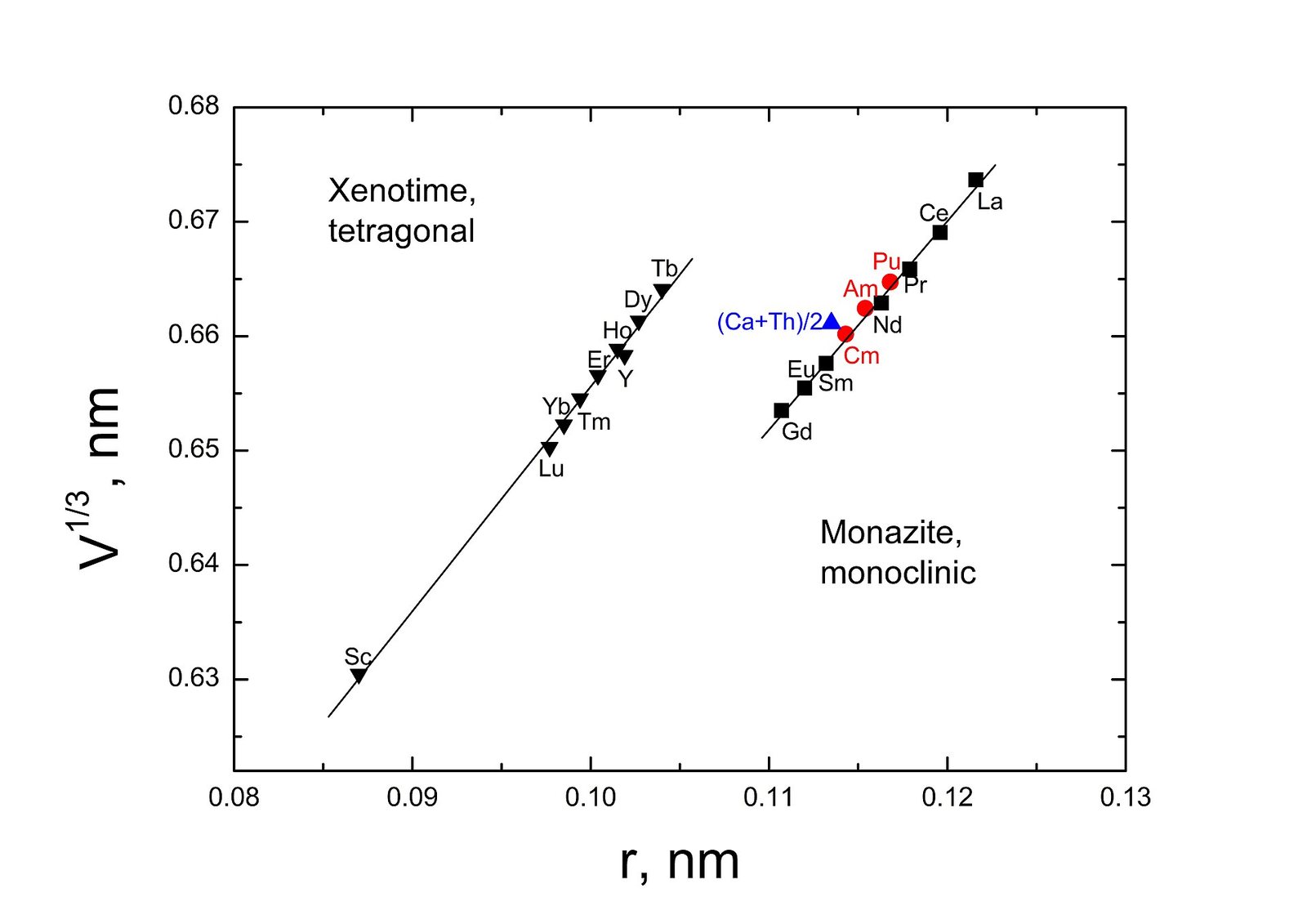
Xenotime
A yttrium phosphate that also carries the heavy rare earths — dysprosium, terbium, erbium — that magnets need.
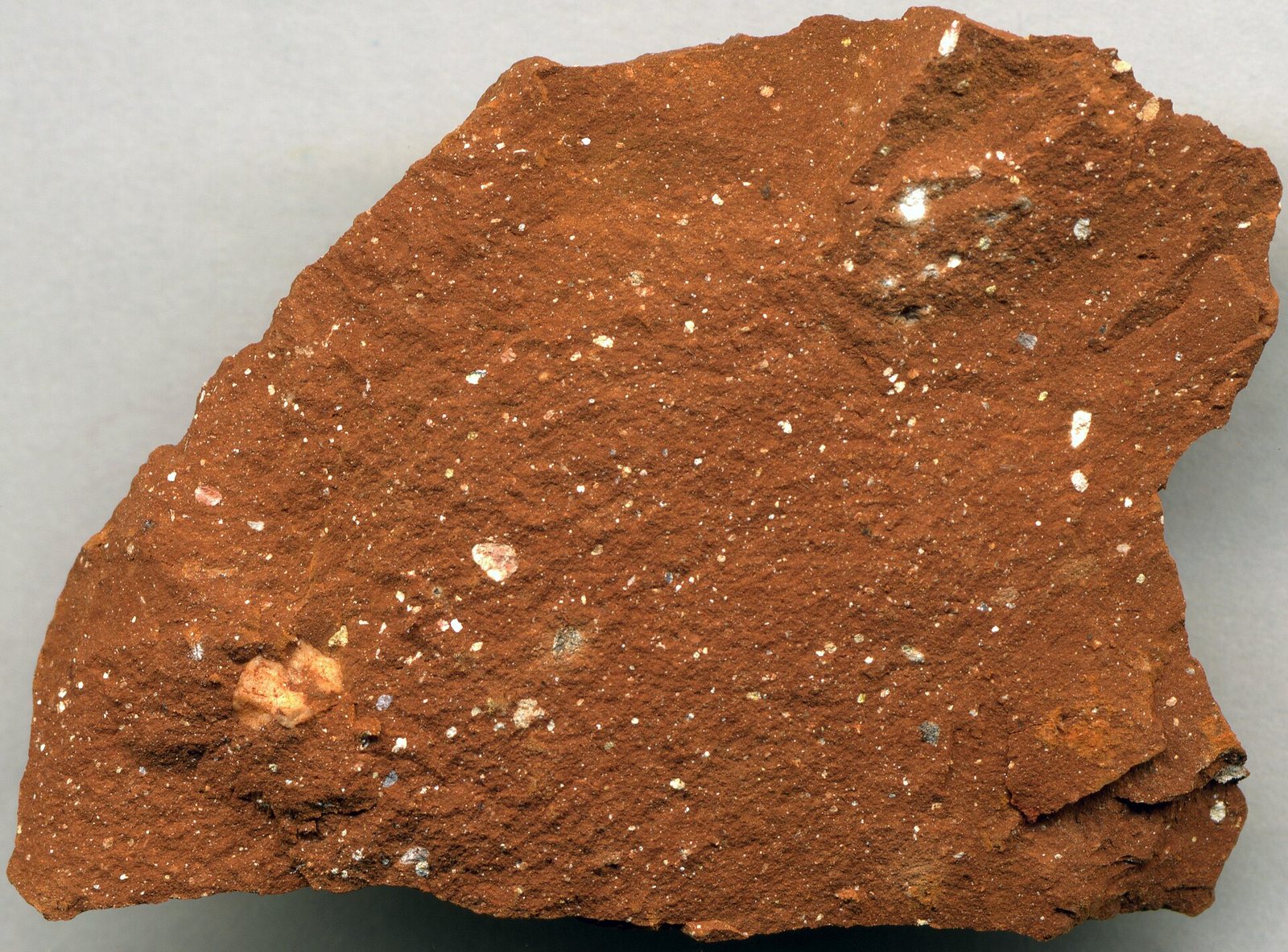
Ion-Adsorption Clay
Weathered granite where rare-earth ions cling loosely to clay surfaces. Grades are very low but the metal washes out…
价格
average, dollars per kilogram: Erbium oxide, 99.5%, minimum
年度平均值dollars per kilogram
基准: average, dollars per kilogram: Erbium oxide, 99.5%, minimum. 年度平均值,来源: USGS Mineral Commodity Summaries 2026 · 来源 ↗. 以下为参考年度均价,非实时市场报价。