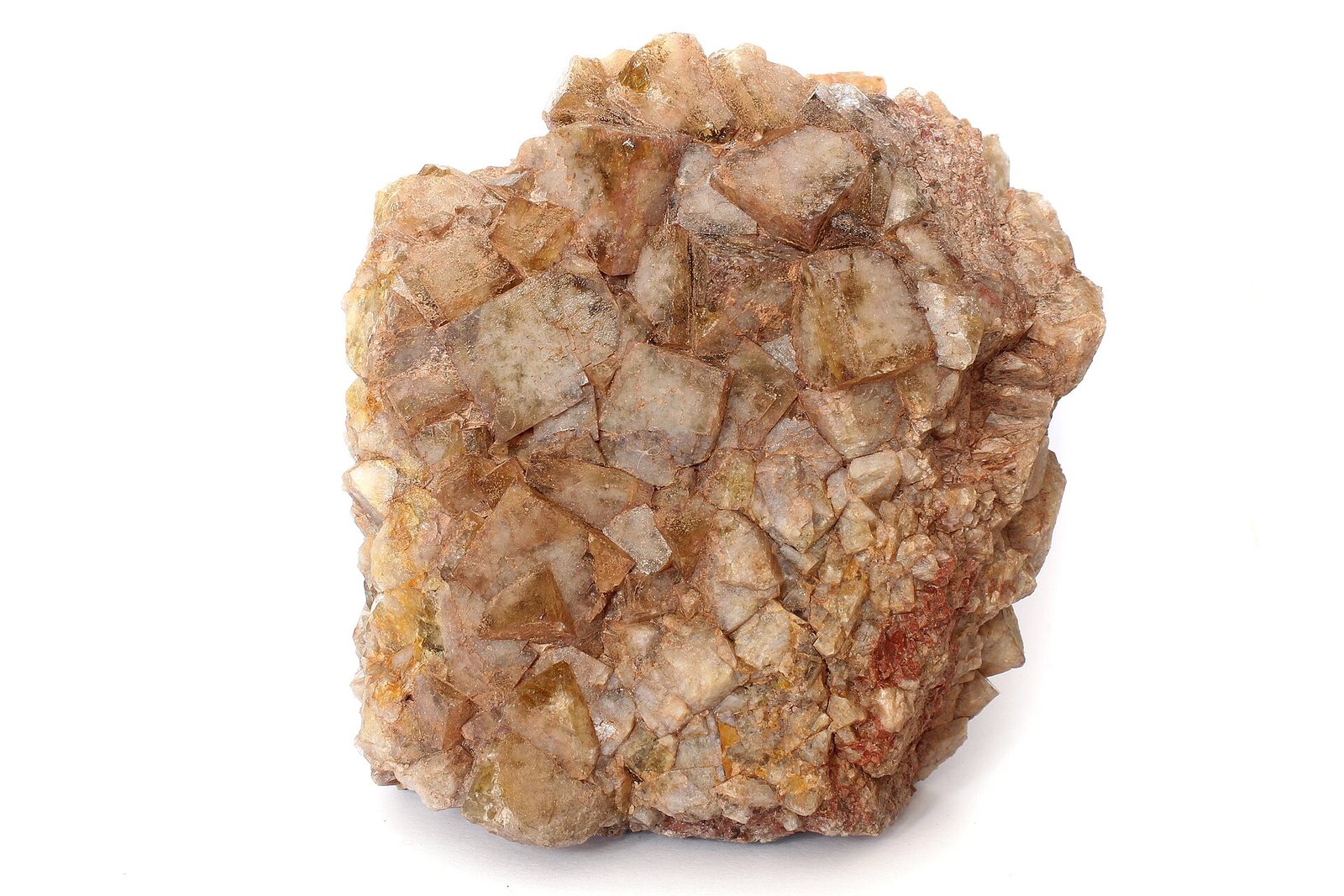
这是什么?
Calcium fluoride, the mineral that every fluorine atom in industry ultimately comes from — including the fluorine in battery electrolyte.
为何重要?
Hydrofluoric acid from fluorspar makes refrigerants, aluminium smelting flux, uranium hexafluoride and the LiPF6 salt in lithium-ion cells.
Where it is in the Earth
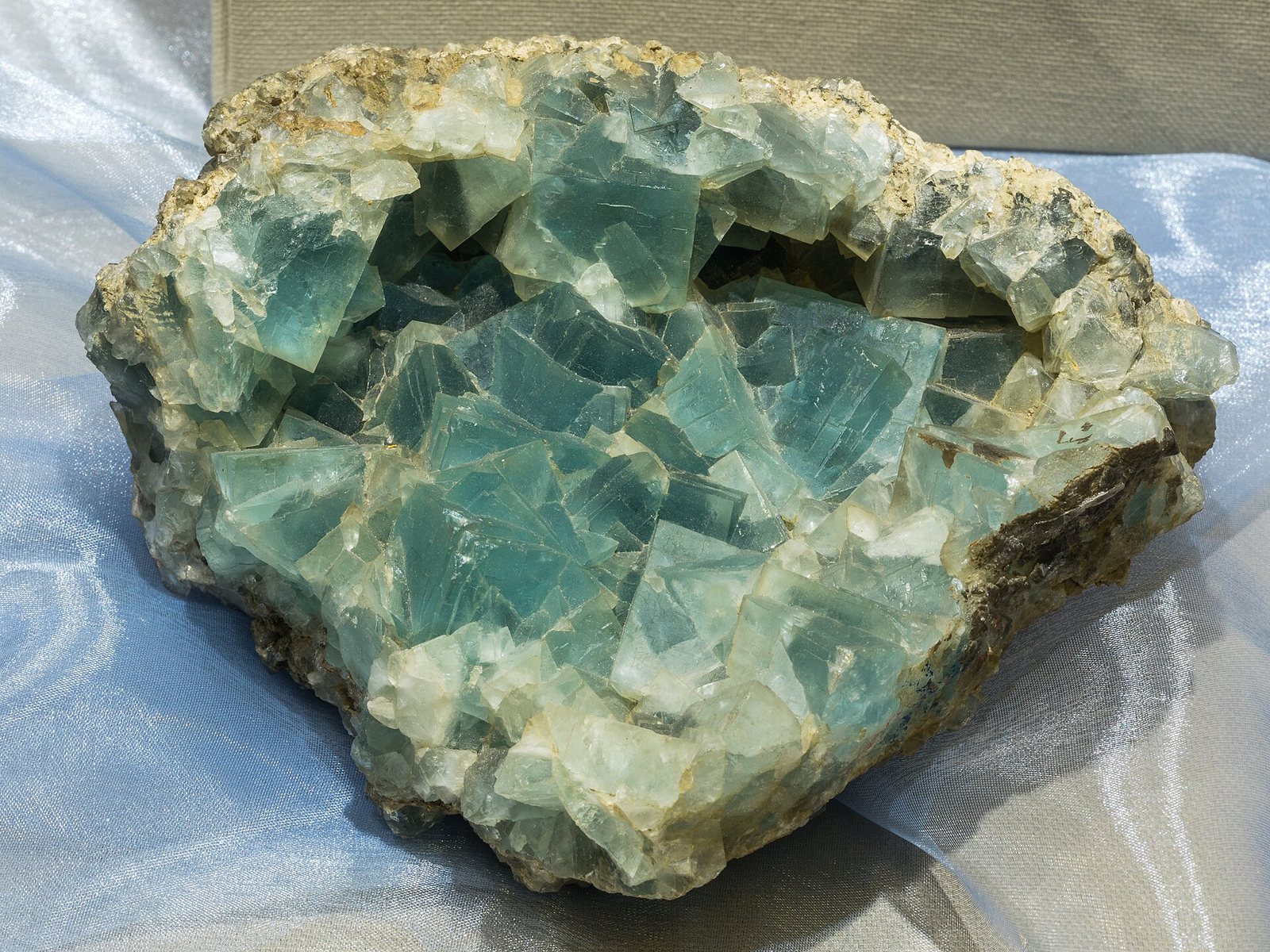
Fluorite — the mineral form of calcium fluoride — forms almost exclusively through hydrothermal processes. Hot, fluorine-bearing fluids, usually derived from the later stages of granite magmatism or from deeply circulating groundwater that has leached fluorine from surrounding rocks, migrate upward along faults and into porous limestone or dolomite beds. As the fluids cool and encounter carbonate rock, calcium and fluoride ions combine and precipitate out of solution, sometimes filling entire fault planes or replacing the host limestone wholesale. The first process produces what geologists call a vein deposit, typically a narrow but steeply dipping body of fluorite mixed with quartz and calcite gangue (the waste minerals that accompany the ore). The second produces a stratabound or manto deposit — a broadly flat, replacement body that can be far larger and easier to mine in bulk.
This distinction in deposit style matters because it controls both the grade of the ore and the type of mining that follows. Vein deposits tend to be high-grade and irregular, demanding selective mining. Manto deposits, such as those in Mexico's San Luis Potosí region, are lower-grade but geometrically predictable and amenable to large-scale extraction. South Africa's deposits, associated with the Bushveld Complex, are a different expression again, occurring in broadly flat, sedimentary layers interbedded with igneous rocks. Mongolia's Bor Undur district exploits large veins cutting Palaeozoic basement. The common thread in every case is an adequate source of fluorine, a plumbing system of fractures to carry it, and a chemically reactive carbonate host to fix it in place.
Fluorine is not rare in the Earth's crust — it is present in granites, in micas, in apatite, and in seawater — but it is rarely concentrated to ore grade. The association with carbonate terranes explains why the great fluorspar districts cluster along ancient continental margins and rift zones where limestone is abundant and where magmatic or tectonic heat drove fluid circulation over geologically long periods.
Getting it out
Most fluorspar is mined by open-pit methods where deposits are shallow, flat-lying, or weathered enough that the rock can be drilled and blasted economically from the surface. Underground mining is used where ore bodies are deep, narrow, or steeply dipping — as is common in classic vein districts. The choice between the two determines how much surrounding rock, called waste or overburden, must be moved for every tonne of ore recovered. Open-pit operations typically move considerably more total rock per tonne of product than underground mines do, but they allow larger machinery and lower labour costs per tonne, which often makes them cheaper overall where the geometry permits.
The grade of a fluorspar deposit is expressed as the percentage of calcium fluoride (CaF₂) in the run-of-mine ore — the material as it comes straight from the blast. Run-of-mine grades vary enormously between deposit types. A high-grade vein might deliver ore that is already close to marketable specification, while a manto or bedded deposit might yield ore that requires extensive processing before it approaches the purity that buyers expect. The two principal commercial grades — acid grade (at least 97% CaF₂) and metallurgical grade (broadly 60–85% CaF₂) — are not simply different names for different ores; they are different products destined for different industries and trading at materially different prices, as the import value data on this page shows.
Because fluorspar is almost always the principal product rather than a by-product of mining something else, the economics of a mine depend directly on the fluorite content of the ore and on how much of that fluorite can be recovered during processing. Dilution — the unavoidable mixing of ore with adjacent waste rock during blasting — reduces effective head grade and therefore increases the processing cost per tonne of saleable product. Managing dilution is a central operational concern, particularly in narrow underground veins.
What pulls on it
The starting point for understanding fluorspar demand is that the mineral is not itself an end product. It is a feedstock, and virtually all of the acid-grade material consumed worldwide is converted into hydrofluoric acid as a first step. From hydrofluoric acid, the fluorine atom is routed into an array of downstream products whose end markets are quite different from one another. Refrigerants — the hydrofluorocarbon and hydrofluoroolefin compounds used in air conditioning and refrigeration — account for a large share of hydrofluoric acid consumption. Aluminium smelting, which uses fluorspar directly as a flux in the cryolite bath of electrolytic reduction cells, represents the largest single use of metallurgical-grade material. Steelmakers also consume metallurgical-grade fluorspar as a slag conditioner. Uranium enrichment requires uranium hexafluoride, and the sole fluorinating agent that can produce it at scale is hydrofluoric acid derived from fluorspar.
The energy transition has added a new dimension to demand. Lithium-ion battery electrolytes use lithium hexafluorophosphate (LiPF₆) as the conducting salt, and its production requires hydrofluoric acid; the same is true of the polyvinylidene fluoride (PVDF) binders used in battery electrodes. As battery manufacturing capacity grows, the fluorine required for these applications grows with it. The significance of this is not merely that demand increases in aggregate, but that the downstream chemistry for battery materials requires acid-grade fluorspar of consistent purity — a different supply proposition from metallurgical-grade flux.
Demand could change sharply in either direction under a limited set of conditions. A large shift toward natural refrigerants — ammonia, carbon dioxide, hydrocarbons — in air conditioning and refrigeration would reduce one of the largest consumption streams. Conversely, a sustained acceleration in battery gigafactory construction would increase demand for the fluorine-intensive materials in electrolyte and electrode manufacturing. The relationship between these two vectors, and which moves faster, will determine the net direction of fluorspar demand over the coming decade, though this page does not forecast the outcome.
Turning ore into product 级别 3
Run-of-mine fluorspar ore almost never meets market specification directly and must be processed through a sequence of size reduction and concentration steps. Comminution — the staged crushing and grinding of ore to liberate fluorite grains from the surrounding gangue minerals — is the first and most energy-intensive phase. The target particle size is determined by the grain size of the fluorite itself: coarser-grained deposits can be liberated with less grinding, which reduces both energy consumption and the generation of ultrafine particles that are difficult to recover.
Concentration is achieved almost universally by froth flotation, a process in which finely ground ore is agitated in water with chemical reagents called collectors and frothers. Collectors adsorb selectively onto fluorite surfaces, making them hydrophobic; when air is introduced, fluorite particles attach to bubbles and float to the surface as a froth, while gangue minerals — principally calcite, quartz, and barite — remain in suspension and are discarded as tailings. The selectivity of flotation against calcite is particularly difficult, because both minerals have similar surface chemistry. Depressants, chemicals that suppress calcite flotation without affecting fluorite, are added to manage this, and their formulation is often the defining process knowledge of a particular operation. Recovery rates and the grade of the resulting concentrate depend on ore mineralogy, grind size, reagent selection, and circuit design; where these are optimised, a high proportion of the fluorite in the feed can be captured in a product approaching acid-grade specification.
Acid-grade concentrate (97%+ CaF₂) can be sold directly to hydrofluoric acid producers, who react it with sulfuric acid to yield hydrogen fluoride gas — the primary intermediate from which all fluorine chemistry flows. Metallurgical-grade concentrate is a less pure product used primarily as a flux in steelmaking and aluminium smelting, where it lowers the melting point of the slag or electrolyte bath rather than serving as a fluorine source. The price differential between the two grades, visible in the import data on this page, reflects both the cost of achieving higher purity and the greater versatility of acid-grade material. Losses occur at every stage: in the tailings stream from flotation, in dust and moisture allowances, and in the difference between the theoretical CaF₂ content of the ore and what flotation can practicably recover. These losses define the yield of the plant and are the primary determinant of processing cost per tonne of saleable product.
Substitution and recycling 级别 3
For acid-grade fluorspar used as the source of industrial fluorine, there is no practical substitute at commercial scale. Hydrofluoric acid can in principle be sourced from fluorosilicic acid, a by-product of the phosphate fertiliser industry in which fluorine is driven off during the acidulation of phosphate rock and recovered from scrubber liquors. This route does supply a fraction of global fluorine demand, particularly in regions with large phosphate processing capacity, but its fluorine content and output are tied to phosphate production volumes and cannot be independently scaled. It does not produce the concentrated, pure hydrofluoric acid that acid-grade fluorspar reactions yield, and further processing to achieve equivalent purity adds cost. The result is that fluorosilicic acid supplements rather than displaces fluorspar-derived acid.
In steelmaking, the flux function of metallurgical-grade fluorspar can be partially replicated by synthetic fluorspar — calcium fluoride produced as a by-product of hydrofluoric acid manufacture — or by other fluxing agents such as lime. Synthetic fluorspar is already consumed in this way and represents genuine substitution, though its availability depends on the output of acid plants. The ability of steelmakers to reduce fluorspar consumption by reformulating slag chemistry has historically been real but limited; there are operating constraints on how far the substitution can be pushed without affecting furnace performance or steel quality.
Recycling of fluorine from industrial waste streams is practised but remains a small fraction of total supply. Spent pot liner from aluminium smelters contains fluoride compounds and is processed to recover both aluminium and fluorine values in some operations. Refrigerant recovery and reclaim programmes recirculate a portion of existing refrigerant charge rather than manufacturing new material, effectively extending the fluorine already in circulation. The barriers to greater recycling are primarily economic and logistical: fluorine is dispersed across many small-volume, geographically scattered waste streams, and the collection and reprocessing cost often exceeds the value of the recovered material relative to virgin concentrate prices.
Where the chain is fragile 级别 4
The single most prominent feature of the fluorspar supply picture is geographic concentration. China produces 6,000 thousand metric tons of an estimated world total of 10,000 thousand metric tons — 60% of global mine output — and holds 110,000 thousand metric tons of the world's 330,000 thousand metric tons of reported reserves, the largest national share. This concentration has been a persistent structural feature rather than a recent development. China also hosts a large proportion of the world's hydrofluoric acid production capacity, meaning that concentration exists not only at the mining stage but also at the first processing step. A policy decision, export restriction, or domestic supply disruption in China propagates through the entire downstream fluorine supply chain with limited buffering capacity elsewhere.
Mongolia and Mexico together account for a further 1,500 thousand metric tons each of annual production, providing the most significant non-Chinese supply, but Mongolia's reserve base of 34,000 thousand metric tons is smaller relative to its production rate than Mexico's 68,000 thousand metric tons, and both countries' output ultimately serves end markets that are themselves geographically concentrated. South Africa's reserve base of 41,000 thousand metric tons is large relative to its current production of 410 thousand metric tons, suggesting headroom for expansion, but reserve figures are subject to reporting conventions that differ by jurisdiction — some countries report reserves on a CaF₂ content basis, others on a gross ore basis, and the USGS data that underlies the figures shown on this page applies its own normalisation that may diverge from national-authority figures. Pakistan's reserve figure is withheld by the source, so its contribution to the global reserve base is not captured in the world total as published.
Lead times for new fluorspar supply are long by the standards of simpler commodities. Exploration, resource definition, permitting, and construction of a new mine and flotation plant typically span many years, and in jurisdictions with complex environmental permitting the timeline is less predictable than in those with streamlined processes. Because fluorspar is a primary product rather than a by-product of base-metal mining, new supply cannot be accelerated simply by increasing the throughput of an existing metals operation. The processing bottleneck extends downstream: hydrofluoric acid plants are classified installations requiring significant permitting in most jurisdictions, and their construction timelines are comparable to those of the mines that feed them. The consequence is that a sustained increase in demand — driven, for example, by battery electrolyte or refrigerant growth — cannot be met quickly by new supply, creating a structural lag between demand signals and supply response that is inherent to the industry's architecture.
其在岩石中的来源
所有含矿矿物 →实际承载以下内容的矿物: fluorspar. 只有其中某种物质的富集程度足以覆盖开采成本,矿床才能成为矿体。
生产主体
在地图上查看 →Mine production
Mine productionthousand metric tons 2025 (估计值) 全球合计 10,000 thousand metric tons
USGS Mineral Commodity Summaries 2026 · Gross weight of all grades; acid grade and metallurgical grade are different markets. · 来源 ↗
横向滚动表格以查看其余列。
| 国家/地区 | 产量 | 占全球份额 |
|---|---|---|
| China | 6,000 | 60.0% |
| Mongolia | 1,500 | 15.0% |
| Mexico | 1,500 | 15.0% |
| South Africa | 410.0 | 4.1% |
| Other countries | 200.0 | 2.0% |
| Vietnam | 160.0 | 1.6% |
| Spain | 140.0 | 1.4% |
| Brazil | 100.0 | 1.0% |
| Iran | 70.00 | 0.7% |
| Thailand | 55.00 | 0.6% |
| Pakistan | 50.00 | 0.5% |
| Germany | 35.00 | 0.3% |
| Tajikistan | 15.00 | 0.1% |
| United States | Not applicable | — |
| 全球合计 | 10,000 | 100% |
"未披露"表示美国地质调查局(USGS)为避免泄露单个企业数据而对该数字进行了保密处理——并不意味着数值为零。各国行数之和不一定等于世界合计,原因在于来源对每个数字单独进行四舍五入处理,且并不总是单独列出"其他国家/地区"一行。
储量持有方
Reserves
Reservesthousand metric tons 2025
USGS Mineral Commodity Summaries 2026 · 来源 ↗
| 国家/地区 | 储量 | 占全球份额 |
|---|---|---|
| China | 110,000 | 33.3% |
| Mexico | 68,000 | 20.6% |
| South Africa | 41,000 | 12.4% |
| Mongolia | 34,000 | 10.3% |
| Other countries | 32,000 | 9.7% |
| Vietnam | 16,000 | 4.8% |
| Spain | 15,000 | 4.5% |
| Iran | 7,600 | 2.3% |
| Thailand | 3,600 | 1.1% |
| Brazil | 2,500 | 0.8% |
| United States | Not applicable | — |
| Germany | Not applicable | — |
| Pakistan | Not applicable | — |
| Tajikistan | Not applicable | — |
| 全球合计 | 330,000 | 100% |
价格
average unit value of imports, cost, insurance, and freight, dollars per metric ton: Metallurgical grade
年度平均值dollars per metric ton
基准: average unit value of imports, cost, insurance, and freight, dollars per metric ton: Metallurgical grade. 年度平均值,来源: USGS Mineral Commodity Summaries 2026 · 来源 ↗. 以下为参考年度均价,非实时市场报价。
average unit value of imports, cost, insurance, and freight, dollars per metric ton: Acid grade
年度平均值dollars per metric ton
基准: average unit value of imports, cost, insurance, and freight, dollars per metric ton: Acid grade. 年度平均值,来源: USGS Mineral Commodity Summaries 2026 · 来源 ↗. 以下为参考年度均价,非实时市场报价。
其加工与精炼地点
| 工厂 | 类型 | 阶段 | 国家/地区 | 角色 |
|---|---|---|---|---|
| Port Hope Conversion Facility | 化工厂 | 精炼 | Canada | 输入 |
其用途
所有终端市场 →| 终端市场 | 其在彼处的用途 | 重要性 |
|---|---|---|
| Nuclear Power | Fluorine for uranium hexafluoride | 重要 |