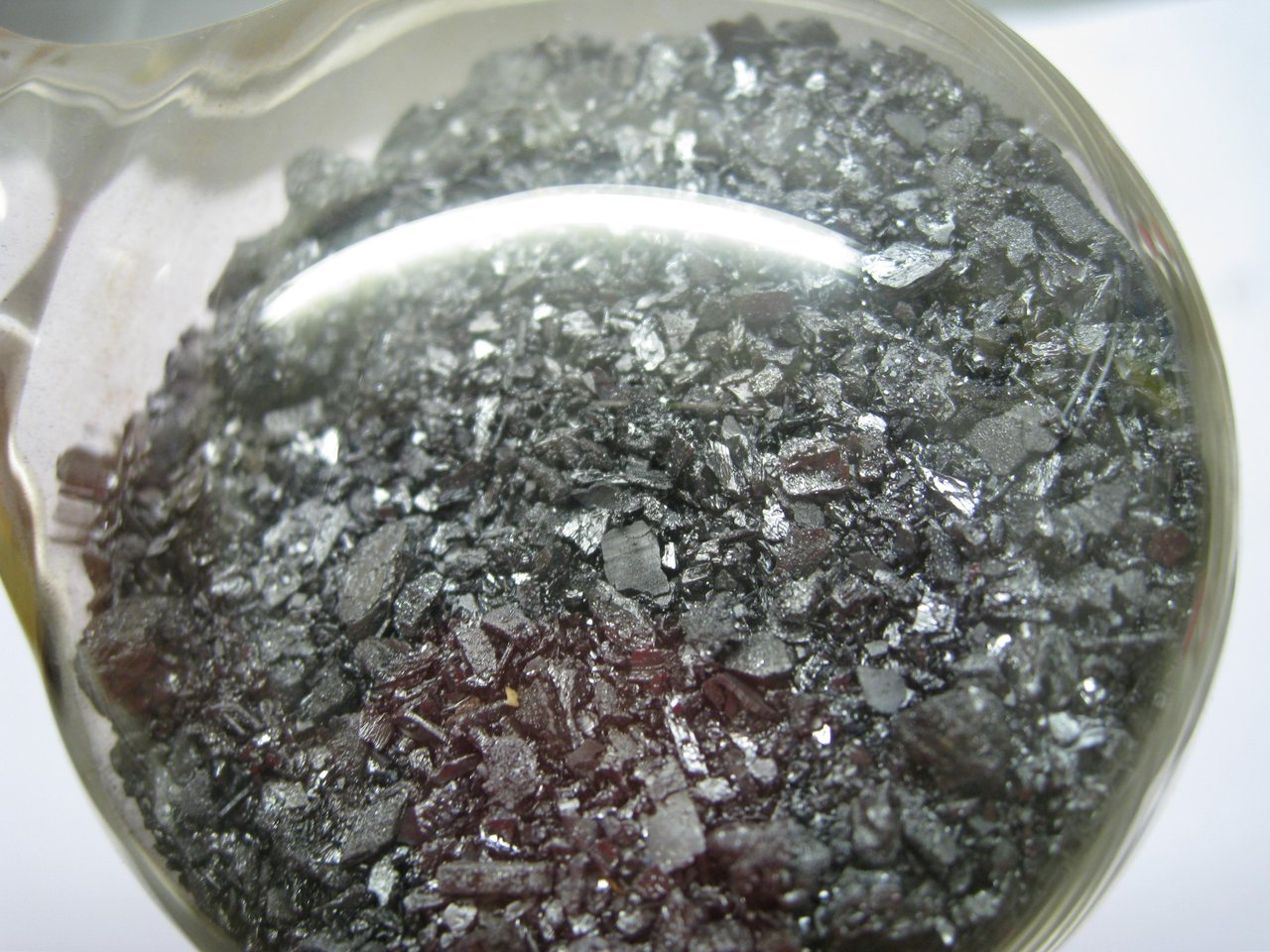
これは何か
A purple-black element that turns straight from solid to vapour, extracted from ancient nitrate deposits and from oilfield brine.
なぜ重要なのか
Iodised salt prevented a global cause of preventable brain damage; iodine is also in X-ray contrast media and in polarising film for every LCD screen.
Where it is in the Earth
Iodine does not form ore minerals in the conventional sense — there is no discrete iodine-bearing crystal that a geologist chips from a vein. Instead, the element is dissolved in water, and the question of where it concentrates is really a question of where certain waters have been trapped and enriched over geological time. The two commercial source types are very different in origin but share this common thread: both are ancient brines, waters that have spent millions of years in contact with organic-rich sediments.
In the Atacama Desert of northern Chile, iodine occurs alongside nitrate salts — collectively called caliche — in one of the driest places on Earth. The prevailing explanation is that iodine originally entered the atmosphere from the ocean, was carried inland by wind and fog, and accumulated in surface and near-surface evaporite deposits over tens of millions of years in a climate so arid that rainfall never washed it away. The caliche layers, which can extend across large areas of the Atacama, hold iodine at concentrations that make extraction worthwhile. This is a sedimentary accumulation, not a hydrothermal or igneous one.
Japan's iodine comes from a completely different setting: deep formation waters in Chiba Prefecture, in the Minami Kanto gas field east of Tokyo. Here, ancient marine sediments rich in organic matter were buried and compacted over geological time. The iodine that living organisms — particularly marine algae and plankton — had concentrated in their tissues was released into the pore water as the sediments were buried. That iodine-rich brine, under pressure, is brought to the surface as a by-product of natural gas production. Japan's reserve figures in the table appear very large relative to its current production rate precisely because this brine reservoir is deep and extensive, even if the flow rates recoverable at any given time are constrained.
Getting it out
Because iodine exists dissolved in water or locked in salt-bearing rock rather than in a solid ore mineral, the methods used to extract it look quite different from conventional hard-rock mining. In Chile's Atacama, the caliche — a hard, cemented layer of nitrate and associated salts — is mined from open pits using earthmoving equipment. The iodine content of the caliche is low enough that large volumes of material must be shifted to produce relatively small quantities of iodine; the economics are tied closely to the simultaneous recovery of nitrates, which are the primary product. Iodine is in this sense a co-product rather than the sole target of the operation.
In Japan, and in the oilfield brines of Turkmenistan, Iran, Azerbaijan and elsewhere in the table, there is no digging at all. Wells are drilled into the subsurface formation, and the brine is pumped or allowed to flow to the surface under its own pressure. The 'grade' in this context is the concentration of iodine dissolved in the brine, typically measured in milligrams per litre. A higher concentration means fewer litres of brine need to be processed to yield a kilogram of iodine, which matters greatly for energy and infrastructure costs. Because the brine has to be handled and disposed of in large quantities, and because it often contains other dissolved materials, operating a brine-based iodine plant is as much a water-management exercise as a mining one.
The United States has known brine resources — the reserve figure in the table reflects this — but domestic production is withheld by the reporting agency, meaning the source does not publish a specific number. What is clear is that the country relies on imports, predominantly from Chile and Japan, for the majority of its needs.
What pulls on it
Iodine demand falls into several distinct categories that have little to do with one another technically, which means the market can be pulled in different directions simultaneously. The oldest and most widely known use is in human nutrition: iodine added to table salt corrects a dietary deficiency that, left unaddressed, causes goitre and impairs cognitive development. This use is large in aggregate but grows only as slowly as population does, and in countries where iodisation programmes are already universal it is essentially stable.
X-ray contrast media represent a substantial industrial use. These are iodine-containing compounds injected into patients before certain medical imaging procedures to make blood vessels and organs more visible. Demand here tracks the number of imaging procedures performed globally — a figure that rises as populations age and as diagnostic medicine expands in middle-income countries. A different kind of imaging underpins a third major use: polarising film for liquid crystal displays. Every LCD screen — in televisions, computers and smartphones — contains a layer of polyvinyl alcohol film that has been oriented and dyed with iodine to polarise light. This application grew rapidly alongside the consumer electronics industry and remains significant, though it is sensitive to changes in display technology over the longer term.
Biocidal applications — disinfectants, antiseptics, animal feed supplements and crop protection — collectively account for another share of demand. Industrial catalysts, particularly in the production of certain organic chemicals, consume iodine in a way that is tied closely to the output of specific chemical plants rather than to broad economic trends. For demand to shift sharply downward, a successor display technology that does not use iodine-based polarising film would have to achieve wide deployment; for it to shift sharply upward, a significant new application at scale would have to emerge.
生産者
地図で見る →Mine production
Mine productionmetric tons 2025 (推定値) 世界合計 34,000 metric tons
USGS Mineral Commodity Summaries 2026 · Reported as elemental iodine content. · 出典 ↗
テーブルを横にスクロールすると残りの列が表示されます。
| 国 | 生産 | 世界に占める割合 |
|---|---|---|
| Chile | 23,000 | 67.6% |
| Japan | 9,000 | 26.5% |
| Turkmenistan | 800.0 | 2.4% |
| Iran | 700.0 | 2.1% |
| Azerbaijan | 210.0 | 0.6% |
| Indonesia | 50.00 | 0.1% |
| Russia | 8.00 | 0.0% |
| United States | Withheld | — |
| 世界合計 | 34,000 | 100% |
「非開示」とは、個別企業のデータが特定されないようUSGSが数値を公表しなかったことを意味し、ゼロを意味するものではありません。出典が各数値を独立して丸め処理しており、「その他の国」の内訳を常に示しているわけではないため、各国の数値の合計が世界合計と一致しないことがあります。
埋蔵量の保有者
Reserves
Reservesmetric tons 2025
USGS Mineral Commodity Summaries 2026 · 出典 ↗
| 国 | 埋蔵量 | 世界に占める割合 |
|---|---|---|
| Japan | 4,900,000 | 77.8% |
| Chile | 750,000 | 11.9% |
| United States | 250,000 | 4.0% |
| Azerbaijan | 170,000 | 2.7% |
| Russia | 120,000 | 1.9% |
| Turkmenistan | 70,000 | 1.1% |
| Iran | 40,000 | 0.6% |
| Indonesia | Not applicable | — |
| 世界合計 | >6,300,000 | 100% |
情報源はこの世界合計値を点推定値ではなく範囲推定値として公表しているため、最終列のシェアもそれ自体が範囲推定値となる。
価格
crude iodine, average unit value of imports (cost, insurance, and freight), dollars per kilogram
年間平均dollars per kilogram
基準: crude iodine, average unit value of imports (cost, insurance, and freight), dollars per kilogram. 以下に公表された年間平均値: USGS Mineral Commodity Summaries 2026 · 出典 ↗. これらは参照用の年間平均値であり、リアルタイムの市況相場ではない。