Dari batuan ke produk, ditelusuri
The Materials Atlas
Material Tambang & deposit Pemrosesan & pemurnian Perjalanan-perjalanan kustodi Rantai-rantai pasokan Perusahaan Negara Berita
Material berdasarkan rak Bahan Baku Baterai Unsur Tanah Jarang Tembaga & Kelistrikan Material Semikonduktor Material Nuklir Dirgantara & Pertahanan Logam Mulia Baja & Logam Paduan Mineral Industri Mineral Pertanian Bahan Baku Energi Mineral-mineral bijih Tabel periodik
Permintaan Pasar akhir Teknologi Kalkulator material Peta Penyaring
Pelajari & alat PelajariGlosarium Tanya DataAgen AI Riset & dataAPI ★ Tersimpan
Tentang Tentang kamiMetodologi Sumber dataKontak Penafian
Opsi pembacaan
🧭 Tampilan Terpandu Baru mengenal ini — kadar bijih, konsentrat, pemurnian, produk sampingan? Kami menjelaskan setiap istilah saat Anda menjelajah, dalam bahasa yang mudah dipahami. Data yang sama, dengan bantuan yang sudah tersedia.
⚡ Tampilan Ahli Anda sudah memahami industri ini. Cukup datanya — bersih, cepat, dan ringkas, tanpa penjelasan tambahan. Ini adalah tampilan default.
Tema
Bahasa antarmuka
Kedalaman Halaman material ditulis dalam empat tingkat. Pilih salah satu di halaman material mana pun dan pilihan tersebut akan diingat.
★ Tersimpan Riset & data
Krypton

Material Semikonduktor

Krypton Kr · 36

A rare noble gas, about one part per million of the air, separated only where enough air is already being processed.

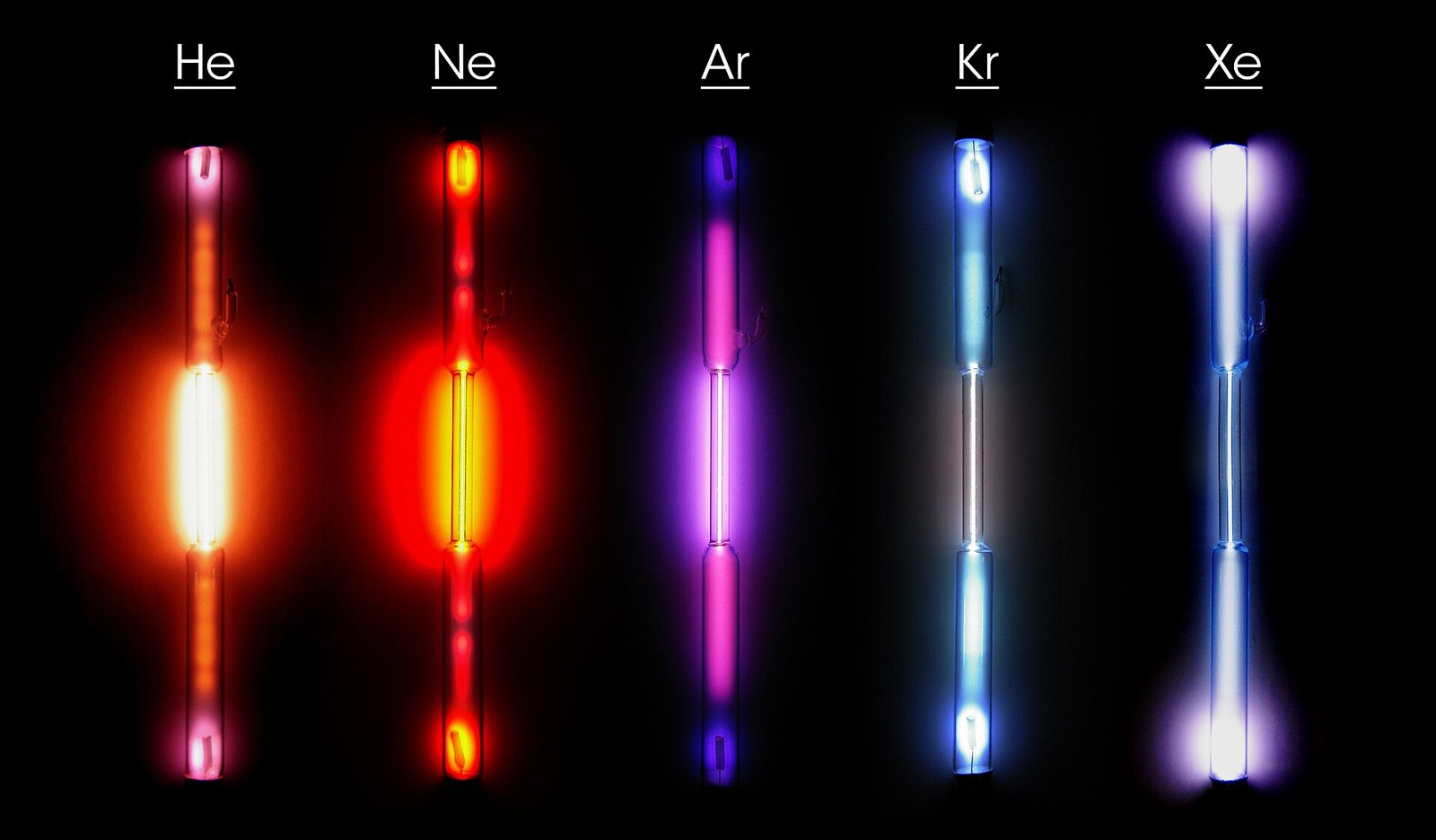
Spectre tubes à gaz · Alchemist-hp , derivative work by Poke2001 · CC BY-SA 2.0 de · Wikimedia Commons

Apa ini?

A rare noble gas, about one part per million of the air, separated only where enough air is already being processed.

Mengapa ini penting?

Krypton fluoride lasers pattern chips, and krypton fills the gap in high-performance window glazing.

Where it is in the Earth

Krypton is not a mineral and has no ore. It is a noble gas — one of the chemically inert elements in the rightmost column of the periodic table — and it exists in the atmosphere as a trace constituent, present at roughly one part per million by volume. That concentration is the same everywhere on Earth's surface, because the atmosphere mixes on timescales far shorter than the processes that could fractionate it. There are no krypton-rich geological formations, no veins to follow, no grades to map. The gas accumulated in the atmosphere over geological time as a decay product of certain radioactive isotopes and as a primordial remnant from when the planet formed, but it is so chemically unreactive that it bonds with nothing in the crust and stays in the air.

The practical consequence is that the geography of krypton supply has nothing to do with where the gas is in the ground. It is uniformly distributed in the atmosphere above every country on Earth. What determines where krypton is produced is instead the geography of large-scale air separation — the industrial process that liquefies air and distils it into its component gases. Wherever there is a plant large enough, and designed to capture the minor constituents rather than vent them, krypton can be recovered. The resource is the air itself; the constraint is entirely one of processing infrastructure.

Getting it out

Because krypton occurs in the atmosphere rather than in rock, it is never mined in any conventional sense. It is recovered exclusively as a by-product of air separation units, known in the industry as ASUs. An ASU takes in ordinary air, removes water vapour and carbon dioxide, then chills the remaining gas mixture until it liquefies. Once liquid, the different components — nitrogen, oxygen, argon, and the minor noble gases including krypton and xenon — can be separated by fractional distillation, the same principle used in an oil refinery but applied at temperatures well below minus one hundred degrees Celsius. Krypton, being heavier than nitrogen and oxygen, concentrates in particular fractions during this process.

Not every ASU recovers krypton. The gas is present in such small quantities that capturing it requires additional distillation columns and purification steps beyond what a plant needs to produce its primary products of nitrogen and oxygen. Only the largest plants, typically those built to supply industrial gases at scale, find it worthwhile to install and operate this extra equipment. The decision is entirely economic: the value of the krypton and xenon recovered must justify the capital and operating cost of the additional columns. Because the feedstock — air — costs nothing beyond the energy to compress and cool it, there is no waste rock, no tailings, no stripping ratio. The concept of grade does not apply. What varies is the efficiency of capture and the purity of the product stream.

What pulls on it

Krypton reaches end users through two principal routes, which are quite different in character. The first is the use of krypton fluoride, or KrF, lasers in semiconductor manufacturing. These lasers produce ultraviolet light at a wavelength suited to photolithography — the process by which circuit patterns are projected onto silicon wafers to create integrated circuits. The krypton is consumed in the laser gas mixture, which degrades over time and must be refreshed. Demand from this source is tied directly to the volume of semiconductor wafers being processed globally, and more specifically to the proportion of chip production that uses KrF lithography rather than newer techniques operating at shorter wavelengths.

The second significant use is in insulating glazing — the filling of the gap between the panes in high-performance double or triple-glazed windows. Krypton conducts heat less readily than air or argon, so a krypton-filled gap can be made narrower while achieving the same or better insulating performance. This matters in building designs where window thickness is constrained. Demand here is linked to construction activity, to energy efficiency standards in building regulations, and to the willingness of buyers to pay a premium over argon-filled units. For demand to shift sharply in either direction, one would need either a significant change in which lithography technology dominates chip factories, or a sustained shift in construction standards and consumer preferences for glazing performance.

Turning ore into product Tingkat 3

The separation of krypton from air proceeds in stages. In the primary ASU, air is compressed, cooled, and fed into distillation columns where nitrogen and oxygen are drawn off as the main products. Argon is recovered separately in a side column. The heavier noble gases — krypton and xenon together — accumulate in the oxygen-rich liquid at the base of the low-pressure column, reaching a concentration many times higher than in the original air but still far from pure. This enriched stream, sometimes called crude krypton-xenon or krypton-xenon concentrate, is the starting point for further processing.

The concentrate is then processed in dedicated purification trains. Residual oxygen and nitrogen are removed by catalytic reaction — oxygen is typically reacted away over a catalyst, and the resulting contaminants are stripped out. Further fractional distillation separates krypton from xenon, since the two gases differ enough in boiling point to allow clean separation given sufficient column height and reflux. The krypton fraction is then passed through adsorption beds, usually filled with molecular sieve materials, to remove remaining trace impurities. The end product is krypton gas at semiconductor-grade purity, typically supplied in compressed gas cylinders or, for large consumers, in liquid form in cryogenic vessels. The traded form noted in the data — sold initially as a krypton-xenon mixture and separated later — reflects the fact that some intermediate traders or end-users prefer to take the mixed product and perform final separation themselves, often because they need both gases and can optimise the split for their own process.

Losses occur at each stage, and the overall yield from air to finished product is low in absolute terms, though the cost of the feedstock is effectively zero. The main cost drivers are electrical power for compression and refrigeration, the capital cost of the distillation and purification equipment, and the logistics of handling cryogenic liquids. Because krypton and xenon are recovered from the same stream, the economics of one gas are intertwined with those of the other; a plant operator managing this fraction must balance recovery of both simultaneously.

Substitution and recycling Tingkat 3

In semiconductor lithography, the practical substitute for KrF lasers is a different laser technology operating at a shorter wavelength, specifically ArF (argon fluoride) lasers and, at the leading edge of production, extreme ultraviolet systems. The transition toward shorter wavelengths has been ongoing for some years, and it does reduce the share of wafers processed by KrF tools, though it does not eliminate them; older chip designs and mature process nodes continue to use KrF equipment, and the installed base turns over slowly. Argon fluoride systems use no krypton at all, so any shift of production volume toward them is a direct substitution away from krypton demand in this application.

In glazing, argon is the straightforward substitute. It is far more abundant, far cheaper, and is recovered in much larger quantities from the same air separation plants. The trade-off is thermal performance: to match krypton's insulating effect, an argon-filled unit requires a wider gap, which adds to overall window thickness. Where building specifications can accommodate the extra thickness, argon is the default choice. Krypton's use in glazing therefore depends on a relatively narrow set of applications where thin profiles are specifically required. Recycling of krypton is limited in practice. The gas used in laser systems is consumed or becomes chemically altered and is not recovered in useful quantities. Gas extracted from old glazing units at end of life is theoretically recoverable but the logistics of collection and purification make this economically marginal, and no significant recycling stream operates at scale.

Where the chain is fragile Tingkat 4

The supply picture for krypton carries several structural features that deserve careful attention. The most important is by-product dependence: krypton cannot be produced on its own terms. It is available only when and where large ASUs are running, primarily to supply nitrogen and oxygen to steelmakers, chemical plants, and hospitals. If those primary markets contract — or if the economics of the primary gases shift — krypton supply adjusts accordingly, with no independent mechanism to compensate. A researcher examining production figures should bear in mind that the world total shown in the data reflects the subset of ASU capacity configured and operated to capture the noble gas fraction, not total installed ASU capacity globally.

Geographic concentration is a second concern. The data show U.S. domestic production at 1.5 million litres against a world total of 110 million litres, with a net import reliance estimated at 93 percent for 2025. The leading import sources for the 2021–2024 period are listed as not available in the source data, which itself reflects a reporting constraint worth noting: trade in noble gases is not always disaggregated in national customs data with the granularity researchers would prefer, and figures from different national or commercial sources may differ in their inclusion of krypton-xenon mixtures versus separated product. A significant share of global separation capacity has historically been located in a small number of countries, making the supply chain sensitive to disruptions in those locations.

Processing bottlenecks add a further layer of fragility. Even when ASUs are running and capturing the krypton-xenon fraction, the purification infrastructure to take that concentrate to semiconductor or glazing grade is more limited and geographically concentrated than the primary separation capacity. Lead times for expanding purification capacity are not trivial — the specialised distillation equipment requires engineering and fabrication that extends over months to years. The combination of by-product dependence, geographic concentration of both separation and purification, and the long lead times for capacity additions means that the supply chain has limited ability to respond quickly to a sustained increase in demand or to offset a regional disruption.

Baca angka-angka ini dengan benar. Reported in millions of litres of gas. Purified gas, usually sold with xenon as a mixture then separated.

Siapa yang memproduksinya

Lihat di peta →

Rare gases production, (million liters)

Rare gases production, (million liters)million liters 2025 (estimasi) Total dunia 110.0 million liters

USGS Mineral Commodity Summaries 2026 · Reported in millions of litres of gas. · sumber ↗

Gulir tabel ke samping untuk melihat kolom-kolom yang tersisa.

NegaraProduksi Pangsa dunia
Other countries 110.0 100.0%
United States 1.50 1.4%
Total dunia 110.0100%

"Ditahan" berarti USGS menyembunyikan angka tersebut untuk menghindari pengungkapan data perusahaan tertentu — bukan berarti nol. Baris per negara tidak selalu berjumlah sama dengan total dunia karena sumber membulatkan setiap angka secara independen dan tidak selalu merinci baris "negara lain".

Material

Semua material Mineral kritis Tanah jarang Bahan baku baterai Mineral-mineral bijih Tabel periodik Penyaring

Permukaan tanah

Tambang & deposit Pemrosesan & pemurnian Negara Peta

Perekonomian

Perjalanan-perjalanan kustodi Rantai-rantai pasokan Pasar akhir Teknologi Perusahaan Kalkulator material

Pelajari

PelajariGlosarium Tanya DataAgen AI Riset & dataAPI Terbuka Berita★ Tersimpan

Tentang kami

Tentang kamiKontak MetodologiSumber data Kebijakan editorial Kebijakan privasiKetentuan penggunaan Penafian