Da rocha ao produto, rastreado
The Materials Atlas
Materiais Minas e depósitos Processamento e refinação Jornadas de custódia Cadeias de abastecimento Empresas Países Notícias
Materiais por categoria Materiais para Baterias Elementos de Terras Raras Cobre e Elétrico Materiais para Semicondutores Materiais Nucleares Aeroespacial e Defesa Metais preciosos Aço e metais de liga Minerais Industriais Minerais Agrícolas Matérias-Primas Energéticas Minerais minério Tabela periódica
Procura Mercados finais Tecnologias Calculadora de materiais Mapas Triador
Aprender e ferramentas AprenderGlossário Consultar os DadosAgentes de IA Pesquisa e dadosAPI ★ Guardado
Sobre Sobre nósMetodologia Fontes de dadosContacto Aviso legal
Opções de leitura
🧭 Vista Guiada Novo nisto — teores de minério, concentrado, refinação, subprodutos? Explicamos cada termo à medida que navega, em linguagem simples. Os mesmos dados, com a ajuda integrada.
⚡ Visão de Especialista Já conhece o setor. Apenas os dados — claros, rápidos e compactos, sem explicações adicionais. Esta é a vista predefinida.
Tema
Idioma da interface
Profundidade As páginas de materiais são redigidas em quatro níveis. Escolha um em qualquer página de material e essa escolha será guardada.
★ Guardado Pesquisa e dados
Krypton

Materiais para Semicondutores

Krypton Kr · 36

A rare noble gas, about one part per million of the air, separated only where enough air is already being processed.

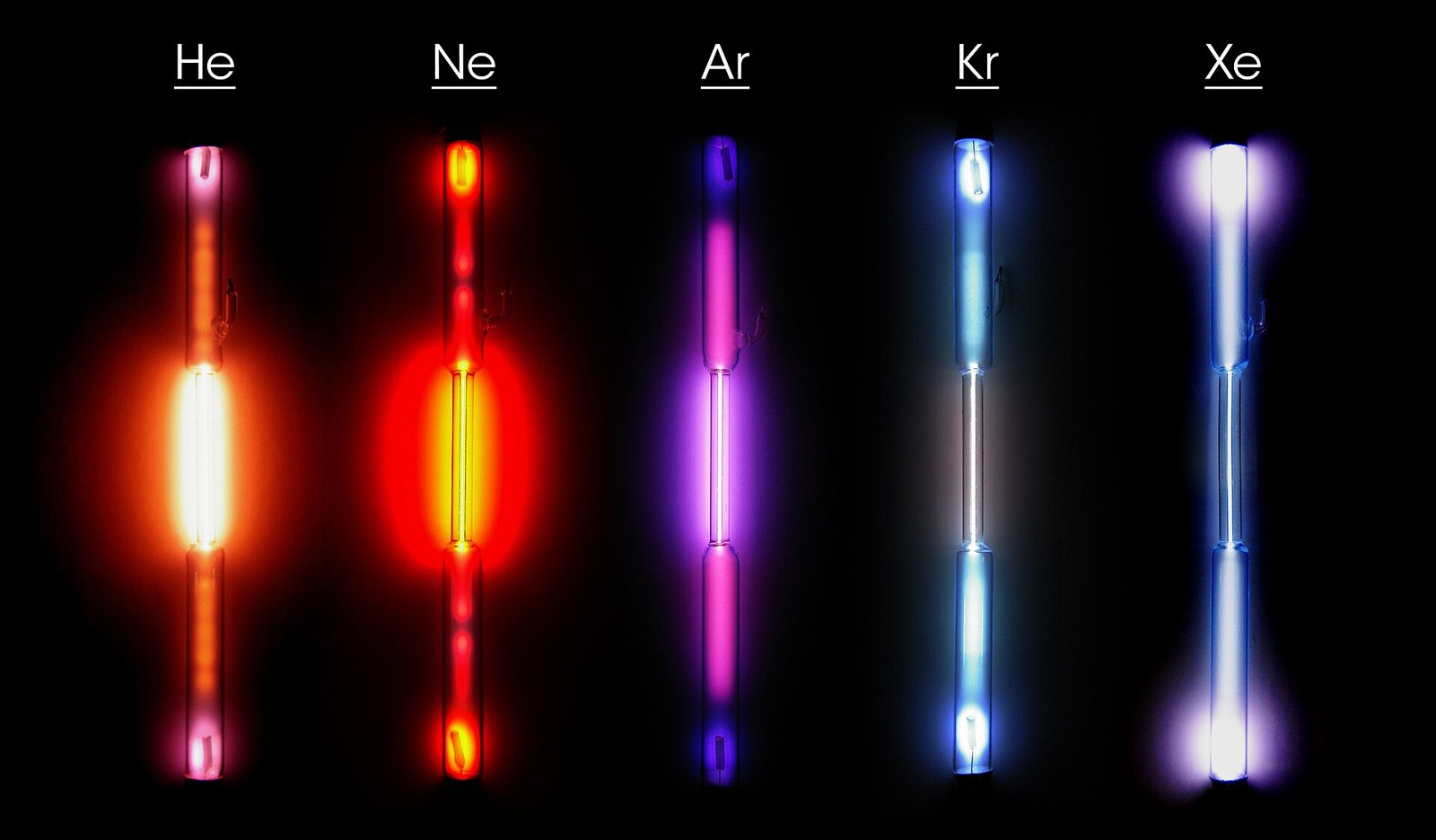
Spectre tubes à gaz · Alchemist-hp , derivative work by Poke2001 · CC BY-SA 2.0 de · Wikimedia Commons

O que é?

A rare noble gas, about one part per million of the air, separated only where enough air is already being processed.

Por que razão é importante?

Krypton fluoride lasers pattern chips, and krypton fills the gap in high-performance window glazing.

Where it is in the Earth

Krypton is not a mineral and has no ore. It is a noble gas — one of the chemically inert elements in the rightmost column of the periodic table — and it exists in the atmosphere as a trace constituent, present at roughly one part per million by volume. That concentration is the same everywhere on Earth's surface, because the atmosphere mixes on timescales far shorter than the processes that could fractionate it. There are no krypton-rich geological formations, no veins to follow, no grades to map. The gas accumulated in the atmosphere over geological time as a decay product of certain radioactive isotopes and as a primordial remnant from when the planet formed, but it is so chemically unreactive that it bonds with nothing in the crust and stays in the air.

The practical consequence is that the geography of krypton supply has nothing to do with where the gas is in the ground. It is uniformly distributed in the atmosphere above every country on Earth. What determines where krypton is produced is instead the geography of large-scale air separation — the industrial process that liquefies air and distils it into its component gases. Wherever there is a plant large enough, and designed to capture the minor constituents rather than vent them, krypton can be recovered. The resource is the air itself; the constraint is entirely one of processing infrastructure.

Getting it out

Because krypton occurs in the atmosphere rather than in rock, it is never mined in any conventional sense. It is recovered exclusively as a by-product of air separation units, known in the industry as ASUs. An ASU takes in ordinary air, removes water vapour and carbon dioxide, then chills the remaining gas mixture until it liquefies. Once liquid, the different components — nitrogen, oxygen, argon, and the minor noble gases including krypton and xenon — can be separated by fractional distillation, the same principle used in an oil refinery but applied at temperatures well below minus one hundred degrees Celsius. Krypton, being heavier than nitrogen and oxygen, concentrates in particular fractions during this process.

Not every ASU recovers krypton. The gas is present in such small quantities that capturing it requires additional distillation columns and purification steps beyond what a plant needs to produce its primary products of nitrogen and oxygen. Only the largest plants, typically those built to supply industrial gases at scale, find it worthwhile to install and operate this extra equipment. The decision is entirely economic: the value of the krypton and xenon recovered must justify the capital and operating cost of the additional columns. Because the feedstock — air — costs nothing beyond the energy to compress and cool it, there is no waste rock, no tailings, no stripping ratio. The concept of grade does not apply. What varies is the efficiency of capture and the purity of the product stream.

What pulls on it

Krypton reaches end users through two principal routes, which are quite different in character. The first is the use of krypton fluoride, or KrF, lasers in semiconductor manufacturing. These lasers produce ultraviolet light at a wavelength suited to photolithography — the process by which circuit patterns are projected onto silicon wafers to create integrated circuits. The krypton is consumed in the laser gas mixture, which degrades over time and must be refreshed. Demand from this source is tied directly to the volume of semiconductor wafers being processed globally, and more specifically to the proportion of chip production that uses KrF lithography rather than newer techniques operating at shorter wavelengths.

The second significant use is in insulating glazing — the filling of the gap between the panes in high-performance double or triple-glazed windows. Krypton conducts heat less readily than air or argon, so a krypton-filled gap can be made narrower while achieving the same or better insulating performance. This matters in building designs where window thickness is constrained. Demand here is linked to construction activity, to energy efficiency standards in building regulations, and to the willingness of buyers to pay a premium over argon-filled units. For demand to shift sharply in either direction, one would need either a significant change in which lithography technology dominates chip factories, or a sustained shift in construction standards and consumer preferences for glazing performance.

Leia os números corretamente. Reported in millions of litres of gas. Purified gas, usually sold with xenon as a mixture then separated.

Quem o produz

Ver no mapa →

Rare gases production, (million liters)

Rare gases production, (million liters)million liters 2025 (estimado) Total mundial 110.0 million liters

USGS Mineral Commodity Summaries 2026 · Reported in millions of litres of gas. · fonte ↗

Deslize a tabela lateralmente para ver as colunas restantes.

PaísProdução Partilha do mundo
Other countries 110.0 100.0%
United States 1.50 1.4%
Total mundial 110.0100%

"Withheld" significa que o USGS suprimiu o valor para evitar divulgar dados de uma empresa individual — não significa zero. Os valores por país nem sempre somam o total mundial porque a fonte arredonda cada valor de forma independente e nem sempre discrimina uma linha de "outros países".
Materiais

Todos os materiais Minerais críticos Terras raras Materiais para baterias Minerais minério Tabela periódica Triador

O terreno

Minas e depósitos Processamento e refinação Países Mapas

A economia

Jornadas de custódia Cadeias de abastecimento Mercados finais Tecnologias Empresas Calculadora de materiais

Aprender

AprenderGlossário Consultar os DadosAgentes de IA Pesquisa e dadosAPI aberta Notícias★ Guardado

Sobre nós

Sobre nósContacto MetodologiaFontes de dados Política editorial Política de privacidadeTermos de utilização Aviso legal