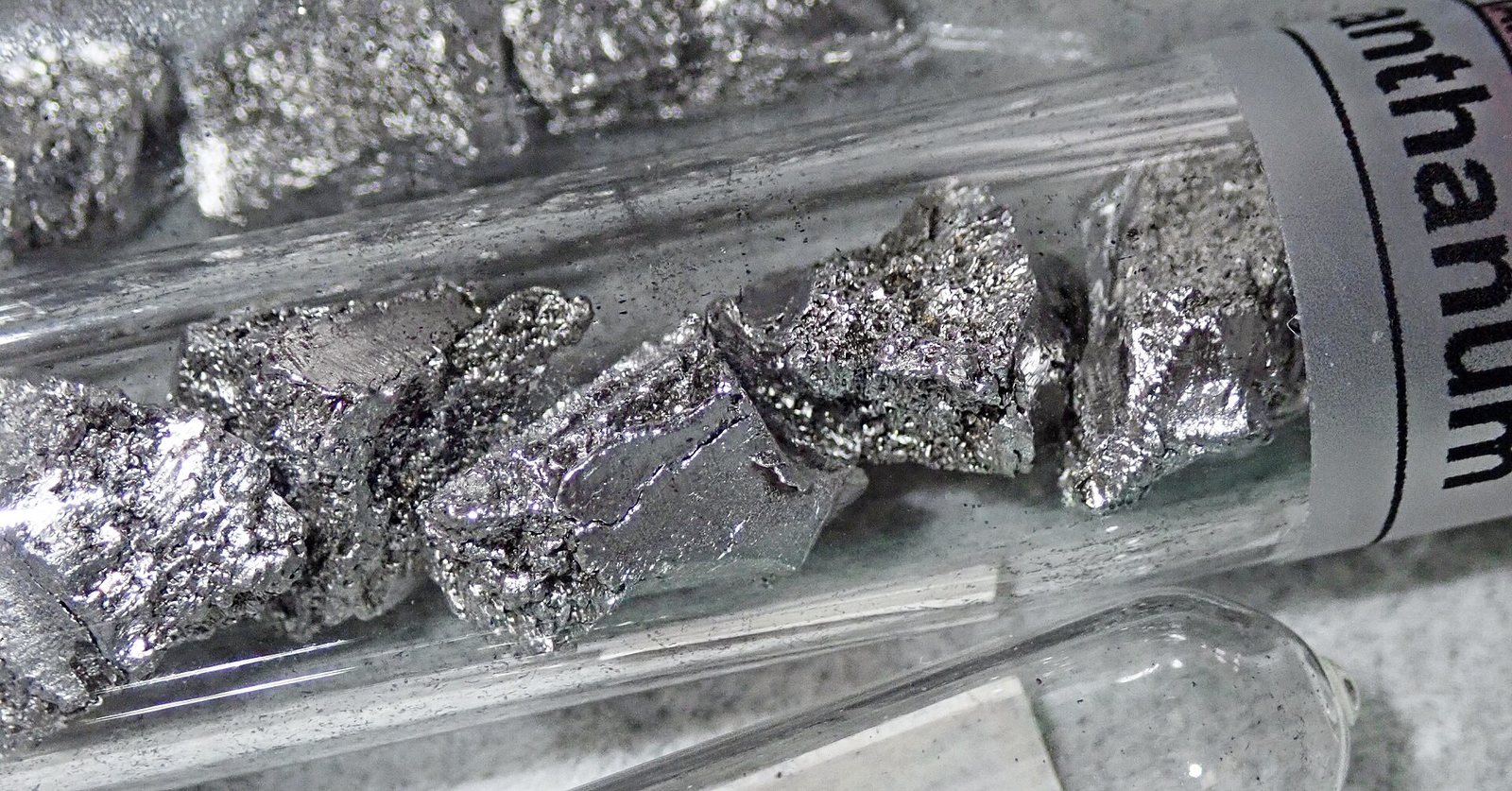
Đây là gì?
The first of the rare earths, used by the tonne in the catalysts that crack crude oil into petrol.
Tại sao điều này quan trọng?
Fluid catalytic cracking is one of the few rare-earth uses measured in thousands of tonnes rather than kilograms.
Where it is in the Earth
Lanthanum belongs to the rare earth elements, a group of seventeen metals that, despite the name, are not especially scarce in the Earth's crust. The difficulty is that they rarely accumulate in one place in concentrations high enough to mine economically. Where they do, it is usually because of unusual igneous or sedimentary processes that allowed rare-earth-bearing minerals to crystallise and persist over geological time.
The two minerals that supply most of the world's lanthanum are bastnasite and monazite. Bastnasite is a fluorocarbonate — a mineral containing carbon, oxygen, and fluorine — that forms in a rock type called carbonatite. Carbonatites are igneous rocks made largely of carbonate minerals, and they originate from magmas that are exceptional in their low silica content and high concentration of carbon dioxide. As such a magma cools, rare earth elements, which do not fit easily into the crystal structures of common silicate minerals, become progressively enriched in the remaining melt and eventually crystallise into bastnasite and related minerals. The Bayan Obo deposit in Inner Mongolia and Mountain Pass in California are both associated with this kind of carbonatite system, which is why they are among the largest rare-earth sources known.
Monazite is a phosphate mineral that carries lanthanum, cerium, neodymium, and thorium together in its structure. It forms both in igneous and metamorphic rocks, but it reaches mineable concentrations most often in placer deposits — accumulations of heavy, chemically resistant minerals that have been liberated by weathering and sorted by rivers or ocean waves over millions of years. Because monazite is dense and durable, it survives the journey from the source rock and settles alongside other heavy minerals such as ilmenite and zircon in coastal or riverine sands. The co-occurrence of thorium, a mildly radioactive element, in monazite complicates both its mining and its processing, a point that matters significantly for where refineries can legally operate.
Getting it out
Both of the principal ore types that carry lanthanum — carbonatite-hosted bastnasite and placer monazite — are worked by open-pit or open-cut methods. In a carbonatite deposit such as Mountain Pass or Bayan Obo, the ore body sits close to the surface and is large enough in plan that miners remove the overlying rock, known as waste or overburden, in stepped terraces and load the ore into trucks for transport to a processing facility. The amount of waste moved relative to each tonne of ore, a ratio miners call the strip ratio, depends on the geometry of the deposit and changes as mining goes deeper.
Placer deposits present a different picture. Because the rare-earth minerals are already concentrated by natural sorting into beach or dune sands, the ore can sometimes be mined with dredges or simple earthmoving equipment. The grade — meaning the proportion of valuable mineral in the ore — is expressed differently for placer and hard-rock deposits, but in both cases lanthanum represents only a fraction of the total rare-earth content of the ore. Cerium is almost always more abundant than lanthanum in bastnasite and monazite alike, so the two elements are produced together whether the mine operator wants both or not. This structural link between lanthanum supply and the demand for other rare earths shapes the economics of the whole chain.
Lanthanum is not mined for its own sake at any operation currently listed in the tables on this page. It emerges as a co-product of mining for cerium, neodymium, and other rare earths, and its output is therefore governed by the extraction decisions made for those elements. When demand for neodymium — used in strong permanent magnets — rises, lanthanum output rises with it, regardless of whether the market for lanthanum itself is strong.
What pulls on it
The largest single use of lanthanum by volume is in fluid catalytic cracking, which refineries use to break heavy crude oil fractions into lighter products including petrol. The catalyst used in this process, known as an FCC catalyst, contains lanthanum oxide as a stabiliser for the zeolite — a porous aluminosilicate mineral — at the heart of the catalyst. Without the lanthanum, the zeolite structure degrades too quickly under the high temperatures inside the reactor. Because this application consumes lanthanum continuously — spent catalyst is regularly replaced — and because refining throughput is large, this is one of the few uses of a rare earth element measured in thousands of tonnes rather than in kilograms or tens of kilograms.
The second significant market is nickel-metal-hydride batteries, which use a lanthanum-rich alloy as the negative electrode material. These batteries powered hybrid vehicles before lithium-ion technology became dominant, and they remain in use in some hybrid models and in consumer electronics. Demand from this sector has been broadly flat or declining in relative terms as lithium-ion chemistry takes a larger share of new applications. Lanthanum also appears in optical glass — where it raises the refractive index without colouring the glass — in phosphors for lighting, and in miscellaneous metallurgical additions. The USGS groups batteries, catalysts, ceramics, glass, and metallurgy as the primary domestic applications.
The direction of demand depends heavily on what happens to petroleum refining. If refinery throughput falls because of a long-run shift away from liquid fuels, the FCC catalyst market, which underpins lanthanum demand, would contract substantially. Conversely, growth in hybrid vehicle production could support battery-related demand. These two forces move in broadly opposite directions, so the net trajectory is not obvious without knowing the relative rates of change — which vary by region and policy environment.
Turning ore into product Cấp độ 3
Rare earth ore processing begins with comminution — crushing and grinding the rock to liberate the mineral grains from the surrounding waste — followed by physical concentration. For bastnasite, flotation is the standard technique: finely ground ore is mixed with water and chemical reagents that make the target mineral grains attach to air bubbles, which carry them to the surface of a froth while waste minerals sink. The resulting concentrate still contains a mixture of all the rare earth elements present in the ore, because bastnasite and monazite carry lanthanum, cerium, neodymium, praseodymium, and others locked inside the same crystal structure.
Separating individual elements from the concentrate requires hydrometallurgy — the use of aqueous chemistry rather than heat. The concentrate is dissolved in acid, typically hydrochloric or sulfuric, producing a solution of mixed rare earth salts. Solvent extraction then separates the elements from one another: the solution is contacted repeatedly with an organic solvent containing reagents that preferentially bind one element over another, gradually producing streams enriched in each target element. Lanthanum, being the lightest of the lanthanides, is relatively straightforward to separate from the heavier rare earths but must still be split cleanly from cerium, its nearest neighbour in atomic number. This step-by-step separation takes place in large banks of mixer-settler units and requires significant quantities of reagents, water, and energy. The separated lanthanum is then precipitated, typically as a carbonate or oxide, dried, and calcined to produce the lanthanum oxide that is the standard traded form. Facilities capable of performing this separation include the Neo Performance Materials plant at Sillamäe in Estonia and the Lynas Advanced Materials Plant at Kuantan in Malaysia, both of which process mixed rare earth feedstocks from outside their host countries.
The location of separation capacity matters enormously, because without it a mine's output cannot be turned into a usable product. China built its separation infrastructure over decades and currently accounts for the large majority of global capacity. The plants in Estonia and Malaysia represent efforts to establish separation capability outside China, but they depend on feedstock supply chains that are themselves subject to policy and logistics constraints. Recovery losses occur at every stage — flotation, leaching, and solvent extraction each leave some lanthanum in tailings or effluent — and the cumulative yield from ore to separated oxide is well below one hundred percent, though the precise figure varies by ore type and plant design.
Substitution and recycling Cấp độ 3
In fluid catalytic cracking, lanthanum can be partially replaced by cerium or by increasing the proportion of other catalyst components, but doing so involves a performance trade-off. Cerium is the rare earth most chemically similar to lanthanum and the most abundant in the same ores, so it is the natural candidate for substitution. However, the two elements do not perform identically in stabilising zeolite structure under refinery conditions, and reformulating a commercial FCC catalyst requires testing and qualification that takes time and money. Refiners have economic incentives to use less lanthanum when its price rises, and the low price levels visible in the price history on this page reflect in part the market's awareness that demand is not entirely inelastic.
In nickel-metal-hydride batteries, the lanthanum-rich mischmetal alloy — mischmetal being a mixed rare earth alloy used without full separation — is essentially defined by its lanthanum content and cannot be straightforwardly replaced within that battery chemistry. The more pertinent substitution here is at the system level: lithium-ion cells displacing nickel-metal-hydride cells entirely, which is already occurring in many applications. This is not substitution within lanthanum's use but substitution of the entire technology, and it reduces the demand for lanthanum rather than replacing it with another material.
Recycling of lanthanum is limited. Spent FCC catalyst is removed from refineries in large quantities, but recovering lanthanum from it at commercial scale is not widely practised; most spent catalyst is landfilled or used as a low-grade fill material. End-of-life nickel-metal-hydride batteries do contain recoverable lanthanum, and some hydrometallurgical recycling of battery packs occurs, particularly in Japan and Europe, but the fraction of total lanthanum supply that comes back through secondary production is small. The low market price of lanthanum oxide reduces the economic incentive to invest in dedicated recovery infrastructure, since the value recovered may not cover the cost of collection, sorting, and processing.
Where the chain is fragile Cấp độ 4
Lanthanum supply carries several layers of concentration risk that are worth distinguishing from one another. At the mining stage, production is reported by the USGS in ways that make global totals difficult to verify independently, partly because Chinese output figures are published through official channels that do not always align with third-party estimates, and partly because lanthanum is not always disaggregated from total rare earth oxide production in national statistics. The DATA block for this entry shows world production and reserves as empty, which reflects the limits of what is reliably reported rather than an absence of production. Readers should treat any precise global tonnage figure for lanthanum with caution.
At the processing stage, the concentration of separation capacity in China represents the most structurally significant constraint. Even where mining occurs outside China — as at Mountain Pass in the United States — the separated oxide that refineries and battery makers actually need has historically been produced predominantly within Chinese facilities. The plants at Sillamäe and Kuantan have added non-Chinese separation capacity, but their feedstock sourcing, throughput, and financial resilience introduce their own uncertainties. The monazite route introduces an additional complication: thorium content means that processing facilities face radioactive materials licensing requirements that vary by jurisdiction and can substantially extend permitting timelines or limit where plants can be built at all.
The by-product structure of lanthanum supply means that its availability is not primarily determined by lanthanum demand. When neodymium markets are weak and mine operators reduce output, lanthanum output falls too. When neodymium demand is strong and output rises, lanthanum accumulates faster than the market absorbs it, which is one reason the price series in the table on this page shows values well below those of more demand-constrained rare earths. This structural surplus tendency makes investment in dedicated lanthanum recovery or processing difficult to justify on lanthanum economics alone, which in turn means that if demand were to grow sharply — for example through a policy-driven expansion of FCC catalyst use or a reversal of the shift away from nickel-metal-hydride batteries — the supply response would depend on decisions made primarily with reference to other elements in the same ore.
Nguồn gốc của nó trong đá
Tất cả khoáng vật quặng →Đây là các khoáng sản thực sự mang lại lanthanum. Một mỏ khoáng chỉ là thân quặng khi một trong số chúng có hàm lượng đủ cao để bù đắp chi phí khai thác.
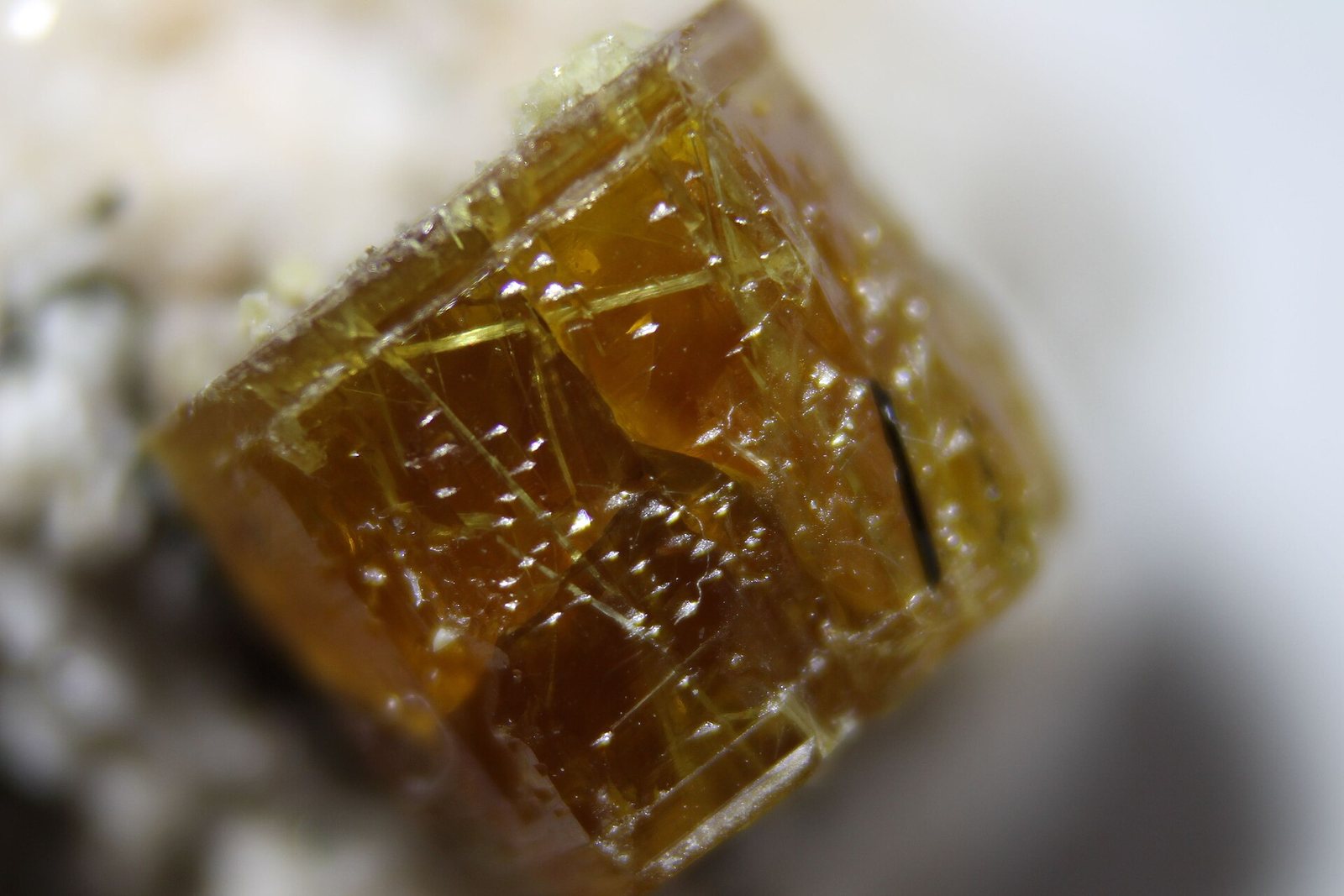
Bastnäsite
The world's principal light rare-earth mineral, mined from carbonatites. Low in thorium, which makes it easier to…
Monazite
A rare-earth phosphate found in heavy mineral sands. Carries thorium, so it is radioactive enough to be regulated.
Giá
average, dollars per kilogram: Lanthanum oxide, 99.5% minimum
Trung bình nămdollars per kilogram
Cơ sở: average, dollars per kilogram: Lanthanum oxide, 99.5% minimum. Trung bình năm theo công bố trong USGS Mineral Commodity Summaries 2026 · nguồn ↗. Đây là mức trung bình hàng năm tham khảo, không phải báo giá thị trường trực tiếp.
Các mỏ sản xuất khoáng sản này
Tất cả mỏ →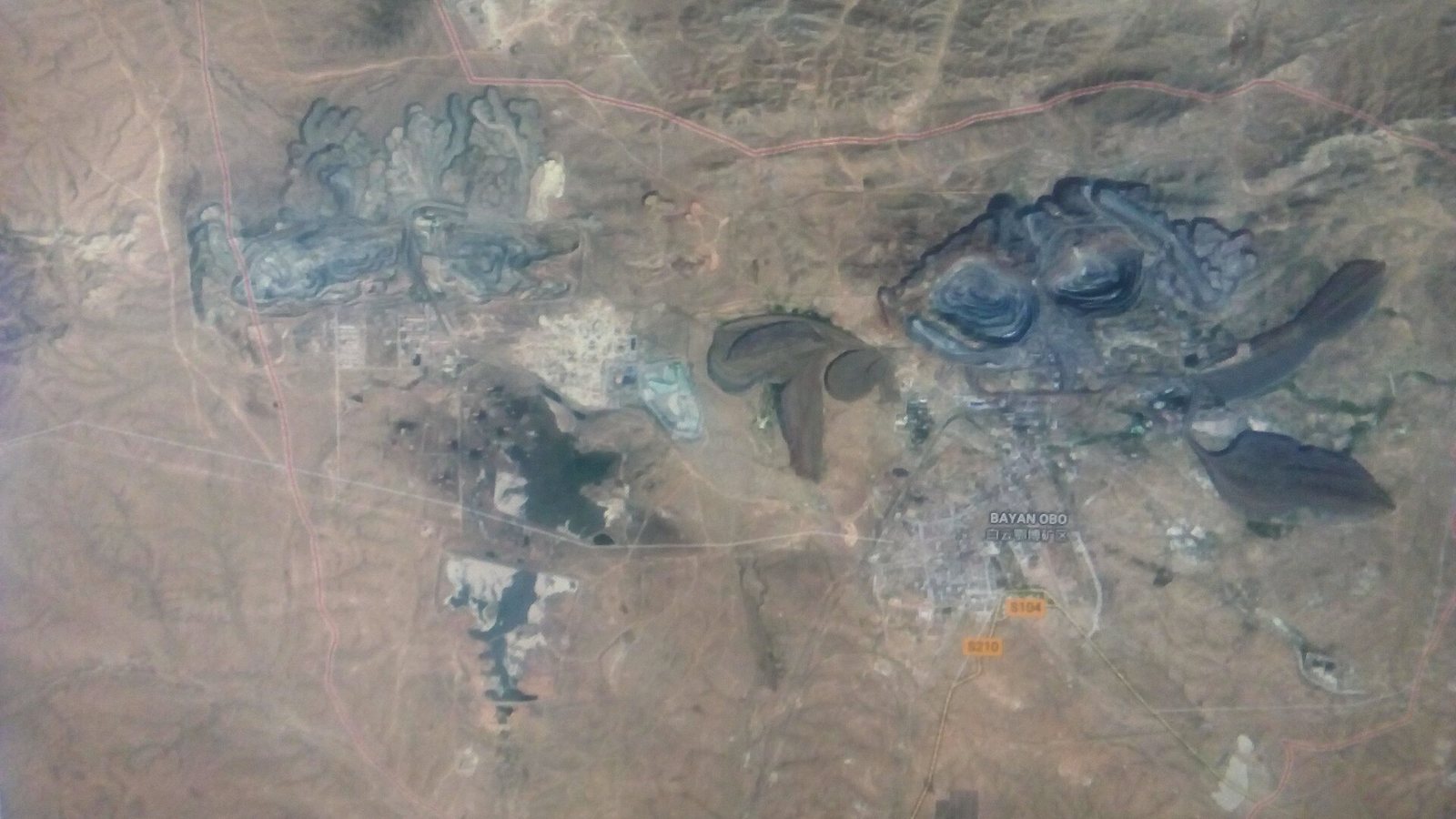
Nơi nó được chế biến và tinh luyện
| Nhà máy | Loại | Giai đoạn | Quốc gia | Vai trò |
|---|---|---|---|---|
| Lynas Advanced Materials Plant, Kuantan | Nhà máy tách chiết | Tinh luyện | Malaysia | Sản lượng đầu ra |
| Neo Performance Materials, Sillamäe | Nhà máy tách chiết | Tinh luyện | Estonia | Sản lượng đầu ra |