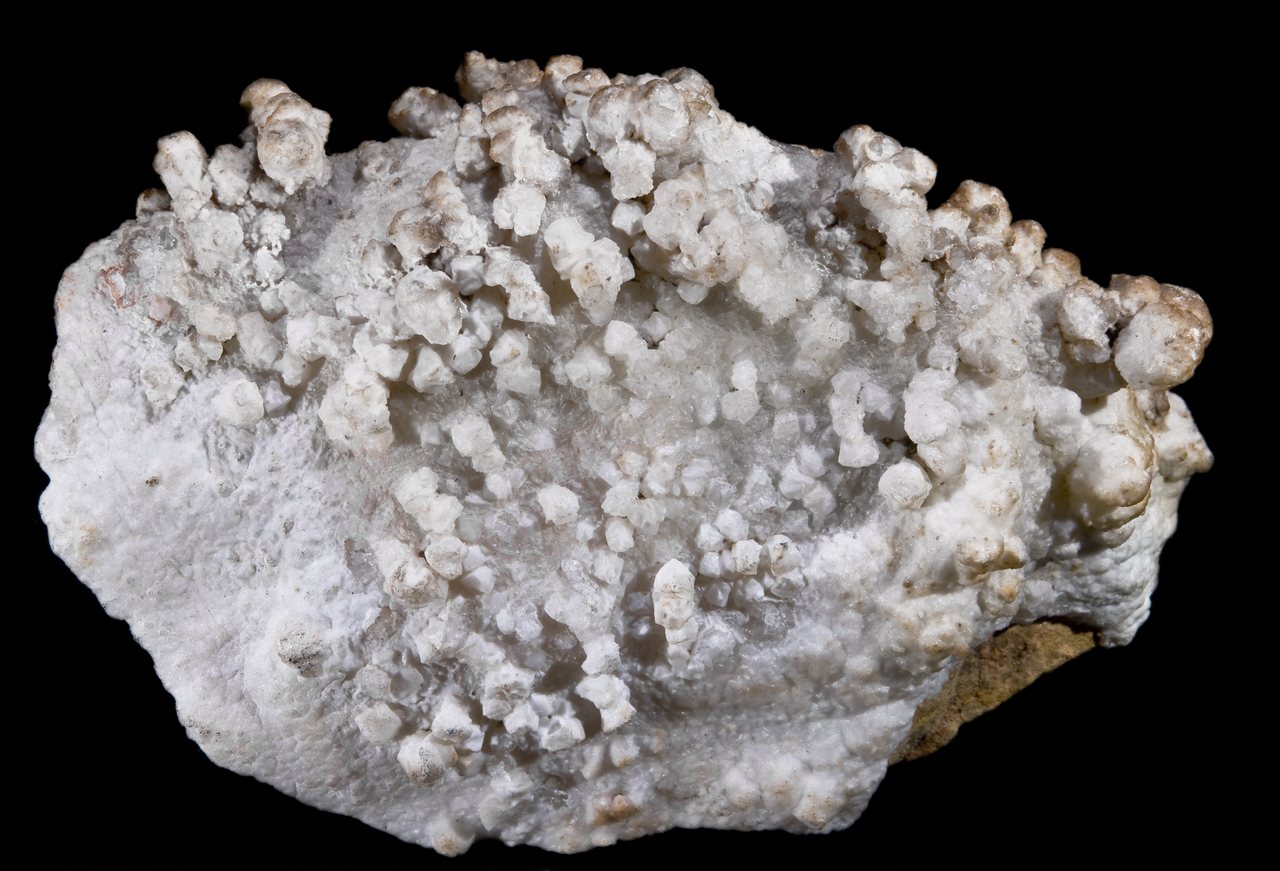
이것은 무엇인가?
Magnesia and its relatives, made from magnesite rock or extracted from seawater, which survive heat that would destroy almost any other cheap material.
왜 중요한가?
Dead-burned magnesia lines the furnaces that make steel and cement. Without refractories there is no high-temperature industry at all.
Where it is in the Earth
Magnesium is the eighth most abundant element in the Earth's crust, yet the deposits worth mining are those where geological processes have concentrated it into a small number of mineral forms. The most important is magnesite, a magnesium carbonate mineral (MgCO₃) that forms in two principal ways. Cryptocrystalline magnesite — fine-grained and white, sometimes called amorphous or Veitsch-type after the Austrian deposits — typically forms when magnesium-rich hydrothermal fluids move through serpentinite, a rock produced when oceanic crust reacts with seawater at low temperatures. That serpentinisation converts olivine and pyroxene minerals into serpentine, releasing magnesium that later precipitates as magnesite along fractures and in replacement zones. The second type, macrocrystalline or sparry magnesite, is coarser grained and appears to have formed from magnesium-bearing brines that replaced dolomite or limestone in ancient sedimentary sequences, sometimes aided by heat from nearby igneous intrusions.
The geography of magnesite deposits reflects the geological history of continental margins and ancient ocean floors. Russia's enormous reserves in the Urals and Siberia, Slovakia's deposits in the Western Carpathians, and the Chinese province of Liaoning all sit within belts of ultramafic rocks — the deep mantle material that produces the magnesium-rich precursor serpentinite. Greece, Turkey, and Austria share a similar tectonic inheritance along the margins of what was once the Tethys Ocean. Brazil's deposits are hosted in metamorphic sequences of Precambrian age, formed under conditions that concentrated magnesium carbonate over hundreds of millions of years. Dolomite, a calcium-magnesium carbonate, is a secondary source: it occurs in enormous quantities worldwide, but its magnesium content is lower than pure magnesite, which affects how much material must be processed to yield a given quantity of magnesia. Seawater and brines from salt lakes and ancient evaporite deposits also carry dissolved magnesium at workable concentrations, and in countries without large magnesite reserves this aqueous source becomes the basis for production entirely.
The mismatch between where reserves sit and where production is highest tells a story worth understanding. Russia and Slovakia hold the two largest reported national reserves, at 2,300,000 and 1,200,000 thousand metric tonnes respectively, yet China — with reserves of 700,000 thousand metric tonnes — accounts for 12,700 of the world's 21,000 thousand metric tonnes of annual production. China's Liaoning province contains some of the world's highest-grade magnesite, and decades of sustained investment in mining and calcination capacity have made it the dominant producer by a very wide margin. Australia and Greece each hold 280,000 thousand metric tonnes of reserves but produce considerably less, reflecting differences in infrastructure, energy cost, and the pace at which deposits have been brought into operation.
Getting it out
Magnesite is almost always mined by open-pit methods, and the reason is straightforward: the deposits are typically large, relatively near the surface, and the ore is the rock itself rather than a metal scattered through it at low concentrations. In an open-pit mine, overlying material — called overburden — is stripped away by drilling, blasting, and mechanical excavation to expose the ore body beneath. The ore is then blasted in benches, loaded into trucks, and hauled to a processing plant. Because magnesite is the product rather than a trace constituent, the ratio of waste rock moved to usable ore is much lower than it would be in a metal mine, though it still depends on how close the deposit sits to the surface and how the ore body is shaped.
Where deposits are deeper, or where high-grade ore occurs in pockets within lower-grade host rock, underground mining is used instead. Adits — horizontal tunnels — or shafts are driven into the hillside or ground, and ore is extracted by methods such as room-and-pillar mining, where pillars of rock are left standing to support the roof, or by variations of cut-and-fill. Austria and Slovakia, where some of the longest-established European operations run, have historically used underground methods in parts of their ore bodies. The grade of magnesite ore matters primarily in terms of its MgO content and its levels of impurities such as silica, calcium, iron, and aluminium. High-purity, low-silica magnesite is particularly valuable for making refractory-grade magnesia, because those impurities can compromise the performance of the final product at high temperatures.
Seawater extraction is a fundamentally different operation. Seawater contains magnesium ions in solution, and by adding lime — itself made from calcined limestone — to seawater, magnesium hydroxide precipitates out as a fine solid. That solid is collected, filtered, and then processed further into magnesia. The attraction of this route is that the raw material is essentially inexhaustible; the constraint is energy and the availability of suitable lime. Canada's production and historically that of the United States draw partly on this seawater or brine route, as does Israel, one of the leading import sources for the United States. The seawater route tends to produce a high-purity product because the precipitation process is selective, but the energy and chemical costs are higher than simply quarrying a rich magnesite deposit, which is why the rock-based route dominates global output wherever decent deposits exist.
What pulls on it
The single largest call on magnesium compounds is the lining of high-temperature furnaces, collectively called refractories. A refractory is any material that can survive temperatures far beyond what steel or ordinary ceramics can tolerate, and dead-burned and fused magnesia are among the few materials cheap enough to use in tonnage quantities that can do so. Steel production is the main customer: the basic oxygen furnace, the electric arc furnace, and the ladle in which molten steel is transported all require magnesia-based refractory linings that must be replaced regularly as they erode. Cement kilns, non-ferrous smelters, and glass-melting furnaces are also significant consumers. Because refractory consumption is tied directly to the volume of steel and cement produced, demand for dead-burned magnesia broadly tracks global industrial output, with a lag corresponding to how quickly existing furnace linings wear through.
Beyond refractories, caustic-calcined magnesia serves a range of industrial and agricultural purposes. It is used to neutralise acidic industrial effluents, to treat drinking water, and as a soil amendment to correct magnesium deficiency in agricultural land. Magnesium hydroxide is valued as a flame retardant in plastics and cables because it releases water vapour when heated, cooling the material and diluting combustible gases, without generating toxic by-products in the way that halogen-based flame retardants can. This application has grown as fire-safety regulations have tightened in construction and electronics. A smaller but technically specific use of high-purity fused magnesia is in electrical heating elements and cables, where it acts as an electrical insulator that must also conduct heat efficiently.
What would have to change for demand to shift sharply? On the downside, any structural reduction in global steelmaking capacity — whether through a shift to alternative materials or a long-run contraction in construction activity — would reduce refractory consumption in step. The gradual improvement in refractory technology, which has extended the service life of furnace linings over several decades, already means that each tonne of steel produced requires somewhat less magnesia than it once did, even as total steel output has grown. On the upside, the expansion of electric arc furnace steelmaking, which uses different refractory profiles than basic oxygen steelmaking, and the growth of flame-retardant demand driven by building codes and electric vehicle battery enclosures, represent areas where volumes could increase. Neither shift is abrupt; both move on the timescale of industrial investment cycles.
생산 주체
지도에서 보기 →Mine production
Mine productionthousand metric tons 2025 (추정치) 세계 합계 21,000 thousand metric tons
USGS Mineral Commodity Summaries 2026 · Reported as magnesium oxide (MgO) equivalent. · 출처 ↗
나머지 열을 보려면 표를 옆으로 스크롤하십시오.
| 국가 | 생산 | 세계 비중 |
|---|---|---|
| China | 12,700 | 60.5% |
| Brazil | 1,800 | 8.6% |
| Russia | 1,700 | 8.1% |
| Turkey | 1,600 | 7.6% |
| Austria | 650.0 | 3.1% |
| Spain | 640.0 | 3.0% |
| Australia | 400.0 | 1.9% |
| Other countries | 340.0 | 1.6% |
| Slovakia | 330.0 | 1.6% |
| Canada | 230.0 | 1.1% |
| Iran | 200.0 | 1.0% |
| Greece | 130.0 | 0.6% |
| India | 85.00 | 0.4% |
| United States | Withheld | — |
| 세계 합계 | 21,000 | 100% |
'비공개'는 USGS가 개별 기업의 데이터 노출을 막기 위해 수치를 억제한 것으로, 0을 의미하지 않습니다. 출처가 각 수치를 독립적으로 반올림하고 '기타 국가' 항목을 항상 별도로 구분하지는 않기 때문에, 국가별 합계가 세계 합계와 일치하지 않을 수 있습니다.
매장량 보유 주체
Reserves
Reservesthousand metric tons 2025
USGS Mineral Commodity Summaries 2026 · 출처 ↗
| 국가 | 매장량 | 세계 비중 |
|---|---|---|
| Other countries | 2,500,000 | 32.1% |
| Russia | 2,300,000 | 29.5% |
| Slovakia | 1,200,000 | 15.4% |
| China | 700,000 | 9.0% |
| Greece | 280,000 | 3.6% |
| Australia | 280,000 | 3.6% |
| Brazil | 200,000 | 2.6% |
| Turkey | 110,000 | 1.4% |
| India | 66,000 | 0.8% |
| Austria | 49,000 | 0.6% |
| United States | 35,000 | 0.4% |
| Spain | 35,000 | 0.4% |
| Iran | 10,000 | 0.1% |
| Canada | Not applicable | — |
| 세계 합계 | 7,800,000 | 100% |
수출 통제
| 국가 | 지배력 | 적용 대상 |
|---|---|---|
| China | Export licensing requirement for materials and technologies | Antimony (2024), bismuth (2025), synthesized diamond (2025), gallium (2023), germanium (2023), graphite (2023), indium (2025), magnesium materials (2024), molybdenum (2025), rare earths (2025), silver (2026), tellurium (2025), tungsten (2025), and items related to lithium batteries and artificial graphite anode materials (2025). ↗ |
USGS Mineral Commodity Summaries 2026, table 4 — controls in effect as of January 2026, excluding controls since lifted.