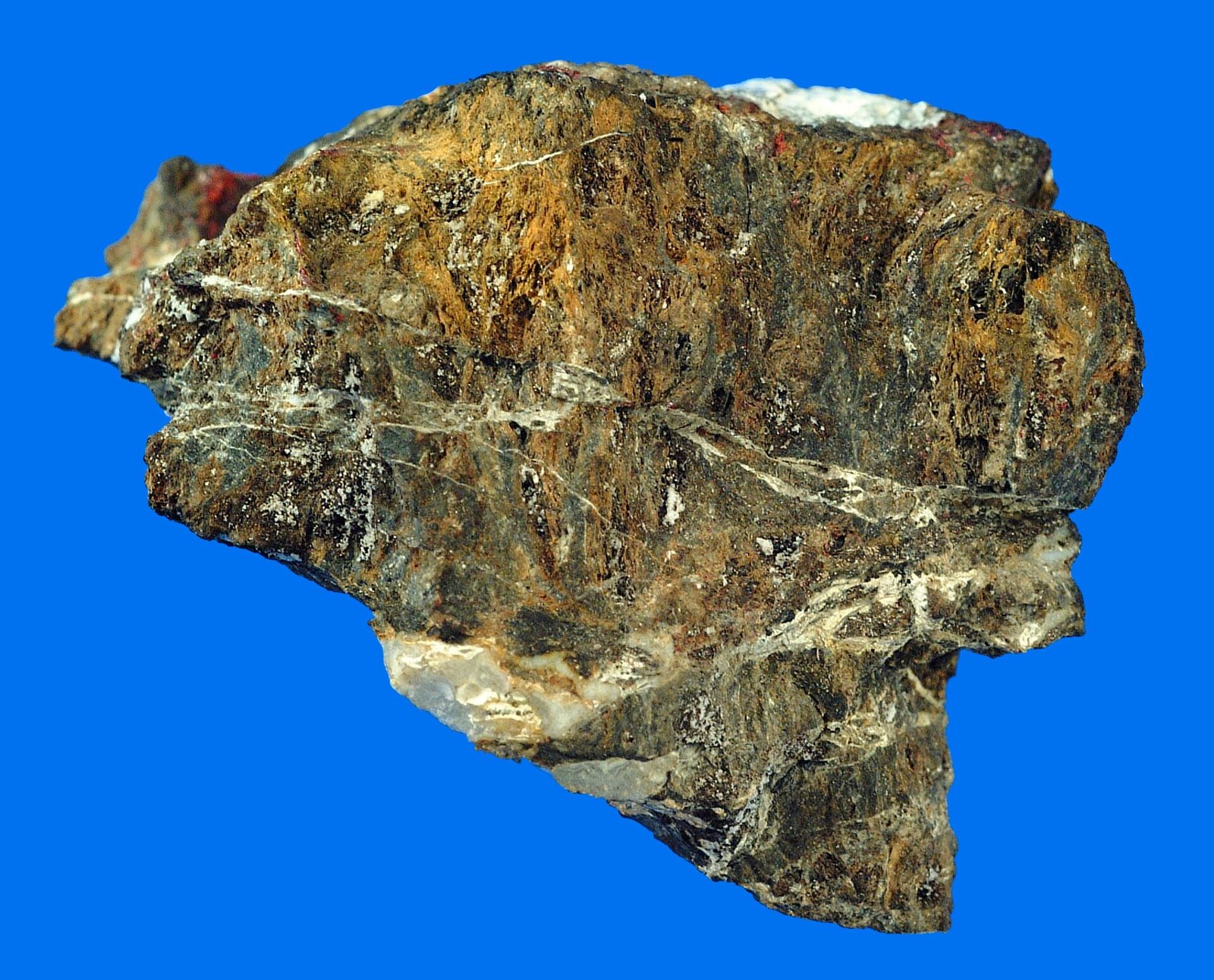
Was ist das?
The only metal that is liquid at room temperature, and one of the most tightly regulated substances in the world.
Warum ist das wichtig?
Mercury is the clearest case of a material being deliberately designed out: the Minamata Convention is phasing it out of products and processes worldwide.
Where it is in the Earth
Mercury is a dense, silver-coloured liquid at ordinary temperatures, with a melting point of −38.8 °C, which means it is never solid in any warm environment. In the Earth's crust it is genuinely rare, and it becomes mineable only where specific geological conditions have concentrated it into a mineral called cinnabar — mercury sulfide — over long periods of hydrothermal activity. Hydrothermal simply means hot water moving through rock: water heated by magmatic or geothermal sources dissolves mercury from surrounding rock, carries it upward through fractures, and deposits cinnabar when the water cools or encounters chemically different rock near the surface. Because this process depends on relatively shallow, low-temperature circulation, mercury deposits tend to sit in the upper few kilometres of the crust, often close to ancient volcanic arcs or fault zones.
The classic geological setting is what geologists call an epithermal deposit — formed at low temperatures and shallow depths — typically hosted in sedimentary rocks such as limestone, chert, or shale that have been cut through by faults. The Almadén district in Spain, historically the world's largest source, sits in Palaeozoic sediments deformed by faulting. The Idria deposit in what is now Slovenia, the Huancavelica deposit in Peru, and various deposits across central Asia share the same broad character: fault-controlled conduits, chemically reactive host rock, and a tectonic history involving compression or extension that opened pathways for heated fluids. China's producing areas, concentrated in Guizhou province, follow the same pattern — fault systems cutting through carbonate sequences.
Because the geological conditions are specific and not especially common, the world's significant mercury deposits have always been few in number and geographically clustered. Most of the historically large deposits are now exhausted or deliberately idled under international agreements. What remains in active production is, by comparison with the industry of the mid-twentieth century, very small.
Getting it out
Cinnabar, the principal ore of mercury, typically occurs in veins or as disseminations through the host rock rather than in massive, uniform bodies. Historically this meant underground mining, following the veins by hand and later by machine. Some deposits were amenable to open-pit methods where ore was close to the surface and concentrated enough to justify the earthmoving involved. The choice between open-pit and underground working comes down to the geometry of the ore body and the grade — that is, how much mercury metal can be recovered from each tonne of rock mined. Because mercury deposits are generally small and irregular compared with, say, a large copper porphyry, the volumes of rock moved are modest by modern mining standards.
Grade matters enormously because mercury is expensive to process and the metal itself has a declining market. An ore body that might have been economic at higher mercury prices a generation ago may not justify the cost of development today. In practice, much of the world's current supply does not come from primary mercury mining at all. A significant portion is recovered as a by-product of mining other metals — particularly gold, where mercury occurs alongside gold mineralisation in some deposits — or from the retorting of mercury-bearing waste and tailings left by earlier operations. By-product recovery changes the economics entirely: the cost of producing the mercury is largely absorbed by the primary metal, and the mercury is captured because releasing it to the environment is no longer acceptable under national and international regulations rather than because it commands a price that rewards recovery on its own terms.
The direction of primary mercury mining is unambiguously downward. The Minamata Convention on Mercury, which came into force in 2017, commits its signatories to phasing out primary mercury mining. The figures in the production table reflect this: global mine output is a fraction of what it was in earlier decades, and the countries still reporting primary output are few. Norway's figure relates to legacy material management rather than active ore extraction in the conventional sense.
What pulls on it
Mercury's uses have contracted sharply over the past half century, and that contraction has been deliberate. The clearest driver is regulation: many countries have banned or heavily restricted mercury in products ranging from thermometers and blood-pressure monitors to fluorescent lamps, batteries, and dental amalgam. The Minamata Convention extends this pressure globally, requiring signatories to phase out whole categories of mercury-added products by agreed deadlines. The result is that demand from what were once large markets — medical devices, electrical switches, measuring instruments — has largely disappeared in countries with effective regulation, and is declining in those still implementing it.
The uses that remain significant fall into two broad categories. Artisanal and small-scale gold mining, known as ASGM, is by some measures now the largest single use. Miners add liquid mercury to gold-bearing alluvial sediment; the mercury amalgamates with gold particles, separating them from the surrounding material. The amalgam is then heated to drive off the mercury and recover the gold. This technique is old, simple, and effective for the type of deposit worked, which is why it persists in parts of sub-Saharan Africa, South America, and South-East Asia despite well-documented harm to human health and river systems. Chlor-alkali production — the industrial process that makes chlorine and caustic soda by passing electricity through brine — historically used mercury-cell technology and consumed mercury continuously as cells aged. Most modern chlor-alkali capacity has converted to membrane-cell technology that uses no mercury, but some older plant remains in operation in certain countries.
For demand to change sharply in either direction, the conditions would need to change at the level of enforcement and international compliance. If ASGM-using countries implement the formalisation and alternative-technology programmes that the Minamata Convention envisages, that use would decline. If enforcement weakens or illegal supply chains expand, it could persist or grow. There are no significant new commercial applications on the horizon that would generate large additional demand; mercury's chemical and physical properties that made it attractive — density, electrical conductivity, liquid state — can be replicated or approximated by other means in almost every modern application where the toxicity is unacceptable.
Wer es produziert
Auf einer Karte anzeigen →Mine production
Mine productionmetric tons 2025 (geschätzt) Weltgesamt 210.0 metric tons
USGS Mineral Commodity Summaries 2026 · Gross weight of mercury metal. · Quelle ↗
Tabelle seitwärts scrollen, um die restlichen Spalten zu sehen.
| Land | Produktion | Anteil an der Weltproduktion |
|---|---|---|
| China | 200.0 | 95.2% |
| Kyrgyzstan | 5.00 | 2.4% |
| Tajikistan | 4.00 | 1.9% |
| Morocco | 2.00 | 1.0% |
| Norway | 1.00 | 0.5% |
| United States | Not applicable | — |
| Weltgesamt | 210.0 | 100% |
Mine production: exports
Mine production: exportsmetric tons 2025 (geschätzt)
USGS Mineral Commodity Summaries 2026 · Gross weight of mercury metal. · Quelle ↗
Tabelle seitwärts scrollen, um die restlichen Spalten zu sehen.
| Land | Produktion | Anteil an der Weltproduktion |
|---|---|---|
| Peru | Not applicable | — |
„Withheld" bedeutet, dass der USGS den Wert zurückgehalten hat, um keine Rückschlüsse auf Daten einzelner Unternehmen zuzulassen – er bedeutet nicht null. Die Länderwerte addieren sich nicht immer zum Weltgesamt, weil die Quelle jeden Einzelwert unabhängig rundet und eine Zeile „sonstige Länder" nicht immer ausweist.
Preis
average unit value of imports, dollars per kilogram
Jahresdurchschnittdollars per kilogram
Grundlage: average unit value of imports, dollars per kilogram. Jahresdurchschnitte gemäß Veröffentlichung in USGS Mineral Commodity Summaries 2026 · Quelle ↗. Dies sind jährliche Referenzdurchschnittswerte, kein Live-Marktpreis.