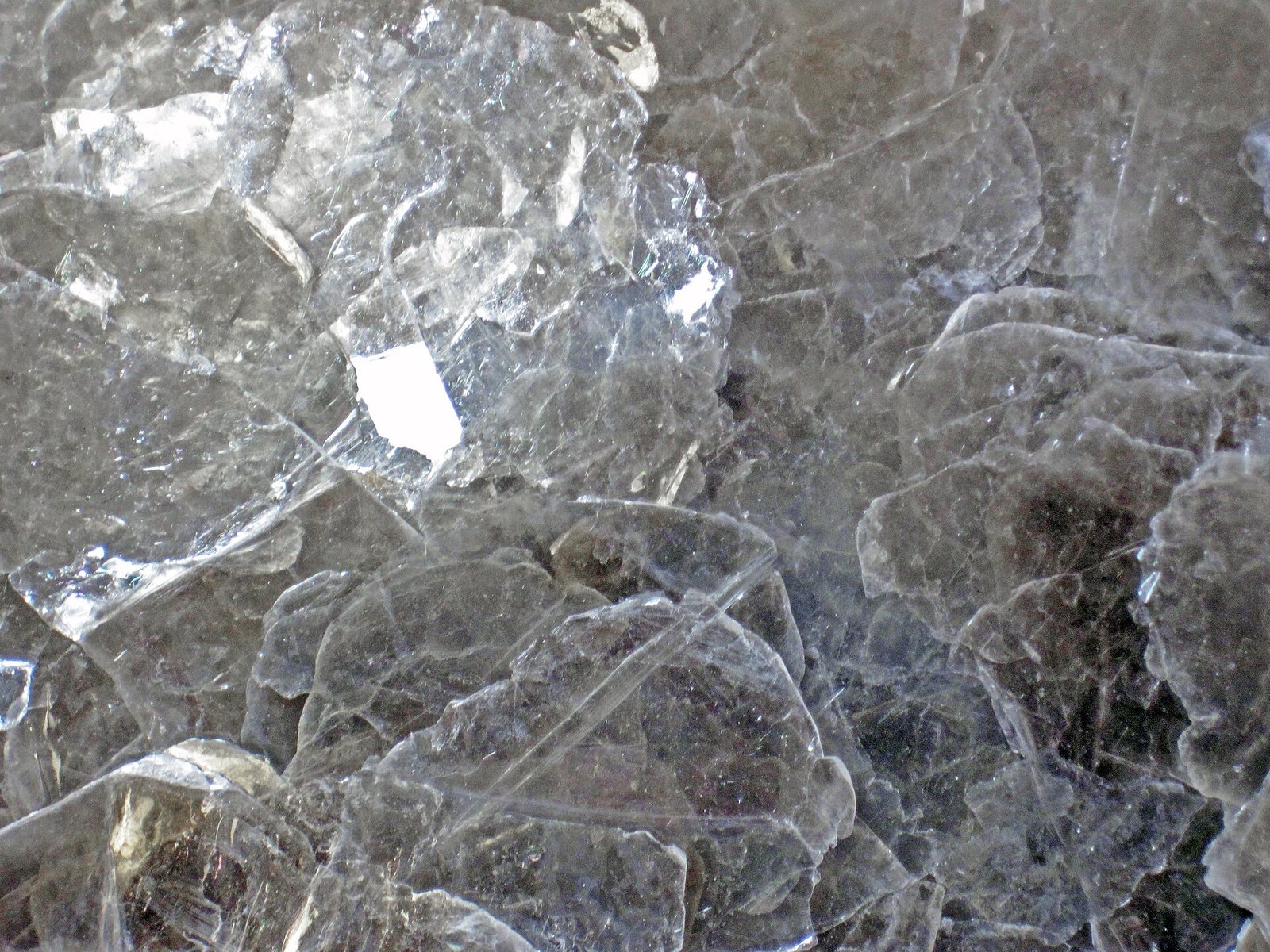
What is it?
A mineral that splits into sheets so thin you can see through them, and that resists both heat and electricity.
Why does it matter?
Sheet mica insulates high-voltage equipment; ground mica gives paint its shimmer and drilling mud its body. Some supply is associated with child-labour concerns.
Getting it out
How mica is extracted depends almost entirely on what form it is needed in. Sheet mica — meaning individual crystals large enough to be trimmed into usable pieces for electrical insulation — is the most demanding to recover. It comes almost exclusively from pegmatite, and because a large crystal must arrive at the surface undamaged, the work is largely done by hand. Pegmatite deposits are typically mined by open pit or shallow underground methods, but the final extraction of book mica from the rock requires hand tools and careful judgement rather than blasting, because explosives shatter the very thing being sought. This labour intensity is the reason sheet mica production has long been concentrated in countries with low labour costs, and it is also part of the context for the child-labour concerns that have been documented in parts of the Indian supply chain.
Scrap and flake mica, by contrast, is produced in much larger quantities and by quite different means. It arises as a by-product when pegmatites are mined for feldspar or quartz, when spodumene pegmatites are worked for lithium, or when metamorphic rocks are processed as aggregate or for other minerals. In Finland, for example, significant mica output comes from the processing of talc and other industrial mineral ores, where mica would otherwise be discarded. In this by-product context, the mica recovery adds value to operations that are already economic for other reasons, and the mica grade in the original rock matters less than the efficiency of the separation stage downstream.
The concept of waste-to-product ratio, sometimes called the strip ratio in open-pit mining, is relevant here but difficult to state simply for mica, because the definition of ore changes depending on which mineral is the primary target. A pegmatite mined specifically for sheet mica may move a large volume of host rock to recover a relatively small mass of usable crystal. In a by-product recovery scenario, the mica fraction was already being moved for other reasons, so its marginal waste burden is low.
Where it is in the Earth
Mica belongs to a family of sheet silicate minerals, meaning their atoms are arranged in flat, repeating layers that can be peeled apart like the pages of a book. The two commercially important species are muscovite, a potassium aluminium silicate that is pale and translucent, and phlogopite, a magnesium-bearing relative that tolerates even higher temperatures. Both form when rocks rich in aluminium, potassium and silica are subjected to heat and pressure deep in the crust, or when hot fluids percolate through existing rock and recrystallise its minerals into new forms.
The largest and most useful crystals grow in a rock type called pegmatite. Pegmatites form in the final stages of magma cooling, when water and other volatile elements become concentrated in the remaining melt and allow ions to migrate freely over long distances. The result is a coarse-grained rock in which individual crystals can reach exceptional size — mica books tens of centimetres across are known from classic deposits. These pegmatites tend to occur in ancient continental cores, which is why major producing regions — parts of India, Madagascar, and the eastern United States historically — sit within very old geological terranes. A second source of mica is metamorphic rock: schists and gneisses that have been recrystallised under regional pressure contain abundant mica, though usually in smaller flakes than pegmatite. Finland's large output comes largely from this metamorphic context, produced as a co-product of other mineral processing rather than from pegmatite mining.
The concentration of mica into an economically workable deposit depends not just on geology but on the physical behaviour of the mineral itself. Because mica cleaves so readily into flat sheets, it tends to survive weathering and transport, accumulating in soils and stream sediments derived from mica-rich bedrock. This means that some mica is recovered from weathered regolith above hard-rock deposits rather than from the pegmatite itself, which affects both the mining method and the quality of the product recovered.
What pulls on it
Mica reaches the market in two quite different commercial identities, and it is worth keeping them separate when thinking about demand. Sheet mica is bought primarily for its electrical insulating properties. A thin, flexible sheet of muscovite can withstand high voltages and high temperatures simultaneously, which makes it useful in situations where most other insulators would fail — certain industrial heating elements, speciality capacitors, and the commutator segments in some electric motors. This is a relatively small and slowly changing market; the electronics industry has largely moved away from natural mica sheets towards synthetic alternatives where geometrical consistency and cleanliness are priorities.
Ground mica, including the wet-ground and micronised grades, is consumed in much larger quantities and across a wider range of industries. Paint manufacturers use it to give coatings a degree of sheen and to improve weather resistance and crack bridging. Plastics and rubber compounders incorporate mica to stiffen parts and reduce thermal expansion. The construction industry uses it in joint compounds, sealants and roofing materials. Drilling-fluid formulators add flake mica to well-completion muds, where the particles help seal fractured formations and prevent fluid loss into the rock. The cosmetics and personal-care sector uses fine, coated mica as the basis of pearlescent and metallic pigments in products ranging from eyeshadow to automotive paint.
Demand from the cosmetics and personal-care sector has drawn attention partly because it is growing and partly because of the supply-chain concerns it has raised. Consumer brands have had to examine their sourcing more carefully, and some have shifted toward synthetic fluorphlogopite — a laboratory-grown analogue — where they needed to demonstrate that child-labour-free sourcing could be guaranteed. Whether natural mica retains or loses share in this segment depends less on price and more on brand commitments and the effectiveness of certification schemes. In most industrial applications, demand tracks construction activity and manufacturing output rather than any single technology trend.
Who produces it
See it on a map →Mica (Sheet): Mine production
Mica (Sheet): Mine productionmetric tons 2025 (estimated)
USGS Mineral Commodity Summaries 2026 · Scrap and flake mica reported separately from sheet mica; the two are different markets. · source ↗
Scroll the table sideways for the remaining columns.
| Country | Production | Share of world |
|---|---|---|
| India | 1,000 | — |
| Other countries | 200.0 | — |
| China | Not applicable | — |
| Canada | Not applicable | — |
| United States | Not applicable | — |
| France | Not applicable | — |
| Finland | Not applicable | — |
| Madagascar | Zero | — |
| Spain | Zero | — |
| Turkey | Zero | — |
| Korea, Republic of | Zero | — |
Mica (Sheet): Mine production, rounded
Mica (Sheet): Mine production, roundedmetric tons 2025 (estimated)
USGS Mineral Commodity Summaries 2026 · Scrap and flake mica reported separately from sheet mica; the two are different markets. · source ↗
Scroll the table sideways for the remaining columns.
| Country | Production | Share of world |
|---|---|---|
| World total | Not applicable | 100% |
Mica (Scrap and flake): production
Mica (Scrap and flake): productionmetric tons 2025 (estimated)
USGS Mineral Commodity Summaries 2026 · Scrap and flake mica reported separately from sheet mica; the two are different markets. · source ↗
Scroll the table sideways for the remaining columns.
| Country | Production | Share of world |
|---|---|---|
| China | 85,000 | — |
| Madagascar | 70,000 | — |
| Finland | 57,000 | — |
| Other countries | 39,000 | — |
| United States | 26,000 | — |
| Korea, Republic of | 15,000 | — |
| Canada | 14,000 | — |
| France | 14,000 | — |
| India | 13,000 | — |
| Turkey | 9,500 | — |
| Spain | 8,000 | — |
Mica (Scrap and flake): production, rounded
Mica (Scrap and flake): production, roundedmetric tons 2025 (estimated) World total 350,000 metric tons
USGS Mineral Commodity Summaries 2026 · Scrap and flake mica reported separately from sheet mica; the two are different markets. · source ↗
Scroll the table sideways for the remaining columns.
| Country | Production | Share of world |
|---|---|---|
| World total | 350,000 | 100% |
“Withheld” means the USGS suppressed the figure to avoid disclosing an individual company's data — it does not mean zero. Country rows do not always sum to the world total because the source rounds each figure independently and does not always break out an “other countries” line.
Who holds the reserves
Mica (Scrap and flake): Reserves
Mica (Scrap and flake): Reservesmetric tons 2025
USGS Mineral Commodity Summaries 2026 · source ↗
| Country | Reserves | Share of world |
|---|---|---|
| Korea, Republic of | 12,000,000 | — |
| China | 1,100,000 | — |
| Turkey | 620,000 | — |
| India | Large | — |
| Madagascar | Large | — |
| Spain | Large | — |
| Canada | Large | — |
| Finland | Large | — |
| France | Large | — |
| Other countries | Large | — |
| United States | Large | — |
Mica (Scrap and flake): Reserves, rounded
Mica (Scrap and flake): Reserves, roundedmetric tons 2025
USGS Mineral Commodity Summaries 2026 · source ↗
| Country | Reserves | Share of world |
|---|---|---|
| World total | Large | 100% |
Mica (Sheet): Reserves
Mica (Sheet): Reservesmetric tons 2025
USGS Mineral Commodity Summaries 2026 · source ↗
| Country | Reserves | Share of world |
|---|---|---|
| India | 110,000 | — |
| China | 75,000 | — |
| United States | Very small | — |
| Canada | Not applicable | — |
| Finland | Not applicable | — |
| France | Not applicable | — |
| Korea, Republic of | Not applicable | — |
| Madagascar | Not applicable | — |
| Spain | Not applicable | — |
| Turkey | Not applicable | — |
| Other countries | Moderate | — |
Mica (Sheet): Reserves, rounded
Mica (Sheet): Reserves, roundedmetric tons 2025
USGS Mineral Commodity Summaries 2026 · source ↗
| Country | Reserves | Share of world |
|---|---|---|
| World total | Not applicable | 100% |
Price
average, dollars per metric ton: Ground: Dry
Annual averagedollars per metric ton
Basis: average, dollars per metric ton: Ground: Dry. Annual averages as published in USGS Mineral Commodity Summaries 2026 · source ↗. These are reference annual averages, not a live market quote.
average value, muscovite and phlogopite mica, dollars per kilogram: Splittings
Annual averagedollars per kilogram
Basis: average value, muscovite and phlogopite mica, dollars per kilogram: Splittings. Annual averages as published in USGS Mineral Commodity Summaries 2026 · source ↗. These are reference annual averages, not a live market quote.
average, dollars per metric ton: Ground: Wet
Annual averagedollars per metric ton
Basis: average, dollars per metric ton: Ground: Wet. Annual averages as published in USGS Mineral Commodity Summaries 2026 · source ↗. These are reference annual averages, not a live market quote.
average, dollars per metric ton: Scrap and flake
Annual averagedollars per metric ton
Basis: average, dollars per metric ton: Scrap and flake. Annual averages as published in USGS Mineral Commodity Summaries 2026 · source ↗. These are reference annual averages, not a live market quote.